Hydroponic Bell Peppers: Full Nutrient & System Guide (Stop Blossom End Rot)
Science-backed guide to growing hydroponic bell peppers. Covers best systems (Dutch bucket, DWC, NFT), stage-specific EC/pH charts, nutrient schedules, calcium for blossom end rot prevention, LED lighting, indoor pollination, and yield expectations.
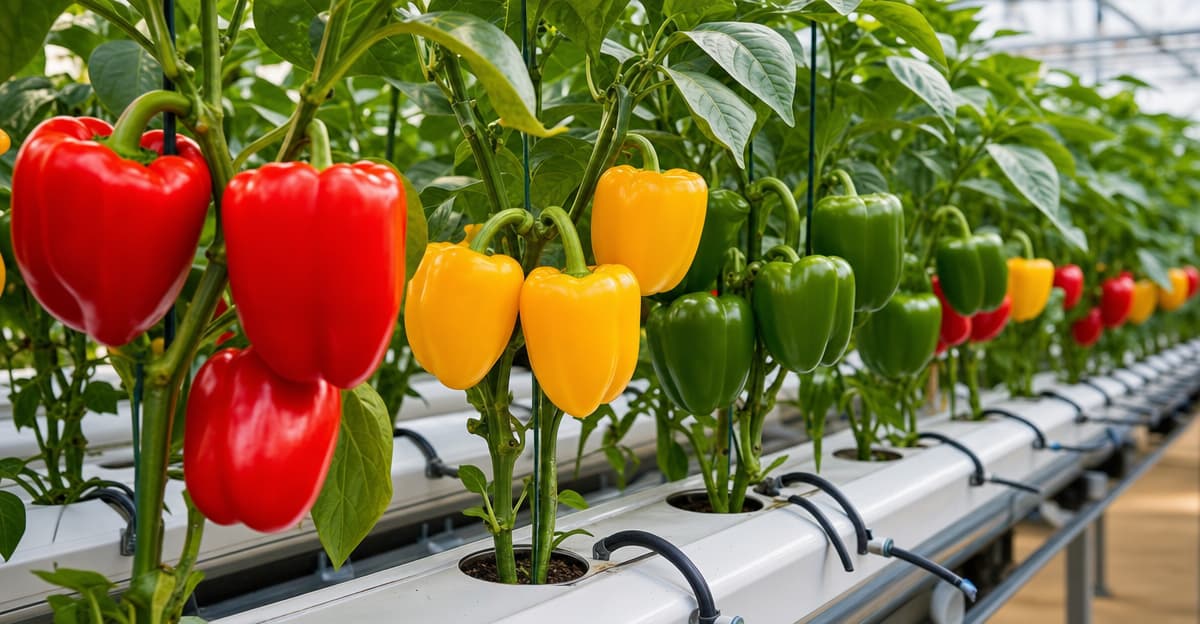
Key takeaway: Hydroponic bell peppers (Capsicum annuum) yield up to 8 kg/m² and reach harvest 30–40 days faster than soil-grown plants when given precise nutrient management. In a controlled hydroponic trial, conventionally fertigated bell peppers produced over three times more fruit per plant (8.4 vs 2.6) with higher chlorophyll content compared to organic alternatives. The keys to success are drip or Dutch bucket systems, calcium management to prevent blossom end rot, and supplemental lighting — where LED intra-canopy illumination increased fruit set by up to 74%.
Why Grow Bell Peppers Hydroponically?
Bell peppers (Capsicum annuum) are one of the highest-value hydroponic fruiting crops, and research consistently shows measurable advantages over soil cultivation:
- Faster maturity. Hydroponic bell peppers reach first harvest in approximately 100–110 days from transplant, compared to 120–150 days in field soil. The combination of direct nutrient access and optimized root zone temperature eliminates soil-related growth delays.
- Higher yield per area. Well-managed hydroponic systems produce 8 kg/m² — roughly double the 3–4 kg/m² typical of open-field production. A 2026 study achieved 6.61 kg/m² under greenhouse conditions with optimized fertigation (Pimentel-Pujols et al., 2026).
- No soil-borne disease. Eliminating soil removes Phytophthora capsici, Fusarium, Verticillium, and root-knot nematodes — the four most destructive soilborne pathogens of bell peppers in conventional agriculture.
- Year-round production. With supplemental LED lighting and climate control, you can harvest bell peppers 12 months a year regardless of outdoor season.
- Water efficiency. Recirculating hydroponic systems use 70–80% less water than field irrigation. In drip-to-drain systems, runoff is recaptured and reused.
- Precise calcium delivery. Blossom end rot — the most common bell pepper problem — is a calcium transport disorder. Hydroponics gives you direct control over calcium concentration, pH, and irrigation uniformity, dramatically reducing BER incidence compared to soil where calcium availability depends on soil chemistry, compaction, and moisture fluctuations.
Best Hydroponic Systems for Bell Peppers
Bell peppers are large, heavy-fruiting plants with a 140+ day growing cycle. They need strong root support, high nutrient concentrations during fruiting, and consistent moisture delivery to prevent blossom end rot. Not every hydroponic system is equally suited.
| System | Suitability | Best For | Setup Cost |
|---|---|---|---|
| Drip / Dutch bucket | Excellent | Commercial and large plants | $60–200 |
| Ebb & Flow | Excellent | Home growers, multiple plants | $80–200 |
| DWC (Deep Water Culture) | Good | Single plants, beginners | $30–80 |
| NFT (Nutrient Film Technique) | Good | Compact varieties only | $80–150 |
| Aeroponics | Good | Advanced growers | $200–500+ |
| Kratky (passive) | Not recommended | — | — |
Drip / Dutch Bucket — The Industry Standard
Most commercial hydroponic bell peppers worldwide are grown in drip systems — either on rockwool slabs or in Dutch buckets filled with perlite, perlite-vermiculite blends, or coco coir. Nutrient solution is pumped through drip emitters to each plant on a timer, with excess draining back to the reservoir.
Why drip dominates: bell peppers have a long growing season (5+ months from seed to final harvest), produce heavy fruit loads that need stable root-zone moisture, and respond strongly to precise fertigation control. A substrate-based drip system delivers consistent moisture between irrigation events, which is critical for calcium transport and BER prevention. A 2026 greenhouse study found that high-dose fertigation on carbonized rice husk substrate achieved the highest bell pepper yield at 6.61 kg/m² — 140% more than the lowest-performing substrate-fertigation combination.
For a DIY setup, fill 5-gallon Dutch buckets with 70% perlite and 30% vermiculite (or 100% coco coir), run a drip line from a 20-gallon reservoir, and set a timer to irrigate 4–6 times daily for 3–5 minutes per cycle. Ensure 10–20% runoff to prevent salt buildup.
Ebb & Flow — Excellent for Home Growers
Ebb and flow (flood and drain) systems cycle nutrient solution in and out of a grow tray filled with clay pebbles, perlite, or coco coir. The intermittent flooding provides excellent root-zone oxygenation — roots get soaked during flood cycles and access oxygen during drain periods. Flood 15–30 minutes, drain fully for 45–60 minutes. This wet-dry rhythm suits bell peppers well.
DWC — Good for Single Plants
Deep Water Culture suspends roots directly in an oxygenated nutrient solution. DWC works for bell peppers if you provide strong continuous aeration. Use a minimum 5-gallon (19L) bucket per plant, run air stones 24/7, and keep dissolved oxygen above 6 mg/L. Keep nutrient solution temperature at 18–20°C to prevent root rot.
DWC's main limitation for bell peppers is the long growing season. Over 5+ months, root mass can become enormous, and maintaining dissolved oxygen in a heavily rooted reservoir becomes challenging. DWC works best for single plants or small setups where you can monitor closely.
NFT — For Compact Varieties Only
NFT channels work for smaller bell pepper varieties, but full-sized plants with heavy fruit loads can overwhelm standard channels. Use wide channels (100 mm+) and provide external plant support structures. Root systems can block flow in narrow channels over the long season, so inspect regularly.
Why Kratky Doesn't Work for Bell Peppers
Passive Kratky hydroponics is not suitable for bell peppers. The 140+ day growing cycle, extensive root system, and high water and nutrient demands exceed passive system capabilities. Without active oxygenation, root rot develops in later growth stages, and the lack of consistent moisture delivery makes blossom end rot almost inevitable.
Best Bell Pepper Varieties for Hydroponics
Choosing the right variety matters. Bell peppers come in two main growth habits, and hydroponics favors certain traits.
Standard Blocky Types — Highest Yield
These are the classic grocery-store bell peppers. They produce large (150–250 g), thick-walled fruit but need 75–90 days from flowering to full color change.
| Variety | Mature Color | Fruit Size | Notes |
|---|---|---|---|
| Revolution | Red | 180–220 g | Disease resistant, high yield |
| Aristotle | Red | 200–250 g | Excellent BER tolerance |
| Commandant | Red | 220–260 g | Greenhouse standard, large blocky fruit |
| Golden California Wonder | Yellow | 150–200 g | Classic variety, reliable producer |
| Orange Blaze | Orange | 170–210 g | Sweet flavor, compact plants |
Compact / Mini Varieties — For Small Spaces
If you're growing under a single grow light or in a small tent, compact varieties stay under 60 cm tall and produce faster.
| Variety | Mature Color | Height | Notes |
|---|---|---|---|
| Lunchbox | Red/Yellow/Orange | 45–60 cm | Mini snacking peppers, very productive |
| Mini Belle | Mixed | 35–50 cm | Compact, good for DWC buckets |
| Redskin | Red | 30–45 cm | Dwarf, excellent for windowsill growing |
Color and Harvest Timing
All bell peppers start green. The color change (to red, yellow, or orange) happens 2–4 weeks after the fruit reaches full size. Green peppers are simply unripe — they have lower sugar content and different flavor. Red peppers have the highest vitamin C and beta-carotene content. You can harvest at any color stage, but leaving fruit on the plant until full color reduces the total number of fruit the plant produces, since each developing fruit draws resources from new flower set.
Nutrient Solution and EC/pH Management
Bell peppers are heavy feeders with nutrient demands that shift across growth stages — similar to their close relative, hydroponic tomatoes. Getting the nutrient solution right is where most growers succeed or fail.
Stage-Specific EC and pH Targets
| Growth Stage | Duration | EC (mS/cm) | pH | Key Nutrient Focus |
|---|---|---|---|---|
| Seedling | ~28 days | 1.5–2.0 | 5.5–6.5 | Balanced; moderate concentration |
| Vegetative | ~30 days | 2.0–2.5 | 5.5–6.5 | Nitrogen for leaf and stem growth |
| Flowering | ~14 days | 2.2–2.8 | 5.5–6.5 | Phosphorus increase; potassium ramp |
| Fruiting | 60+ days | 2.2–3.0 | 5.5–6.5 | Maximum potassium; steady calcium |
These ranges come from validated research data. Start at the lower end of each range and increase gradually over the first week of each stage. Bell peppers are less tolerant of EC spikes than tomatoes — sudden increases above 3.0 mS/cm cause osmotic stress that manifests as leaf curl, flower drop, and reduced fruit size.
A key difference from tomatoes: bell pepper seedlings start at a higher EC (1.5–2.0 vs 0.8–1.2 for tomatoes). A 2025 study on bell pepper seedling production in an indoor vertical farm confirmed that bell pepper seedlings perform well at higher EC levels and respond strongly to DLI increases (Adame-Adame et al., 2025).
Macronutrient Targets (ppm)
| Nutrient | Seedling | Vegetative | Flowering | Fruiting |
|---|---|---|---|---|
| Nitrogen (N) | 80–130 | 150–210 | 170–265 | 160–220 |
| Phosphorus (P) | 20–40 | 30–55 | 30–55 | 30–55 |
| Potassium (K) | 80–130 | 180–270 | 220–300 | 260–350 |
| Calcium (Ca) | 100–150 | 150–220 | 150–250 | 180–280 |
| Magnesium (Mg) | 25–40 | 35–50 | 40–55 | 40–60 |
| Sulfur (S) | 30–50 | 40–60 | 45–65 | 50–70 |
Note the dramatic potassium increase from seedling (80–130 ppm) to fruiting (260–350 ppm). Potassium drives fruit development, wall thickness, sugar accumulation, and disease resistance. The optimal NPK ratio at full fruiting is approximately 190-40-300 with a Ca:Mg ratio of 4:1 and a K:Ca ratio of 1.5:1.
Micronutrient Requirements
Ensure your nutrient solution includes these essential micronutrients:
| Micronutrient | Target (ppm) |
|---|---|
| Iron (Fe) | 2.5 |
| Manganese (Mn) | 0.55 |
| Boron (B) | 0.5 |
| Zinc (Zn) | 0.3 |
| Copper (Cu) | 0.05 |
| Molybdenum (Mo) | 0.05 |
Iron is the most critical micronutrient for bell peppers. Use chelated iron (Fe-DTPA or Fe-EDDHA) to maintain availability across the 5.5–6.5 pH range. Iron deficiency causes interveinal chlorosis on young leaves — a common nutrient deficiency that's easily corrected when caught early.
Calcium and Blossom End Rot Prevention
Blossom end rot (BER) — the dark, sunken lesion on the bottom of the fruit — is the single most common problem in hydroponic bell peppers. Despite what many guides suggest, BER is rarely caused by insufficient calcium in the nutrient solution. University of Florida IFAS Extension research confirms that the issue is calcium transport: calcium moves through the plant only via the transpiration stream and cannot be redistributed once deposited in tissue. Fruits have lower transpiration rates than leaves due to their waxy coating, placing them at a competitive disadvantage for calcium allocation.
To prevent BER:
- Maintain calcium at 180–280 ppm in the nutrient solution during fruiting. This is higher than many generic hydroponic formulas provide.
- Keep EC stable. High EC reduces calcium absorption even when calcium levels are adequate. Avoid EC above 3.0 mS/cm during fruit set.
- Favor nitrate-nitrogen over ammonium-nitrogen — ammonium competes with calcium at root uptake sites. Excessive nitrogen also promotes leaf growth, which diverts calcium away from developing fruit.
- Maintain humidity at 55–70%. Low humidity increases transpiration too rapidly; high humidity reduces it. Both extremes starve fruit tips of calcium.
- Keep the K:Ca ratio at or below 1.5:1 during fruiting. Excess potassium antagonizes calcium uptake.
- Irrigate consistently. Irregular moisture delivery is the most common real-world cause of BER. Drip systems with timers eliminate this variable.
- Foliar calcium sprays do not work. IFAS research explicitly states that "foliarly-applied Ca fertilizers are not likely to correct or prevent BER" because calcium cannot be actively mobilized downward from leaves to fruits.
Week-by-Week Nutrient Targets
The stage ranges above give you safe zones. This schedule provides specific optimal targets and transition protocols for each week.
Weeks 1–4 (Seedling): Start at EC 1.5 with N 100 ppm. Increase EC by 0.1 mS/cm per week. By week 4, target EC 2.0 with N 130 ppm, P 40 ppm, K 130 ppm, Ca 150 ppm, Mg 40 ppm, S 50 ppm.
Weeks 5–8 (Vegetative): Transition EC from 2.0 to 2.5 over 3 days by making 25% concentration increases daily. Optimal targets: N 180 ppm, P 40 ppm, K 225 ppm, Ca 180 ppm, Mg 45 ppm, S 50 ppm. Potassium demand nearly doubles from the seedling stage.
Weeks 9–10 (Flowering): Shift to bloom formula. Potassium jumps to 260 ppm while nitrogen holds at 200 ppm. Increase calcium to 200 ppm. Monitor pH closely during this transition — the shift in nutrient ratios can cause pH drift. See our pH crash guide for troubleshooting.
Weeks 11+ (Fruiting): Full fruiting formula with N 190 ppm, P 40 ppm, K 300 ppm, Ca 220 ppm, Mg 50 ppm, S 60 ppm. The NPK ratio at this stage is 190-40-300. Maintain the Ca:Mg ratio at 4:1 to support calcium transport.
Transition Protocol
When switching between stages, never jump EC by more than 0.5 mS/cm in a single day. A sudden EC spike causes osmotic stress that manifests as temporary wilting, leaf curl, and flower drop.
The safest transition protocol:
- Mix the new stage formula at target concentration
- Day 1: Replace 25% of reservoir with new formula
- Day 2: Replace another 25%
- Day 3: Full reservoir change to new formula
- Monitor EC and pH for 48 hours before further adjustments
Stock Solution Mixing
For a two-part (A+B) system, keep calcium in Part A (with iron chelate and nitrogen) and sulfates and phosphates in Part B (with potassium and magnesium). Never mix concentrated calcium with concentrated sulfates — they precipitate as calcium sulfate and become unavailable to the plant.
Lighting for Indoor Hydroponic Bell Peppers
Bell peppers are high-light crops — among the most demanding of all hydroponic vegetables. Without sufficient light, plants become leggy, flowers drop, and fruit production drops to near zero.
Light Targets
| Parameter | Seedling | Vegetative/Fruiting |
|---|---|---|
| DLI (mol/m²/day) | 15–20 | 22–30+ |
| PPFD (umol/m²/s) | 250–350 | 400–600 |
| Photoperiod | 16–18 hours | 14–16 hours |
A 2025 study in Horticulturae found that bell pepper seedlings in an indoor vertical farm responded strongly to DLI increases, reaching higher biomass and stockier growth at elevated light levels (Adame-Adame et al., 2025).
Intra-Canopy Lighting — A Game Changer
A 2022 study at the Volcani Center found that supplemental LED lighting within the canopy (not just above it) dramatically improved bell pepper fruit set during winter production. Daytime LED illumination at 225 umol/m²/s inside the canopy increased fruit set by 55%, while edge-of-daytime illumination increased fruit set by 74% with 67% more surviving fruit. CO₂ assimilation in illuminated inner canopy leaves increased 3.3-fold compared to shaded controls (Tiwari et al., 2022).
This means that for indoor growers with tall, branching bell pepper plants, adding side-lighting or inter-canopy LED strips can significantly boost yield — inner canopy leaves that receive less than 50 umol/m²/s are essentially parasitic, consuming sugars without producing enough to support fruit development.
LED Spectrum
Full-spectrum LEDs with approximately 60% red (600–700 nm), 25% green (500–600 nm), and 12–15% blue (400–500 nm) give the best results for bell peppers. Red light drives photosynthesis and fruit development; blue light prevents excessive stem elongation and strengthens vegetative structure.
Practical Setup
For a single plant in a 2x2 ft (60x60 cm) growing area, a 200W LED panel positioned 30–45 cm above the canopy delivers approximately 400–500 PPFD. Raise the light as the plant grows to maintain consistent distance. Use a timer — bell peppers need a dark period of at least 6–8 hours for proper hormone regulation and fruit development.
Pollination Indoors
Bell peppers are self-pollinating — each flower contains both male and female parts. Outdoors, wind and bees provide the vibration needed to release pollen. Indoors, you need to replace that mechanical action.
Bell peppers are generally easier to pollinate than tomatoes. The flowers are more open and pollen transfers with less vibration force. However, poor pollination still results in misshapen fruit, small fruit, or no fruit at all.
Three Methods
- Shake the stems. Gently tap or shake the main stem and branches for 5–10 seconds per plant, once daily when flowers are open. This is the simplest method and works for most home setups.
- Cotton swab or small paintbrush. Gently touch the inside of each open flower, rotating the swab to collect and transfer pollen. More targeted than shaking and useful for individual plants with few flowers.
- Oscillating fan. Position a fan to create gentle, continuous air movement across the plant. Less effective than direct vibration but provides secondary benefits: stronger stems, reduced humidity pockets, and lower fungal disease risk.
Pollinate during mid-morning when humidity is moderate (40–70%) and flowers are fully open. Avoid pollinating when humidity exceeds 70% — pollen becomes sticky and clumps rather than transferring. Maintain temperatures between 21–27°C during flowering — temperatures above 32°C or below 16°C cause pollen sterility and flower drop.
Training and Support
Bell peppers have a different growth habit from tomatoes. They produce a bushy, branching plant rather than a climbing vine. At the "crown" (where the first flower appears), the plant splits into two or more main branches, each of which continues to fork as it grows. Without support, heavy fruit loads will snap branches.
Support Methods
- Stake and tie. Drive a bamboo stake or plant support stake next to each plant. Tie main branches loosely with soft twine or plant clips as they grow. Adjust ties weekly as branches elongate under fruit weight.
- Trellis netting. Stretch horizontal netting (15–20 cm mesh) at 30 cm and 60 cm heights above the growing container. Branches grow up through the netting, which supports fruit weight without individual tying.
- String support (commercial method). Run vertical strings from overhead wires and clip to main branches. Similar to the tomato lean-and-lower system but with 2–4 strings per plant instead of one.
Pruning for Airflow and Yield
- Remove the crown flower. The first flower that appears at the initial branch point (the "crown bud") should be removed. Allowing it to fruit diverts energy from vegetative growth when the plant is still too small to support fruit load.
- Remove suckers below the crown. Any side shoots emerging below the main fork should be removed — they produce little fruit and reduce airflow.
- Thin lower leaves. Remove yellowing or heavily shaded lower leaves to improve air circulation and reduce humidity buildup that encourages powdery mildew.
- Limit fruit load. On each main branch, allow 2–3 developing fruit at a time. Excess fruit leads to smaller peppers and stresses the plant. Remove misshapen or BER-affected fruit immediately.
Common Hydroponic Bell Pepper Problems
Blossom End Rot
Dark, sunken lesion on the bottom of the fruit. See the calcium management section above for detailed prevention. Remove affected fruit immediately — it won't recover. BER typically affects the first fruits most severely. If you address calcium transport factors (consistent irrigation, proper EC, adequate calcium, balanced nitrogen), later fruit sets usually improve.
Flower Drop
Flowers dry and fall off without setting fruit. This is the second most common bell pepper problem.
Common causes: Day temperature above 32°C, night temperature below 16°C, excessive nitrogen (promotes vegetative growth over fruiting), insufficient light below 20 DLI, lack of pollination in indoor environments, or water stress.
Fix: Regulate temperature to 21–27°C day / 16–21°C night. Pollinate daily during flowering. Reduce nitrogen and shift to higher potassium when first flowers appear. Ensure DLI reaches at least 20 mol/m²/day.
Root Rot (Pythium)
Symptoms: brown, mushy roots with a foul smell; wilting despite adequate moisture. Caused by warm nutrient solution (above 25°C) and low dissolved oxygen.
Fix: Keep solution temperature below 22°C. Maintain dissolved oxygen above 6 mg/L with adequate aeration. For active infections, inoculate with beneficial microbes (Trichoderma harzianum, Bacillus subtilis). See our root rot guide for detailed treatment protocols.
Nutrient Burn
Symptoms: brown, crispy leaf margins and tips progressing inward; white salt crust on media surface. Occurs when EC exceeds 3.0 mS/cm or when salt accumulates from insufficient drainage.
Fix: Flush the root zone with pH-adjusted water. Reduce EC to 2.0–2.5 mS/cm and increase gradually. Ensure 10–20% runoff in drain-to-waste systems. Change solution every 1–2 weeks in recirculating systems. Adjust EC downward during hot weather when plants transpire more water relative to nutrients.
pH Instability
Bell peppers are sensitive to pH fluctuations. Nutrient lockout occurs below pH 5.0 (iron and manganese toxicity) or above pH 7.0 (iron, zinc, and manganese deficiency). The transition from vegetative to flowering nutrition can trigger a pH crash if nutrient ratios shift too quickly.
Fix: Check pH daily. Adjust with phosphoric acid (down) or potassium hydroxide (up). Keep pH within 5.5–6.5 at all times. Change nutrient solution completely when pH becomes difficult to stabilize.
Advanced Disease and Pest Management
The issues above are the most common. These less frequent problems can be equally damaging if not identified early.
Bacterial Spot (Xanthomonas spp.)
Small water-soaked leaf lesions turning brown-black with yellow halos. Lesions merge and cause severe defoliation. Raised scab-like lesions appear on fruit. Spread by splash, irrigation water, and contaminated tools. Favored by warm, humid conditions (24–30°C) with leaf wetness.
Treatment: Apply copper-based bactericides. Remove severely infected plants. Avoid overhead irrigation. Use disease-free seed — hot water treat seed at 52°C for 25 minutes.
Prevention: Plant resistant varieties. Sanitize all tools between plants. Avoid working with wet foliage.
Powdery Mildew (Leveillula taurica)
White powdery growth on leaf undersides with yellow-brown discoloration on upper surfaces. Chlorotic leaves drop prematurely, exposing fruit to sunscald. Most severe in greenhouses with poor air circulation.
Treatment: Apply potassium bicarbonate or sulfur-based fungicides. Remove heavily infected leaves. Improve air circulation through spacing and fans. Maintain humidity below 70%.
Prevention: Select resistant varieties. Maintain adequate plant spacing. Avoid excessive nitrogen.
Aphids (Green Peach Aphid)
Small soft-bodied insects on leaf undersides and growing tips. Yellowing, distorted, curling leaves. Sticky honeydew with black sooty mold. Can transmit Cucumber Mosaic Virus (CMV) and Potato Virus Y (PVY).
Treatment: Dislodge with strong water spray. Apply insecticidal soap or neem oil. Release biological controls: ladybugs, lacewings, or parasitic wasps (Aphidius colemani).
Prevention: Inspect transplants before introducing to the grow space. Use yellow sticky traps for early detection. Avoid excessive nitrogen fertilization — lush growth attracts aphid populations.
Diagnostic Leaf Symptom Guide
| Symptom | Likely Cause | First Action |
|---|---|---|
| Dark sunken patch on fruit bottom | Blossom end rot | Stabilize irrigation; check calcium levels |
| Flowers drop before fruit set | Temperature stress or excess N | Check temps; reduce nitrogen |
| Brown crispy leaf margins | Nutrient burn (high EC) | Flush root zone; reduce EC |
| Yellow lower leaves, one-sided wilting | Fusarium wilt | Cut stem — check for brown vascular discoloration |
| White powder on leaf undersides | Powdery mildew | Improve airflow; apply potassium bicarbonate |
| Interveinal chlorosis on young leaves | Iron deficiency | Check pH (likely too high); add chelated iron |
| Stunted growth, purple leaf undersides | Phosphorus deficiency | Check root zone temperature; increase P |
Hydroponic vs. Soil-Grown Bell Peppers
| Factor | Hydroponic (optimized indoor) | Soil-Grown (typical garden) |
|---|---|---|
| Yield per plant | 2–3 kg | 1–1.5 kg |
| Yield per m² | 6–8 kg | 3–4 kg |
| Days to first harvest | 100–110 (from transplant) | 120–150 |
| Water usage | 70–80% less | Baseline |
| BER incidence | Low (with proper management) | Moderate to high |
| Startup cost | $50–300 | $10–30 |
| Year-round production | Yes (with lighting) | Seasonal |
| Soilborne disease risk | None | Phytophthora, Fusarium, nematodes |
In a controlled hydroponic comparison, Tong et al. (2021) found that conventionally fertigated bell peppers produced significantly taller plants (762.6 mm vs 611 mm), higher chlorophyll content (SPAD 73.89 vs 38.43), and over three times more fruit per plant (8.4 vs 2.6) compared to bokashi organic hydroponics. The nutrient solution used N at 163 mg/L, Ca at 147 mg/L, and K at 255 mg/L — values consistent with the vegetative-stage targets in this guide.
Expected Yields and Timeline
| Growth Stage | Duration | What to Expect |
|---|---|---|
| Germination | 10–14 days | Seeds sprout at 21–32°C in rockwool or rapid rooter plugs |
| Seedling | ~28 days | First true leaves; EC 1.5–2.0 |
| Vegetative | ~30 days | Rapid stem and leaf growth; crown bud appears |
| Flowering | ~14 days | Flowers open after crown fork; begin daily pollination |
| Fruiting | 60+ days | Fruit develops, reaching full size in 4–6 weeks; color change takes 2–4 additional weeks |
| Total to first harvest | ~142 days from seed | ~100–110 days from transplant |
A well-managed plant produces approximately 2.5 kg of fruit over its lifecycle, or 8 kg/m² in a multi-plant system. Harvesting at the green stage (full size, before color change) increases total fruit count by 20–30% since the plant redirects energy to new fruit set faster.
Getting Started: Your First Hydroponic Bell Pepper
If this is your first hydroponic bell pepper, start simple:
- Choose a Dutch bucket or DWC. One 5-gallon Dutch bucket with perlite/vermiculite mix, or a DWC bucket with air pump and air stone. Total cost: $40–70.
- Pick a compact variety. Lunchbox or Redskin tolerate beginner conditions, stay compact, and produce within 70–80 days of transplanting.
- Use a pre-mixed hydroponic nutrient. A two-part (A + B) pepper/tomato formula handles the stage transitions. Start at EC 1.5 and follow the label.
- Get a pH/EC meter. This is non-negotiable. Check daily. Adjust pH with phosphoric acid (down) or potassium hydroxide (up).
- Provide enough light. At minimum, a south-facing window plus a 150W LED. Ideally, a 200W LED on a 14–16 hour timer delivering 400+ PPFD.
- Pollinate daily. Gently shake the stems or use a cotton swab on open flowers.
- Watch for BER on the first fruit. Don't panic — remove affected fruit, check your calcium levels and irrigation consistency, and the next set usually comes in clean.
Once you've harvested your first pepper, you'll appreciate why this crop is one of the most rewarding in hydroponics. For precise nutrient management as you scale up, the Truleaf bell pepper page provides stage-specific parameters you can dial into any system.