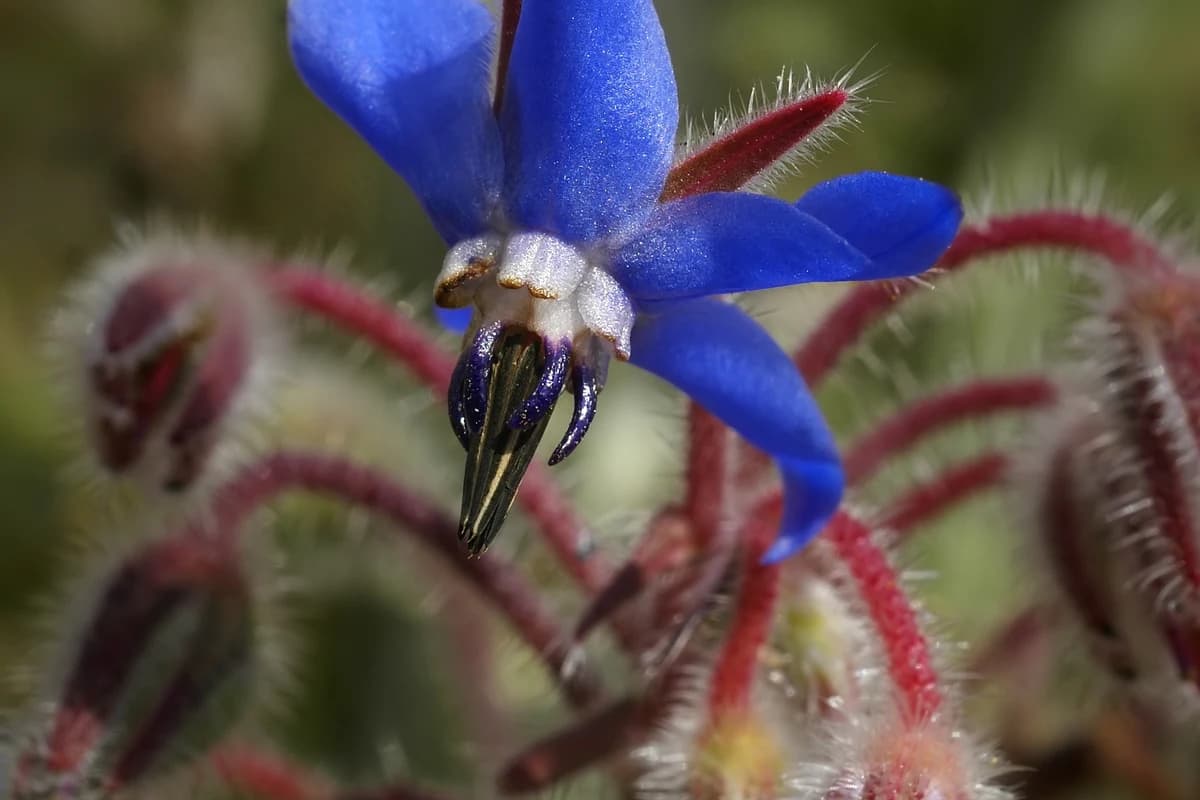
About This Plant
Borage is a fast-growing annual herb grown for cucumber-flavored leaves, edible blue star-shaped flowers, pollinator value, and oil-rich seed. It performs best in sunny, well-drained beds, usually from direct seed because the taproot dislikes transplanting, and can also be grown in containers or soilless substrate systems when drainage and airflow are controlled.
How to Grow Borage
Learn how to grow Borage from seed to harvest in 70 days. Beginner difficulty. Complete nutrient guide, pH/EC requirements, and growing conditions for soil & container.
Sources cited: 18.
Nutrient Requirements by Growth Stage
Do not treat borage as having a settled universal fertilizer recipe. In the best soilless seed-production study, plants in coconut fiber were fertigated at pH 5.8 and EC 2.20, 3.35, or 4.50 dS m-1; derived elemental N-P-K values were about 144-47-186, 179-58-233, and 215-70-279 ppm, with higher balanced EC improving…
Sign in to view nutrient requirements
A free account unlocks NPK targets for all four growth stages, micronutrient levels, a per-stage nutrient calculator, and the full nutrition guide. Signing up takes one click. Truleaf is a free, non-profit project, and every new account helps it grow. No spam, ever.
Growing Environments
Borage fits outdoor beds, pollinator gardens, edible gardens, containers, greenhouses, and indoor short-cycle production when light is adequate. NC State lists container and patio use, broad soil-pH tolerance, and full sun to partial shade…
Temperature
For germination, use Gilbertson et al.'s borage cardinal temperatures: minimum 9C, optimum 23C, and maximum 37C. Field guidance is more conservative, recommending spring sowing once temperatures and soil are above 10C. For flowering plants, a controlled study treated 21/19C day/night as the optimal well-watered condition, while 27/25C with water stress sharply reduced nectar and pollen resources. Keep production cool to moderate rather than heat-driven.
Humidity
No complete source gave a species-specific relative-humidity optimum for borage. Published controlled work used 65/75% day/night RH for microgreens, 80 +/- 10% RH in flowering chambers, and 50 +/- 5% RH for drought-stress seedlings…
Light
Outdoor and extension sources consistently place borage in full sun, with partial or light shade tolerated. Controlled studies used 16 h light for flowering and seedling stress work, while the borage microgreen protocol used a 12 h photoperiod at 300 +/- 15 umol m-2 s-1 PPFD…
Airflow
Use gentle air movement, not strong wind. Illinois Extension notes borage is brittle and can be damaged by wind, while OMAFRA notes seed shattering decreases at higher plant density because crop movement is reduced…
Sign in to view environmental requirements
A free account unlocks exact temperature, humidity, light and airflow targets, including germination and growth ranges, DLI, photoperiod and PPFD, plus the full environment guide. Signing up takes one click. Truleaf is a free, non-profit project, and every new account helps it grow. No spam, ever.
Hydroponic System Compatibility
The strongest controlled-environment match is drip-fed substrate culture: Urrestarazu et al. grew mature borage in 20 L coconut-fiber containers with daily fertigation, and Seifzadeh et al…
Growing Media
Use well-drained media. OMAFRA recommends well-drained soil and avoiding heavy wet soils, while NC State lists clay, loam, and sand tolerance with good drainage and occasional dryness…
Container Specs
Container culture is supported by NC State and UC extension material, but no complete qualified source gave an exact pot volume. Because borage forms a taproot and mature plants reach roughly 50-96 cm tall and 30-46 cm wide, use a deep container as the practical baseline…
Training & Support
Borage does not require trellising, but it benefits from pruning and sometimes staking. Illinois Extension specifically warns that plants are brittle and wind damaged, so stakes can help in exposed sites…
Sign in to view system compatibility
A free account unlocks why each of the six systems fits or fails, plus growing media, container sizes, training methods, companion plants, and the full systems guide. Signing up takes one click. Truleaf is a free, non-profit project, and every new account helps it grow. No spam, ever.
Propagation
Propagate borage from seed and favor direct sowing. OMAFRA lists seed as the propagation method, a 1.25-2.5 cm depth, and spring field seeding once temperatures exceed 10C…
Harvesting
Harvest depends on the crop target. For culinary use, pick young leaves fresh before buds open or before leaves become prickly, and pick flowers as they open…
Planting Calendar
In temperate Northern Hemisphere gardens, direct sow in early to mid spring after frost and after soil is above 10C. Indoor sowing can be used 3-4 weeks before last frost, but transplant carefully because the taproot is easily damaged…
Common Issues
Borage has low pest pressure in many gardens, but it is not pest-free. OMAFRA lists aphids as the most significant Ontario pest and flags caterpillars, powdery mildew, and Sclerotinia white mold as potential problems…
Get the full science-backed guide
By signing up, you help keep Truleaf free and support the growth of our nonprofit project. Your account unlocks full details for every plant issue—including symptoms, causes, step-by-step solutions, and prevention—plus the month-by-month planting calendar, the complete guide, and all research sources. It only takes one click. No spam, ever.