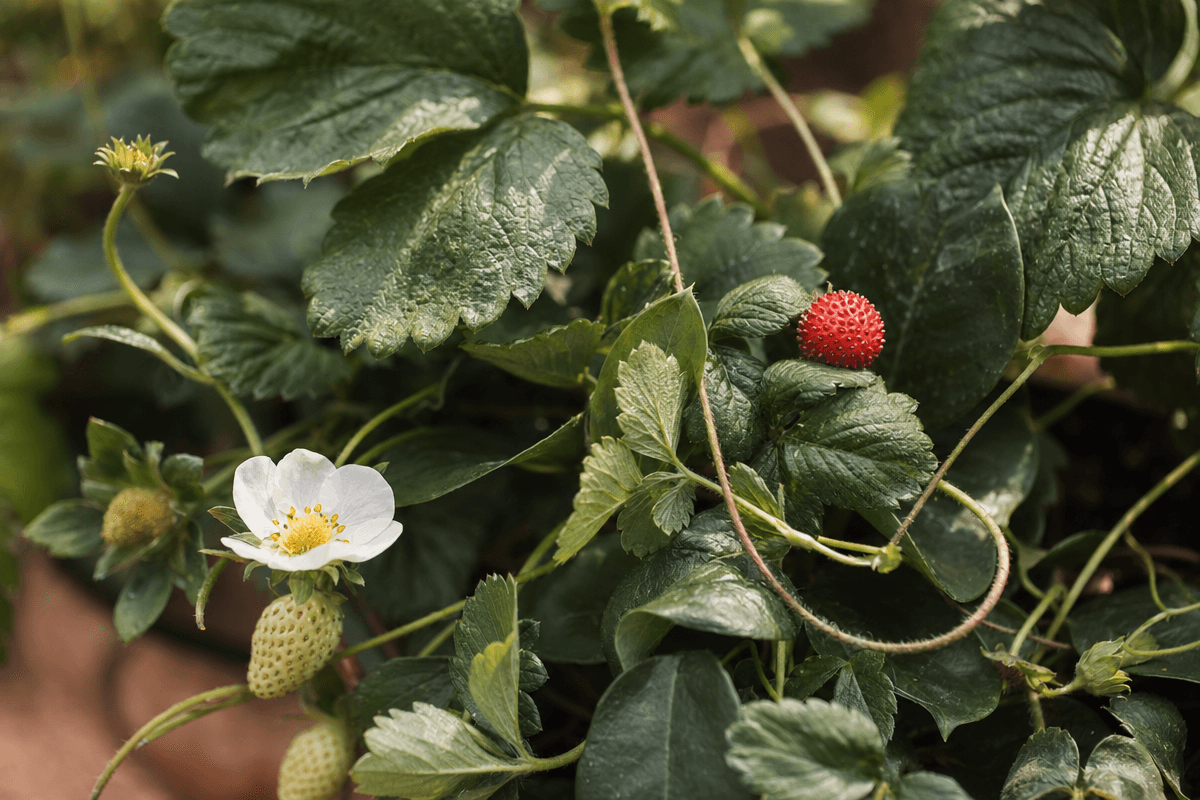
About This Plant
Strawberry is a fruiting perennial grown for soft berries and requires cool root zones, reliable calcium transport, and strong disease management around flowers and fruit.
How to Grow Strawberry
Learn how to grow Strawberry from seed to harvest in 150 days. Beginner difficulty. Complete nutrient guide, pH/EC requirements, and growing conditions for hydroponics, soil & greenhouse.
Sources cited: 21.
Nutrient Requirements by Growth Stage
Strawberry hydroponic nutrient management requires phase-specific adjustments. During establishment (weeks 1-6), a moderate solution of N 80-110, P 15-33, K 100-140, Ca 80-106, Mg 25-50 ppm is recommended…
Sign in to view nutrient requirements
A free account unlocks NPK targets for all four growth stages, micronutrient levels, a per-stage nutrient calculator, and the full nutrition guide. Signing up takes one click. Truleaf is a free, non-profit project, and every new account helps it grow. No spam, ever.
Growing Environments
Strawberries are versatile and can be grown in all four environments. Outdoor cultivation in full sun (minimum 6-8 hours daily) is the primary method, with well-drained, slightly acidic soil (pH 5.8-6.5) preferred…
Temperature
Strawberry (Fragaria x ananassa) thrives within a daytime temperature of 18-24C and nighttime temperature of 10-12C, targeting a 24-hour average near 18-20C. The intermediate regime of 18C day / 10C night produced the highest total fresh mass over a 270+ day production cycle, while cooler temperatures (16/8C) yielded superior fruit quality with highest Brix, sugar/acid ratio, and sensory scores. Growth is possible from approximately 10C to 28C, but temperatures above 27C shift photoperiodic response and above 30C inhibit growth and reduce fruit quality. Seed germination occurs across 15-24C, with ~24C often cited as optimal when combined with 16h light and cold stratification pre-treatment. For hydroponic production, maintaining 18-22C daytime with a 10C day/night differential is optimal for both yield and fruit quality.
Humidity
Relative humidity should be maintained at 40-75% for strawberry production, with an optimal target around 60-65%. Sustained humidity above 75% promotes powdery mildew (Podosphaera aphanis), which is the primary disease concern in greenhouse/hydroponic settings…
Light
Strawberry requires a minimum daily light integral (DLI) of 12 mol/m2/d for acceptable productivity, with optimal production at 20-25 mol/m2/d. A 16-hour photoperiod at 300 umol/m2/s PPFD (DLI ~17.3 mol/m2/d) accelerated flowering by 17-21 days compared to 12 hours in sole-source lighting studies with cv…
Airflow
Gentle airflow of 0.3-1.0 m/s is recommended for strawberry canopy ventilation and disease prevention. Adequate air movement reduces the humidity boundary layer around leaves, enhancing transpiration-driven calcium transport and reducing tip burn incidence…
Sign in to view environmental requirements
A free account unlocks exact temperature, humidity, light and airflow targets, including germination and growth ranges, DLI, photoperiod and PPFD, plus the full environment guide. Signing up takes one click. Truleaf is a free, non-profit project, and every new account helps it grow. No spam, ever.
Hydroponic System Compatibility
Strawberry performs well across most hydroponic systems, though substrate-based drip systems consistently produce the highest yields and resource efficiency. In a direct comparison at the University of Florida, substrate-drip systems produced 144-613% more marketable fruit than NFT, vertical, and aeroponic…
Growing Media
Strawberry grows successfully in a wide range of soilless substrates. The most productive combinations include coarse perlite mixed 1:1 with bark-based media and cocopeat-perlite blends at 40:60 ratio…
Container Specs
Strawberries grow exceptionally well in containers. Iowa State University Extension recommends a minimum container size of 30 cm in diameter and 20 cm deep…
Training & Support
Strawberry plants are naturally low-growing, forming rosettes 15-30 cm tall, and require no training or physical support structures. No trellising, staking, caging, or netting is needed for structural support…
Sign in to view system compatibility
A free account unlocks why each of the six systems fits or fails, plus growing media, container sizes, training methods, companion plants, and the full systems guide. Signing up takes one click. Truleaf is a free, non-profit project, and every new account helps it grow. No spam, ever.
Propagation
Strawberries are most commonly propagated by runners (stolons), which are produced naturally by the mother plant during summer. A single mother plant can produce up to 120 daughter plants in one season…
Harvesting
Strawberries are perennial plants that regrow and fruit for multiple years. June-bearing varieties produce one concentrated harvest over 3-5 weeks, typically mid-June to early July in USDA zones 5-8…
Planting Calendar
For temperate Northern Hemisphere gardens (USDA zones 5-8), bare-root strawberry transplants should be ordered in January and planted outdoors in March or April as soon as the ground is workable. Potted transplants can be planted from May through June…
Common Issues
Strawberry cultivation faces a wide range of pest and disease pressures that vary significantly between field and hydroponic/greenhouse production. The most economically important diseases are Botrytis fruit rot (gray mold) caused by Botrytis cinerea, which thrives in cool, wet conditions, and anthracnose caused by…
Get the full science-backed guide
By signing up, you help keep Truleaf free and support the growth of our nonprofit project. Your account unlocks full details for every plant issue—including symptoms, causes, step-by-step solutions, and prevention—plus the month-by-month planting calendar, the complete guide, and all research sources. It only takes one click. No spam, ever.