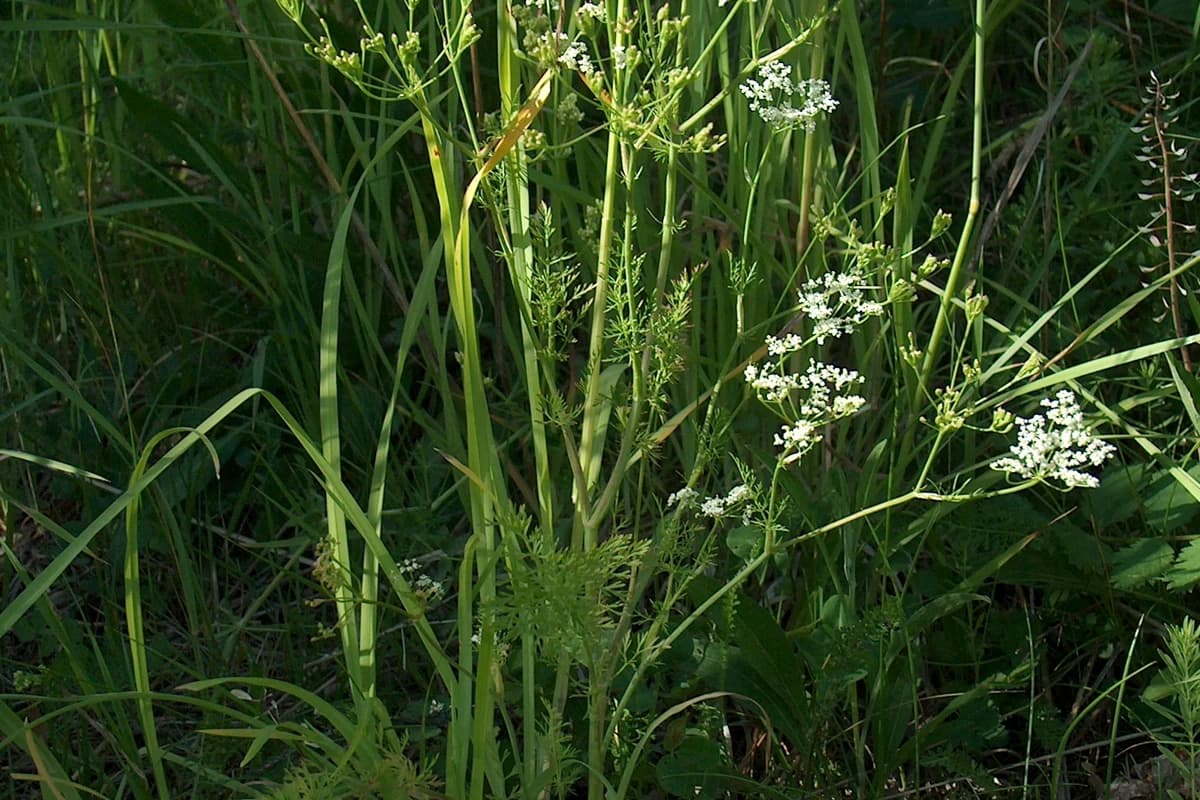
About This Plant
Caraway is a cool-season Apiaceae herb grown mainly for aromatic dry fruits used as a spice. Biennial plants form a low rosette in the first season, overwinter, then flower and set seed in the second season. It performs best in full sun, moist well-drained soil, and moderate soil-test-based fertility.
How to Grow Caraway
Learn how to grow Caraway from seed to harvest in 400 days. Intermediate difficulty. Complete nutrient guide, pH/EC requirements, and growing conditions for soil & container.
Sources cited: 11.
Nutrient Requirements by Growth Stage
Caraway fertility should be soil-test based. Saskatchewan Agriculture reports no completed Western Canadian fertility trials, but advises enough fertility for both companion crop and caraway, close attention to phosphorus and potassium for winter survival, and avoiding excessive first-year nitrogen because it can…
Sign in to view nutrient requirements
A free account unlocks NPK targets for all four growth stages, micronutrient levels, a per-stage nutrient calculator, and the full nutrition guide. Signing up takes one click. Truleaf is a free, non-profit project, and every new account helps it grow. No spam, ever.
Growing Environments
Outdoor beds are the primary environment for caraway, with greenhouse or indoor culture useful for seedlings, leaves, or controlled small-scale trials. For seed production, plan for high light, a long biennial cycle, pollination, and enough root depth; indoor container culture is possible but less efficient than field…
Temperature
Grow caraway as a cool-season crop. Controlled seedling work used a 25/18C day/night chamber, while crop-suitability and extension sources support active growth near 16-20C with 15-25C as a practical controlled-environment range. Keep germination warm and moist, but avoid sustained heat above the mid-20s because seed and oil crops perform best under cool, bright conditions.
Humidity
Use moderate humidity rather than a wet canopy. Seedling research used 60 percent daytime and 80 percent nighttime relative humidity, while field work and crop guides emphasize moist soil, adequate water for seed production, and avoiding cool, persistently wet flowering weather…
Light
Caraway should be treated as a full-sun, long-day seed crop. A 14-16 hour photoperiod works for controlled culture; seedlings can grow at moderate light, but flowering and seed production should receive brighter full-sun-equivalent conditions, around DLI 18-25 where energy cost allows…
Airflow
No caraway paper gives a numeric airflow target, so use moderate air movement as a disease-management control rather than a species-specific speed. Spacing, weed control, and dry foliage are important because blossom blight, anthracnose, Sclerotinia, and powdery mildew all worsen when canopies stay dense or humid…
Sign in to view environmental requirements
A free account unlocks exact temperature, humidity, light and airflow targets, including germination and growth ranges, DLI, photoperiod and PPFD, plus the full environment guide. Signing up takes one click. Truleaf is a free, non-profit project, and every new account helps it grow. No spam, ever.
Hydroponic System Compatibility
Prefer soil beds, deep media beds, and drip-irrigated containers. Drip irrigation has direct caraway field-research support, and deep media gives the taproot more stable moisture without waterlogging…
Growing Media
Use fertile, moist, well-drained loam or sandy loam with organic matter. Illinois Extension recommends full sun and well-drained soil with organic matter, while Saskatchewan warns that sandy soils can cause poor emergence and uneven stands unless moisture is well managed…
Container Specs
Caraway is best in the ground, but a deep container can work for small-space growing. Because extension profiles warn that established plants have deep roots and do not tolerate disturbance, direct sow into the final pot and avoid repeated up-potting…
Training & Support
Caraway needs no trellis or staking. The important cultivation work is stand management: direct sow, keep weeds down during slow emergence, thin rather than transplant, and avoid damaging the taproot…
Sign in to view system compatibility
A free account unlocks why each of the six systems fits or fails, plus growing media, container sizes, training methods, companion plants, and the full systems guide. Signing up takes one click. Truleaf is a free, non-profit project, and every new account helps it grow. No spam, ever.
Propagation
Grow caraway from seed in its final position. Extension sources agree that it is raised from seed and is difficult to transplant once the taproot establishes…
Harvesting
Harvest caraway for dry fruits, usually in the second season. Illinois Extension advises harvesting seed heads after they turn from green to brown, then drying them in a paper bag in a cool, dry, ventilated place…
Planting Calendar
Use a biennial calendar by default. Sow outdoors in early spring as soon as soil can be worked, or in fall for overwintering; plants usually form a rosette in year 1 and flower/set seed in year 2…
Common Issues
The current single mildew entry understated caraway disease risk. Crop guides and disease papers identify blossom blight, anthracnose, Sclerotinia, powdery mildew, root rots, leafhoppers, and aster yellows as more important risks…
Get the full science-backed guide
By signing up, you help keep Truleaf free and support the growth of our nonprofit project. Your account unlocks full details for every plant issue—including symptoms, causes, step-by-step solutions, and prevention—plus the month-by-month planting calendar, the complete guide, and all research sources. It only takes one click. No spam, ever.