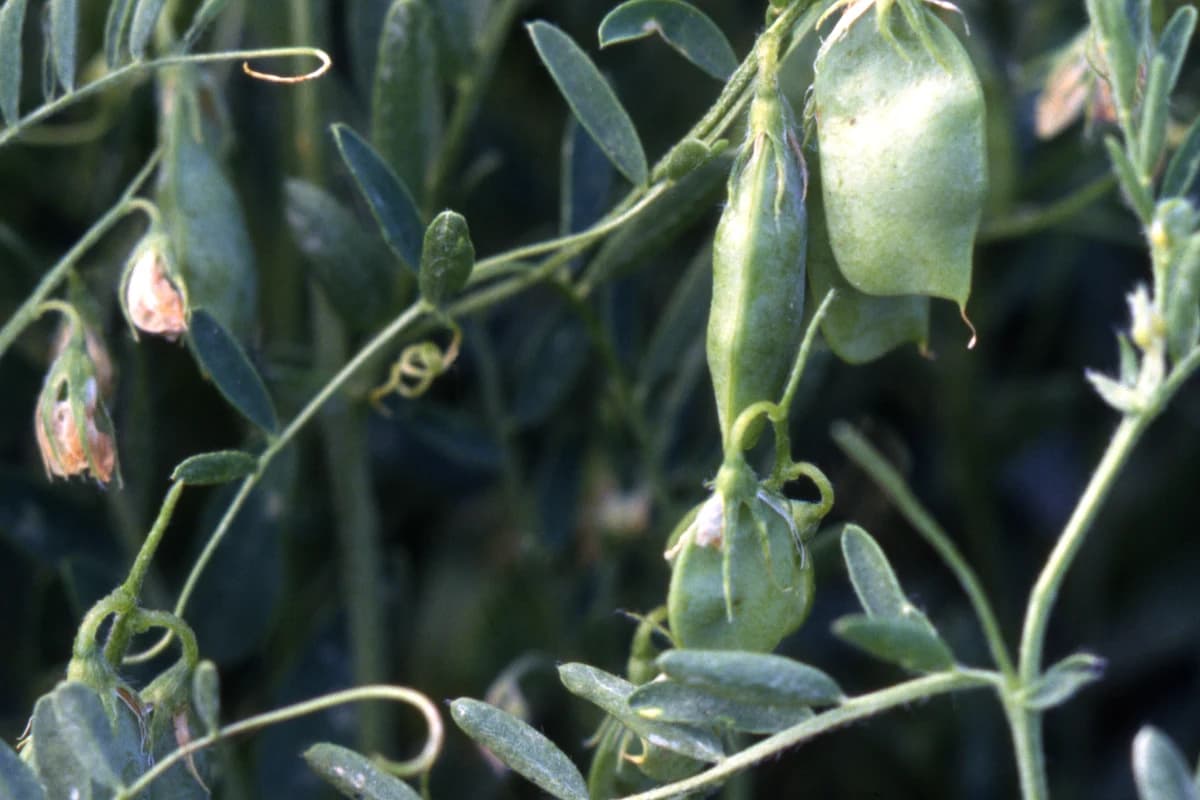
About This Plant
Lentil is a cool-season annual pulse grown for dry, protein-rich seed. It has weak, branching stems, indeterminate flowering, a root system extending at least 60 cm, and the capacity to fix atmospheric nitrogen when inoculated with compatible Rhizobium. Field or deep, well-drained media culture is the established production method. Strongly aerated deep-water culture can carry plants through early seed formation, but full dry-grain yield has not been optimized hydroponically.
How to Grow Lentil
Learn how to grow Lentil from seed to harvest in 95 days. Beginner difficulty. Complete nutrient guide, pH/EC requirements, and growing conditions for hydroponics, soil & greenhouse.
Sources cited: 35.
Nutrient Requirements by Growth Stage
For rhizobia-free mineral-N DWC after the first true leaf, use 120-20-128 ppm N-P-K, with an operating band of N 100-140, P 15-25, and K 105-150 ppm. The direct study held this recipe at EC 1.2 mS/cm and pH 6.0-6.5 through early seed…
Sign in to view nutrient requirements
A free account unlocks NPK targets for all four growth stages, micronutrient levels, a per-stage nutrient calculator, and the full nutrition guide. Signing up takes one click. Truleaf is a free, non-profit project, and every new account helps it grow. No spam, ever.
Growing Environments
Lentil is primarily an outdoor field pulse, but controlled studies confirm indoor, greenhouse, DWC, and container cultivation. Indoor systems require high light, cool reproductive temperatures, canopy support, and an oxygenated or well-drained root zone…
Temperature
Lentil is a cool-season pulse. Germinate seed at 18-25 C, with 21-24 C as a practical target. Maintain active growth near 15-24 C, ideally with cooler nights around a 20 C mean. Protect flowering and pod filling from temperatures above 30 C because heat reduces biomass, grain number, grain size, and yield.
Humidity
Maintain 40-60% RH and target about 50%. Successful lentil studies used operating conditions from about 40% to 65% RH, but no lentil-specific RH optimization experiment was found…
Light
Use a 14-hour photoperiod at about 500 micromol/m2/s, which gives a DLI near 25 mol/m2/day. Lentil is a quantitative long-day crop, and 16 hours can hasten flowering in slower genotypes…
Airflow
Provide continuous gentle canopy air movement to remove humid boundary layers, dry foliage, and strengthen stems. A provisional 0.3-0.8 m/s range is a controlled-environment engineering default; no lentil-specific air-speed trial was located…
Sign in to view environmental requirements
A free account unlocks exact temperature, humidity, light and airflow targets, including germination and growth ranges, DLI, photoperiod and PPFD, plus the full environment guide. Signing up takes one click. Truleaf is a free, non-profit project, and every new account helps it grow. No spam, ever.
Hydroponic System Compatibility
DWC is the only water-culture method with direct reproductive-stage evidence. Oxygen-saturated 35 L DWC supported lentil through bloom, pods, and early seed at pH 6.0-6.5 and EC 1.2 mS/cm, but dry-grain yield was not optimized…
Growing Media
Use a free-draining, well-aerated root zone. Rockwool cubes are documented for starting plants before DWC, while peat-based potting mixes and deep soil tubes supported complete controlled studies…
Container Specs
Lentil can complete its life cycle in a container, but the reviewed literature does not establish a minimum home pot size. One Eston plant matured and produced 7.2 g seed in a 10 cm diameter by 60 cm research tube…
Training & Support
Lentil needs no routine pruning, topping, or trellising, but its weak stems can lodge after rain, in wind, or in dense lush stands. Field growers use retained stubble or compatible barley, oat, or camelina companions for support…
Sign in to view system compatibility
A free account unlocks why each of the six systems fits or fails, plus growing media, container sizes, training methods, companion plants, and the full systems guide. Signing up takes one click. Truleaf is a free, non-profit project, and every new account helps it grow. No spam, ever.
Propagation
Propagate lentil from seed and direct-sow into moist, well-drained soil or the final container. Use about 2.5-6 cm depth, with 4-5 cm as a broad field target…
Harvesting
Treat 95 days as a planning midpoint. Published crops span about 91-119 days, and visual maturity is more reliable than age…
Planting Calendar
For a temperate Northern Hemisphere calendar, direct-sow in April or early May as soon as the seedbed is workable and moist. A three-year northern European trial used 22 April to 20 May sowing and 30 July to 4 September harvest, with 96-119 days to maturity…
Common Issues
Diagnose roots first when lentil yellows or wilts. Brown or black roots, loss of fine laterals and nodules, basal yellowing, and stunting can arise from mixed Fusarium, Rhizoctonia, Pythium, and Aphanomyces infection…
Get the full science-backed guide
By signing up, you help keep Truleaf free and support the growth of our nonprofit project. Your account unlocks full details for every plant issue—including symptoms, causes, step-by-step solutions, and prevention—plus the month-by-month planting calendar, the complete guide, and all research sources. It only takes one click. No spam, ever.