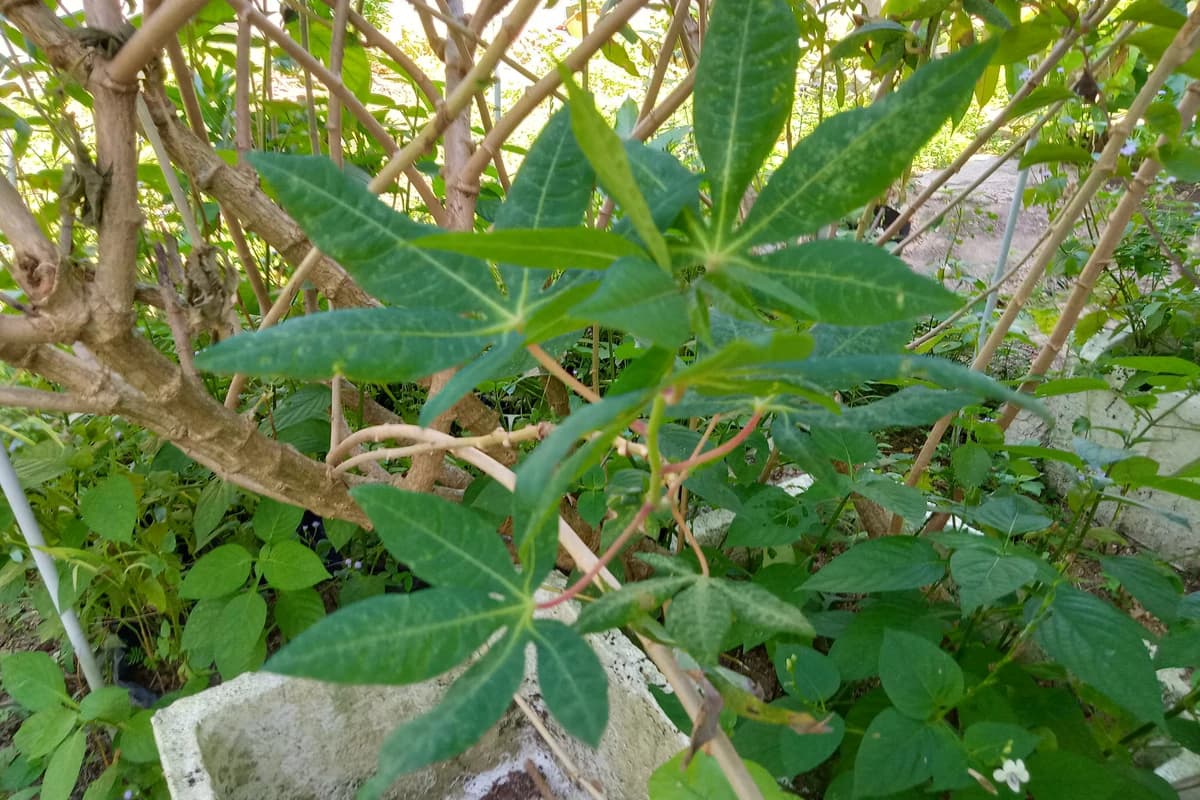
About This Plant
Cassava (Manihot esculenta) is a tropical perennial shrub in the Euphorbiaceae family grown as an annual crop for its starchy tuberous roots. Native to South America, it is a major food source across the tropics requiring 8-12 months frost-free growing. Cassava is extremely potassium-dominant (K:N ratio 2:1 in tubers) and uniquely nitrogen-sensitive. Roots must be properly processed within 24-48 hours of harvest to remove toxic cyanogenic compounds. Propagated exclusively by stem cuttings. An exceptional CO2 responder with +33-100% tuber biomass at elevated CO2.
How to Grow Cassava
Learn how to grow Cassava from seed to harvest in 365 days. Advanced difficulty. Complete nutrient guide, pH/EC requirements, and growing conditions for soil & container.
Sources cited: 50.
Nutrient Requirements by Growth Stage
Cassava has a distinctive nutrient profile: remarkably sensitive to nitrogen excess while being an extremely heavy potassium feeder. Omondi et al…
Sign in to view nutrient requirements
A free account unlocks NPK targets for all four growth stages, micronutrient levels, a per-stage nutrient calculator, and the full nutrition guide. Signing up takes one click. Truleaf is a free, non-profit project, and every new account helps it grow. No spam, ever.
Growing Environments
Cassava can be grown in three practical environments outside the tropics: (1) Outdoor — only viable in frost-free tropical and subtropical zones (USDA 10b-13) with year-round warmth above 20 C and 8+ month growing seasons. Full sun, deep well-drained soil, adequate rainfall or irrigation…
Temperature
Cassava stem cuttings sprout optimally at 28-30 C, with the minimum sprouting temperature at 12-17 C and maximum at 36-40 C. Vegetative growth occurs across 20-35 C with optimal performance at 25-30 C. All growth ceases below 10 C and frost kills aboveground tissue. Prolonged exposure above 35 C reduces photosynthetic efficiency. For controlled environments, maintain 25-30 C with 12-hour photoperiod. Night temperatures should not drop below 20 C during the establishment phase. Cassava is essentially a non-seasonal tropical species requiring consistent warmth throughout its 8-12 month growth cycle.
Humidity
Cassava thrives in humid-warm conditions with 60-80% relative humidity being optimal. Low humidity below 60% causes leaf tip browning and distortion, reducing photosynthetic capacity…
Light
Cassava has a high light saturation point of 1500 umol/m2/s PPFD, reflecting its tropical full-sun habit. For indoor controlled environments, 400-500 PPFD with a 12-hour photoperiod provides a Daily Light Integral (DLI) of approximately 20-22 mol/m2/d, supporting strong vegetative growth and tuber development…
Airflow
Maintain 0.3-1.0 m/s air movement in controlled environments to prevent foliar disease in the humid conditions cassava requires. Adequate ventilation is particularly important during vegetative canopy development when leaf area is highest…
Sign in to view environmental requirements
A free account unlocks exact temperature, humidity, light and airflow targets, including germination and growth ranges, DLI, photoperiod and PPFD, plus the full environment guide. Signing up takes one click. Truleaf is a free, non-profit project, and every new account helps it grow. No spam, ever.
Hydroponic System Compatibility
Aeroponics is the gold-standard system for cassava — producing larger storage roots than drip systems and enabling disease-free propagation with real-time root monitoring. Multiple studies confirm cassava's excellent performance in aeroponic culture, with mini-cutting survival rates of 93%…
Growing Media
Perlite is the preferred growing medium for soilless cassava production, providing excellent drainage and aeration while allowing unimpeded tuber expansion — critical for storage root development. Clay pebbles (LECA) are also excellent, particularly in ebb-and-flow systems where intermittent flooding provides nutrient…
Container Specs
Deep containers are essential for cassava tuber production — storage roots extend to approximately 60 cm depth, while feeder roots penetrate to 100 cm. Minimum container depth of 60 cm and width of 40 cm is required, with 40+ L volume per plant…
Training & Support
Cassava does not require training or support structures under normal growing conditions. Plants grow naturally as semi-woody shrubs reaching 1.8-3 m with a branching canopy…
Sign in to view system compatibility
A free account unlocks why each of the six systems fits or fails, plus growing media, container sizes, training methods, companion plants, and the full systems guide. Signing up takes one click. Truleaf is a free, non-profit project, and every new account helps it grow. No spam, ever.
Propagation
Cassava propagates almost exclusively via stem cuttings. Select healthy lignified stems 8-12 months old, cut into 20-30 cm sections with at least 5 nodes using a sharp knife, and allow 1-3 days to callous before planting…
Harvesting
Cassava tubers reach harvestable maturity at 8-18 months after planting, with early-maturing varieties at 8-10 months and traditional varieties at 12-18 months. Harvest indicators include lower leaves yellowing and dropping, stems becoming woody, and soil cracking around the plant base…
Planting Calendar
In tropical zones cassava is planted at the start of the rainy season — essentially year-round in equatorial regions. In subtropical climates (e.g., South Africa, Florida), direct sow cuttings from late March through June once frost risk passes…
Common Issues
Cassava faces significant biotic threats across its tropical growing range. The two most devastating viral diseases are Cassava Mosaic Disease (CMD) caused by geminiviruses transmitted by Bemisia tabaci whiteflies, with yield losses of 12-82%, and Cassava Brown Streak Disease (CBSD) producing devastating root necrosis…
Get the full science-backed guide
By signing up, you help keep Truleaf free and support the growth of our nonprofit project. Your account unlocks full details for every plant issue—including symptoms, causes, step-by-step solutions, and prevention—plus the month-by-month planting calendar, the complete guide, and all research sources. It only takes one click. No spam, ever.