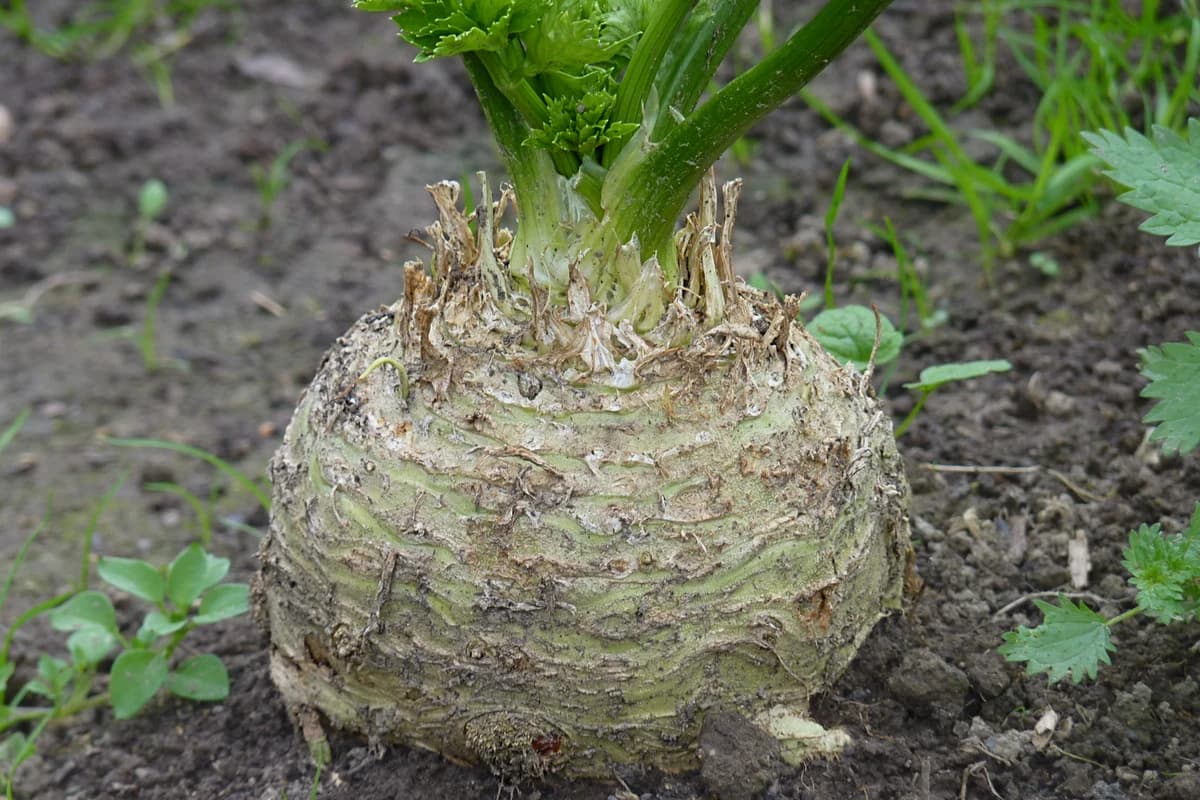
About This Plant
Celeriac, also called celery root, is a cool-season celery type grown for its swollen edible hypocotyl and lower stem rather than a true root. It needs a long, steady season, uniform moisture, fertile soil or media, and protection from transplant chilling that can trigger bolting.
How to Grow Celeriac
Learn how to grow Celeriac from seed to harvest in 180 days. Intermediate difficulty. Complete nutrient guide, pH/EC requirements, and growing conditions for soil & container.
Sources cited: 18.
Nutrient Requirements by Growth Stage
Celeriac is a heavy-feeding, moisture-sensitive crop with strong potassium demand. SARE reports celeriac crop uptake near 105 lb N/ac, 16 lb P/ac, and 160 lb K/ac, while Cornell-derived guidance lists about 180 lb N/ac with soil-test-based P and K additions…
Sign in to view nutrient requirements
A free account unlocks NPK targets for all four growth stages, micronutrient levels, a per-stage nutrient calculator, and the full nutrition guide. Signing up takes one click. Truleaf is a free, non-profit project, and every new account helps it grow. No spam, ever.
Growing Environments
Celeriac is best verified as an outdoor field crop with greenhouse transplant production. It prefers deep, fertile, moisture-retentive soil and steady irrigation…
Temperature
Celeriac is a cool-season Apium crop. Extension sources recommend 21-24C for germination, then cooler seedling growth around 15-21C. Field growth is best in mild weather, roughly 13-24C, with 18C a practical target for steady swelling without heat stress. Avoid exposing young transplants to prolonged cold: several extension sources warn that temperatures below about 13C for a week or more, or colder day-night periods after planting, can trigger premature bolting. Heat above about 27C can slow germination or push poor-quality summer growth, so shade and irrigation matter in hot regions.
Humidity
No complete celeriac source gives a universal active-growth relative-humidity target, so humidity should be managed by disease and water-balance risk rather than treated as a fixed optimum. Storage is well defined: roots keep best near 0-1C with 95-98% RH…
Light
Celeriac is grown as an open-field cool-season crop, but it tolerates moderate shade better than many fruiting vegetables. A two-year German agrivoltaic study found that about 30% PAR reduction did not significantly reduce bulb yield and concluded celeriac was suitable under agrivoltaic panels…
Airflow
Airflow is mainly a disease-management control for celeriac. Septoria apiicola spreads through infected seed, residues, splashing water, tools, workers, and wet foliage, and extension disease guides emphasize sanitation, dry leaves, spacing, and irrigation timing…
Sign in to view environmental requirements
A free account unlocks exact temperature, humidity, light and airflow targets, including germination and growth ranges, DLI, photoperiod and PPFD, plus the full environment guide. Signing up takes one click. Truleaf is a free, non-profit project, and every new account helps it grow. No spam, ever.
Hydroponic System Compatibility
Drip-irrigated soil, raised beds, and deep media containers are the best-supported systems for celeriac. Drip is favored because the crop needs uniform moisture and dry foliage for Septoria prevention…
Growing Media
Use deep, fertile, moisture-retentive media with excellent drainage. Extension guides repeatedly describe celeriac as needing deep loamy or muck-type soils, high organic matter, and uniform water; heavy clay, hardpan, and poorly drained beds reduce quality…
Container Specs
Container celeriac is supported by crop morphology rather than by a precise university container-size trial. The plant forms a broad rosette and a swollen basal hypocotyl, so small herb pots are inappropriate…
Training & Support
Celeriac needs no trellis, cage, stakes, string, topping, or structural pruning. It grows as a compact rosette and the edible portion develops at the crown and soil surface…
Sign in to view system compatibility
A free account unlocks why each of the six systems fits or fails, plus growing media, container sizes, training methods, companion plants, and the full systems guide. Signing up takes one click. Truleaf is a free, non-profit project, and every new account helps it grow. No spam, ever.
Propagation
Propagate celeriac from seed and treat it as a transplant crop in most climates. Purdue recommends starting plants 10-12 weeks before field setting; UMass and SARE describe similar celery-family greenhouse production…
Harvesting
Harvest celeriac when the swollen base reaches about 7.5-10 cm diameter. UMass gives 100-110 days from seeding or 80-90 days from transplanting, while University of Maine trials harvested 121 days after transplanting and Purdue notes that the crop needs at least 120 days…
Planting Calendar
In temperate northern calendars, sow celeriac indoors in late winter to early spring, roughly February through April, then transplant in late spring after the risk of prolonged cold has passed. The crop is long and slow: transplants may be 10-12 weeks old, and harvest often lands in September through November…
Common Issues
The two existing issues, black heart and bolting, are valid but incomplete. Black heart is a calcium-assimilation disorder driven by water stress, rapid growth, and nutrient imbalance, not a simple calcium shortage…
Get the full science-backed guide
By signing up, you help keep Truleaf free and support the growth of our nonprofit project. Your account unlocks full details for every plant issue—including symptoms, causes, step-by-step solutions, and prevention—plus the month-by-month planting calendar, the complete guide, and all research sources. It only takes one click. No spam, ever.