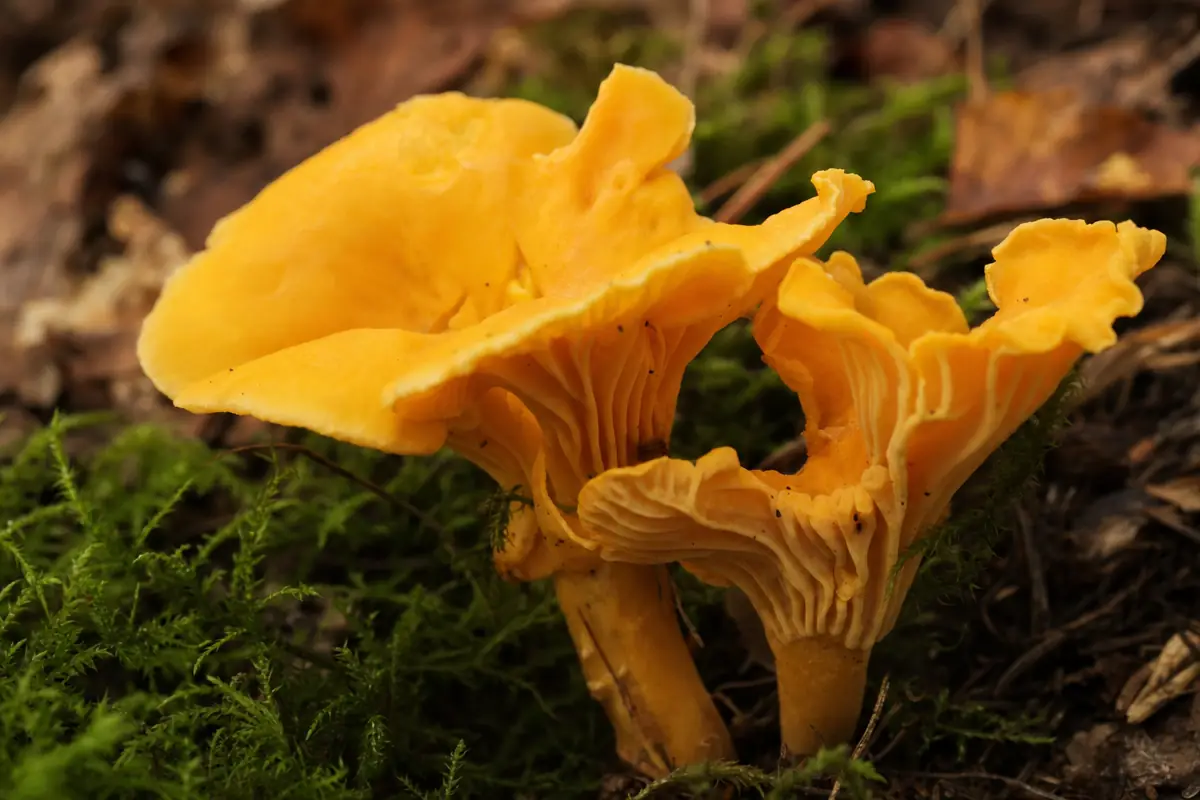
About This Plant
Golden chanterelle is a prized edible ectomycorrhizal mushroom tied to living host trees such as pine, spruce, birch, oak, and beech. Reliable production is not a normal tray or hydroponic crop: it depends on compatible host roots, acidic low-nitrogen forest soil, moist seasonal weather, and careful harvest from long-lived woodland patches.
How to Grow Chanterelle
Learn how to grow Chanterelle from seed to harvest in 365 days. Expert difficulty. Complete nutrient guide, pH/EC requirements, and growing conditions for soil & container.
Sources cited: 8.
Nutrient Requirements by Growth Stage
Stage-specific hydroponic NPK ppm is not applicable to C. cibarius…
Sign in to view nutrient requirements
A free account unlocks NPK targets for all four growth stages, micronutrient levels, a per-stage nutrient calculator, and the full nutrition guide. Signing up takes one click. Truleaf is a free, non-profit project, and every new account helps it grow. No spam, ever.
Growing Environments
The evidence-backed environment is outdoor woodland or long-cycle host-tree culture. Sorokina and Luginina found C…
Temperature
Chanterelle guidance should use forest and host-root conditions, not a warm mushroom-house setpoint. USDA synthesis describes chanterelles as ectomycorrhizal fungi whose fruiting is strongly shaped by weather, with warm summers positively associated with abundance and high soil humidity supporting slow fruit-body growth. Sorokina and Luginina classify C. cibarius as a temperate, moderately warm-climate species in southern taiga and sub-taiga forests. Keep growth guidance around 16-24C, with the caveat that compatible host roots, season, and soil moisture matter more than a single indoor temperature target.
Humidity
For chanterelle, humidity is primarily soil and litter moisture. USDA notes that rain during primordium formation supplies moisture for cell elongation and that high soil humidity lets the long-lived fruit bodies keep growing without drying out…
Light
Chanterelle fruit bodies do not photosynthesize, but light matters indirectly through the host trees and forest structure. Sorokina and Luginina found the species mostly in pure pine and mixed pine-spruce-birch communities with low to medium crown density, and characterized it as shade tolerant but rarely under total…
Airflow
No source verified a fan-speed target for chanterelle fruiting. In practice, airflow means a living, aerated forest soil and a greenhouse or nursery setup that avoids stagnant, contaminated conditions during mycorrhizal synthesis…
Sign in to view environmental requirements
A free account unlocks exact temperature, humidity, light and airflow targets, including germination and growth ranges, DLI, photoperiod and PPFD, plus the full environment guide. Signing up takes one click. Truleaf is a free, non-profit project, and every new account helps it grow. No spam, ever.
Hydroponic System Compatibility
DWC, NFT, ebb-flow, drip hydroponics, Kratky, and aeroponics are unsuitable because they exclude the host-tree ectomycorrhiza and forest-soil habitat. USDA describes chanterelles as dependent on host-tree root tips and well-drained acidic forest soils, while Pachlewski et al…
Growing Media
Use acidic, low-nitrogen forest soil with organic litter and compatible host-tree roots. USDA reports best growth in well-drained forest soils with low nitrogen and pH 4.0-5.5…
Container Specs
Containers are only justified for inoculated host seedlings in nursery or greenhouse experiments. USDA reports greenhouse fruiting from C…
Training & Support
Training support is not applicable to the fungus itself. Chanterelle fruit bodies emerge from soil and litter around ectomycorrhizal host roots, so there are no vines, canes, or stems to trellis…
Sign in to view system compatibility
A free account unlocks why each of the six systems fits or fails, plus growing media, container sizes, training methods, companion plants, and the full systems guide. Signing up takes one click. Truleaf is a free, non-profit project, and every new account helps it grow. No spam, ever.
Propagation
Propagation is specialist ectomycorrhizal nursery work. Pachlewski et al…
Harvesting
Harvest mature fruit bodies from established patches rather than managing a fixed seed-to-harvest crop. USDA reports that chanterelles grow slowly, about 2-5 cm per month, persist an average of 44 days and sometimes more than 90 days, and produce spores over one to two months…
Planting Calendar
Use a woodland season calendar. In temperate Europe and boreal regions, chanterelle fruiting is typically a summer-to-autumn event driven by warm-season growth followed by rainfall and moist soil…
Common Issues
The dominant problems are failure to establish mycorrhiza, failure to fruit, drying, soil disturbance, and contamination in artificial culture. USDA stresses that chanterelle ecology and productivity remain hard to manage and that year-to-year production varies with weather and site factors…
Get the full science-backed guide
By signing up, you help keep Truleaf free and support the growth of our nonprofit project. Your account unlocks full details for every plant issue—including symptoms, causes, step-by-step solutions, and prevention—plus the month-by-month planting calendar, the complete guide, and all research sources. It only takes one click. No spam, ever.