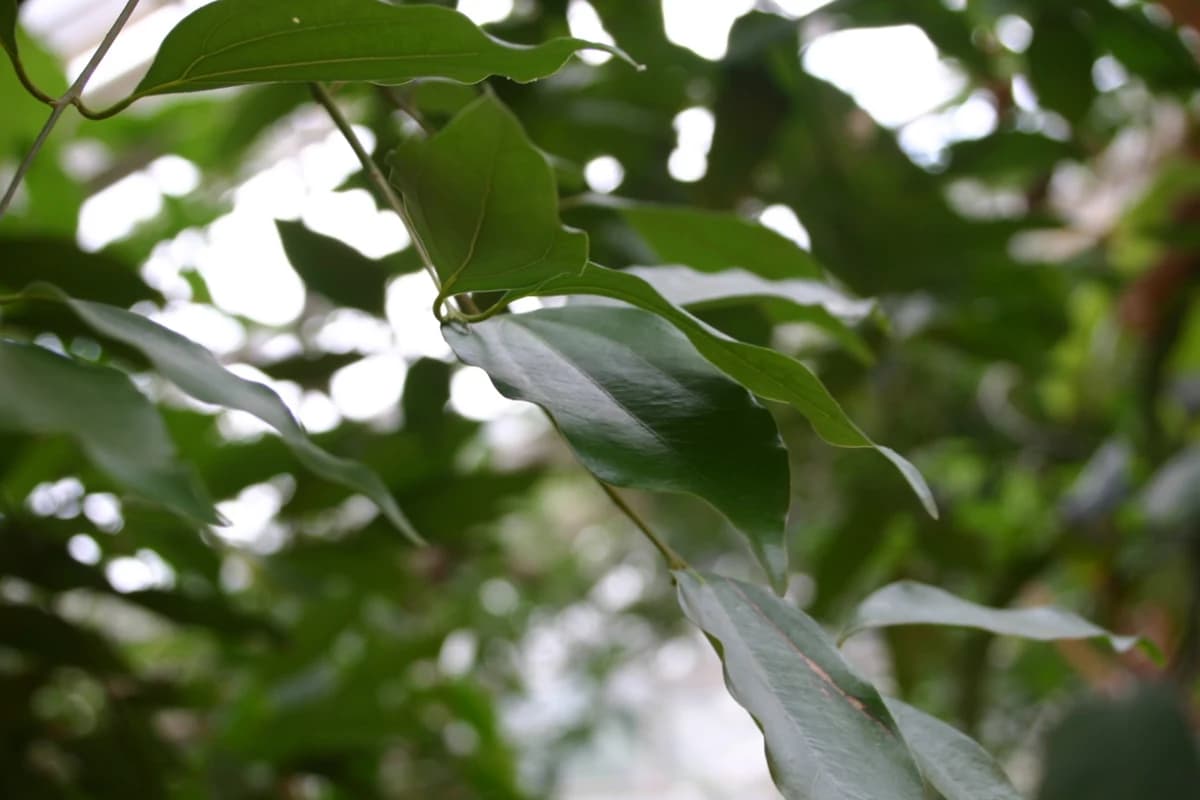
About This Plant
Cinnamon is a tropical evergreen tree grown as a coppiced bush for aromatic inner bark, leaves, and essential oils. It performs best in warm, wet, frost-free conditions, acidic well-drained soil, high humidity, and bright light, with commercial bark harvest based on repeated straight shoot regrowth.
How to Grow Cinnamon
Learn how to grow Cinnamon from seed to harvest in 1095 days. Intermediate difficulty. Complete nutrient guide, pH/EC requirements, and growing conditions for soil & container.
Sources cited: 15.
Nutrient Requirements by Growth Stage
Field nutrition should be soil-test led. Cinnamon sources support acidic, well-drained soils near pH 5.5-6.5 and fertilizer programs based on urea, rock phosphate or Eppawala rock phosphate, and muriate of potash…
Sign in to view nutrient requirements
A free account unlocks NPK targets for all four growth stages, micronutrient levels, a per-stage nutrient calculator, and the full nutrition guide. Signing up takes one click. Truleaf is a free, non-profit project, and every new account helps it grow. No spam, ever.
Growing Environments
Cinnamon is best outdoors in wet tropical or humid subtropical climates, but it can be maintained in greenhouse, conservatory, patio, or indoor container culture where winters are too cold. Outdoor production needs frost-free warmth, bright light, rainfall or irrigation, and deep well-drained acidic soil…
Temperature
Cinnamon should be kept warm year-round. FAO EcoCrop lists optimal growth around 24-30C and absolute tolerance near 18-36C, while Sri Lankan guidance reports strong cultivation performance around 25-35C. The existing germination range of 20-30C is plausible as warm nursery guidance, but complete sources more strongly support it as a crop climate range than as a controlled germination-temperature trial. Protect plants from cold drafts and frost, especially in containers or greenhouses.
Humidity
Cinnamon is a wet-tropical crop and performs best in humid air. Sri Lankan production guidance gives optimum relative humidity near 75-85%, and the current 70-90% range is acceptable as a managed envelope rather than a single target…
Light
Mature cinnamon needs very bright light to full sun where water and heat are adequate; FAO EcoCrop lists very bright light to clear skies as optimal. Young plants benefit from partial shade during nursery and early establishment, and IISR recommends artificial shade until seedlings are about six months old…
Airflow
No complete cinnamon paper defined a numeric airflow target, so the airflow values are greenhouse management guidance rather than species-specific trial data. Use gentle to moderate air movement in humid indoor or greenhouse conditions to reduce stagnant wet foliage, while avoiding cold drafts…
Sign in to view environmental requirements
A free account unlocks exact temperature, humidity, light and airflow targets, including germination and growth ranges, DLI, photoperiod and PPFD, plus the full environment guide. Signing up takes one click. Truleaf is a free, non-profit project, and every new account helps it grow. No spam, ever.
Hydroponic System Compatibility
Cinnamon is poorly suited to water-culture systems such as DWC, NFT, Kratky, and production aeroponics because it is a long-lived woody crop needing large root volume, drainage, oxygen, and physical support. Drip irrigation or fertigation into a large acidic substrate container is the only hydro-style approach with…
Growing Media
Use acidic, well-drained, moisture-retentive media. FAO lists optimal soil pH 5.5-6.5 and absolute pH 5.0-7.0, with light to medium soils and low salinity tolerance…
Container Specs
Containers are suitable for nursery plants and protected ornamental culture, but they should be large, deep, and well drained. Commercial field guidance prefers deep soil, and cinnamon's woody root system makes small herb pots inappropriate…
Training & Support
Training support is required because cinnamon bark production depends on straight harvestable shoots. IISR describes coppicing plants low to encourage side shoots, then repeatedly managing the bush for straight peeling stems…
Sign in to view system compatibility
A free account unlocks why each of the six systems fits or fails, plus growing media, container sizes, training methods, companion plants, and the full systems guide. Signing up takes one click. Truleaf is a free, non-profit project, and every new account helps it grow. No spam, ever.
Propagation
Cinnamon can be propagated from fresh seed, semi-hardwood cuttings, and air layers. For seed, remove fruit pulp, wash the seed, and sow promptly because viability falls quickly; IISR reports germination beginning in about 15-20 days, while Sri Lankan nursery guidance reports healthy seed starting near two weeks…
Harvesting
Commercial cinnamon is managed as a coppiced bush rather than an unmanaged tree. First bark harvest usually begins around 2-3 years after planting under good management, with later harvest cycles based on straight brown-barked regrowth…
Planting Calendar
Calendar timing is tropical and rainfall-driven. IISR reports flowering in January and fruit ripening during June-August under West Coast Indian conditions, with planting during June-July to use monsoon establishment…
Common Issues
The strongest disease evidence supports leaf spot or blight caused by Colletotrichum gloeosporioides and rough bark disease affecting bark quality. Leaf spot appears as brown specks that coalesce into necrotic patches or shot holes, while rough bark produces coarse, scab-like stem surfaces and poor peeling…
Get the full science-backed guide
By signing up, you help keep Truleaf free and support the growth of our nonprofit project. Your account unlocks full details for every plant issue—including symptoms, causes, step-by-step solutions, and prevention—plus the month-by-month planting calendar, the complete guide, and all research sources. It only takes one click. No spam, ever.