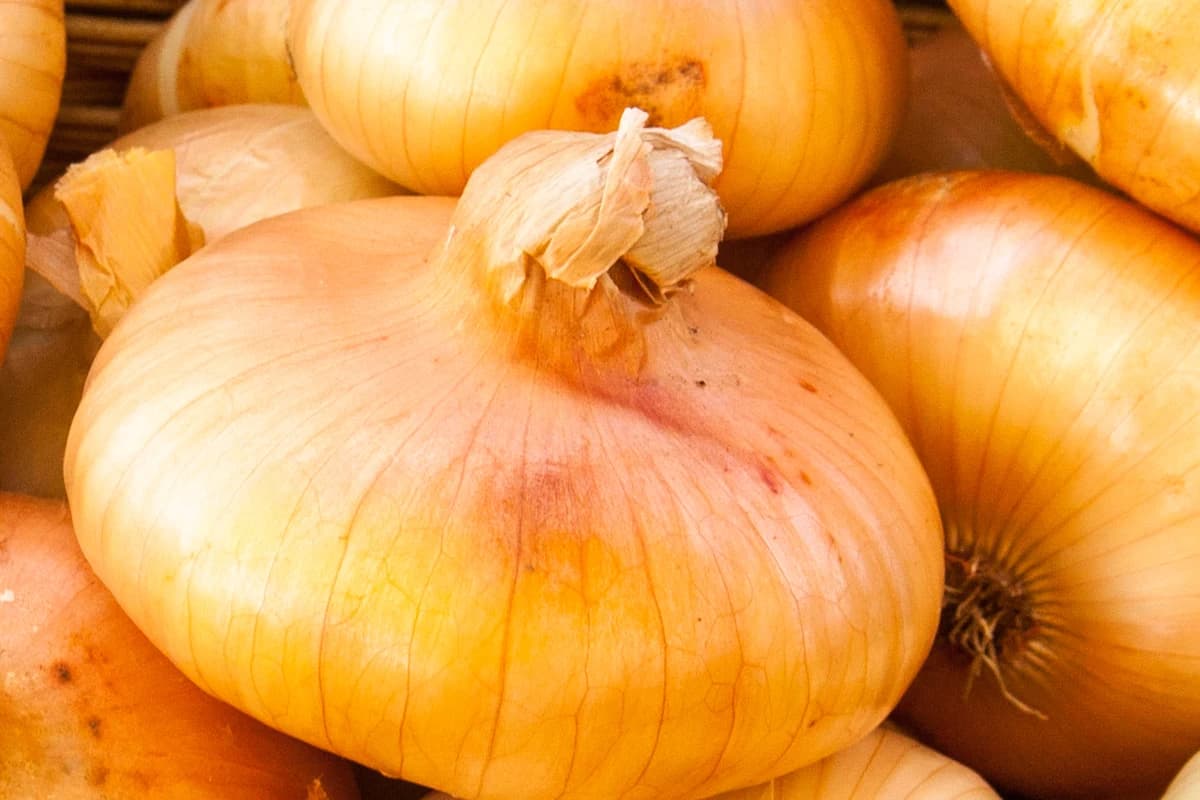
About This Plant
Cipollini onions are small, flattened Allium cepa bulbs valued for their sweet, mild flavor in roasting, caramelizing, and pickling. They grow as cool-season, daylength-sensitive bulb onions, building leaves first and sizing bulbs once the cultivar's photoperiod threshold is met.
How to Grow Cipollini Onion
Learn how to grow Cipollini Onion from seed to harvest in 70 days. Intermediate difficulty. Complete nutrient guide, pH/EC requirements, and growing conditions for hydroponics, soil & greenhouse.
Sources cited: 21.
Nutrient Requirements by Growth Stage
Cipollini-specific ppm trials were not found, so NPK should be treated as Allium cepa evidence rather than cultivar proof. A hydroponic onion study used a starter solution near 184 mg/L N, 56 mg/L P, and 274 mg/L K, then a growth solution near 256 mg/L N, 62 mg/L P, and 391 mg/L K at pH 5.6 and EC 2.0-2.6 dS/m…
Sign in to view nutrient requirements
A free account unlocks NPK targets for all four growth stages, micronutrient levels, a per-stage nutrient calculator, and the full nutrition guide. Signing up takes one click. Truleaf is a free, non-profit project, and every new account helps it grow. No spam, ever.
Growing Environments
Cipollini works outdoors, in greenhouses, indoors under strong light, and in containers when the grower manages daylength, spacing, moisture, and airflow. Outdoor soil culture is the most proven baseline…
Temperature
Cipollini should be managed as a cool-season Allium cepa bulb onion. Seed will germinate in cool soil above about 5C, but emergence is fastest near 24C; cool field seedbeds can slow emergence to several weeks. Vegetative growth is strongest in mild weather around 13-25C, while warm dry conditions help final curing rather than leafy growth. Avoid hot root zones during bulb sizing because onion roots are shallow and stress quickly.
Humidity
Keep humidity moderate and leaves dry. A 40-70% managed range is reasonable indoors, with 55-60% as a practical target when paired with steady airflow…
Light
Give cipollini full sun outdoors or bright indoor light near 18 mol/m2/day DLI or higher when possible. Bulbing is daylength sensitive: short-day onions bulb at shorter days, intermediate types around 13-14 hours, and long-day types above roughly 14 hours, so cultivar choice must match latitude…
Airflow
Use continuous gentle airflow in indoor, greenhouse, and dense container crops. Air movement dries foliage, reduces humid pockets in the tubular leaves, and supports downy mildew and Botrytis prevention when combined with spacing and sanitation…
Sign in to view environmental requirements
A free account unlocks exact temperature, humidity, light and airflow targets, including germination and growth ranges, DLI, photoperiod and PPFD, plus the full environment guide. Signing up takes one click. Truleaf is a free, non-profit project, and every new account helps it grow. No spam, ever.
Hydroponic System Compatibility
Drip-fed aggregate media is the best controlled-environment fit for bulb onions because it supports the bulb crown and keeps the root zone aerated. Floating or actively aerated DWC can work experimentally if bulbs are held above solution, but passive Kratky is not recommended for a long-cycle bulb crop…
Growing Media
Use fertile, well-drained soil with good organic matter and a pH around 6.0-7.0 for field and container production. Seedbeds should be firm and fine textured for uniform stand establishment…
Container Specs
Choose a broad, draining container with at least 25-30 cm usable depth and enough surface area for 7-10 cm bulb spacing. A 5-gallon container can support about six bulbing onions when water and fertility are steady…
Training & Support
Cipollini onions do not need staking, trellising, topping, or pruning. The useful training equivalent is restraint: do not hill dry bulbs, do not bury transplant necks, and cultivate shallowly to avoid damaging the sparse shallow roots…
Sign in to view system compatibility
A free account unlocks why each of the six systems fits or fails, plus growing media, container sizes, training methods, companion plants, and the full systems guide. Signing up takes one click. Truleaf is a free, non-profit project, and every new account helps it grow. No spam, ever.
Propagation
Propagate cipollini from seed, transplants grown from seed, or small onion sets. Sow seed about 0.6-1.3 cm deep in a firm fine seedbed or tray, keep moisture steady, and expect emergence in about 6-12 days in warm controlled conditions, with slower emergence in cold field soil…
Harvesting
Harvest cipollini as mini onions when bulbs are around golf-ball size, often about 60 days from early spring planting for summer mini-onion production. For dry-bulb storage, use maturity cues rather than only calendar days: tops begin to fall, necks soften, and outer scales develop…
Planting Calendar
In temperate gardens, start seed indoors 8-12 weeks before transplanting, direct seed or plant sets as soon as soil can be worked, and transplant once plants are hardened and conditions are cool. Early planting matters because onions need enough leaf growth before daylength and temperature trigger bulbing…
Common Issues
The main risks are moisture-linked foliar and storage diseases plus insect injury. Downy mildew appears as pale patches with gray-white growth under wet cool high-humidity canopies, Fusarium basal rot starts at the basal plate and progresses fastest in warm infected root zones, and Botrytis neck rot is favored by…
Get the full science-backed guide
By signing up, you help keep Truleaf free and support the growth of our nonprofit project. Your account unlocks full details for every plant issue—including symptoms, causes, step-by-step solutions, and prevention—plus the month-by-month planting calendar, the complete guide, and all research sources. It only takes one click. No spam, ever.