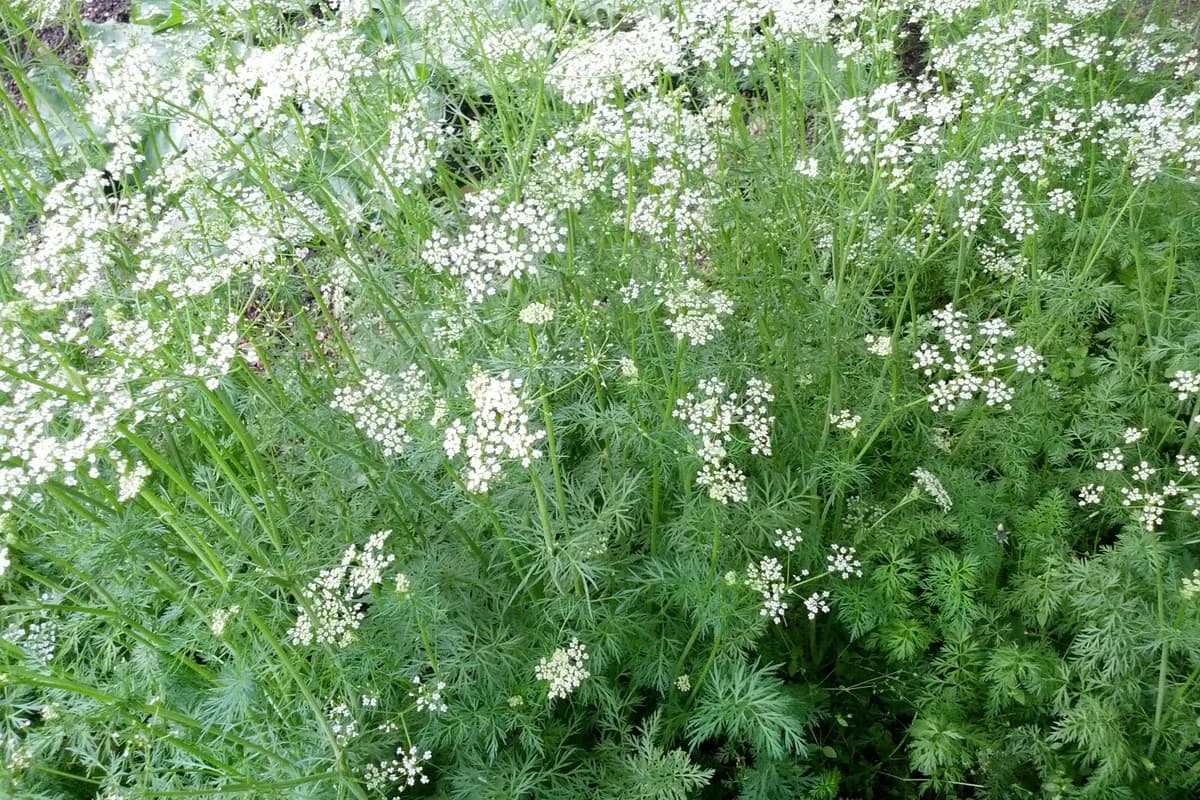
About This Plant
Cumin is a frost-sensitive annual seed spice grown for aromatic dried fruits used in global cuisines. It performs best in full sun, dry air, well-drained loam or sandy loam, and a long frost-free season that finishes dry enough for clean seed harvest.
How to Grow Cumin
Learn how to grow Cumin from seed to harvest in 115 days. Intermediate difficulty. Complete nutrient guide, pH/EC requirements, and growing conditions for soil & container.
Sources cited: 26.
Nutrient Requirements by Growth Stage
Cumin nutrition should be soil-test based. Government and crop guides commonly recommend FYM or compost before sowing with field N and P programs around 30 kg N/ha and 15-20 kg P/ha, while newer regional packages sometimes include K and split N at 30 and 60 days after sowing…
Sign in to view nutrient requirements
A free account unlocks NPK targets for all four growth stages, micronutrient levels, a per-stage nutrient calculator, and the full nutrition guide. Signing up takes one click. Truleaf is a free, non-profit project, and every new account helps it grow. No spam, ever.
Growing Environments
Outdoor soil beds are the best-supported environment for cumin seed production, especially in dry-season or arid systems. Greenhouses and indoor starts are useful for frost avoidance or controlled seedling establishment, but seed production still needs full light, pollination, airflow, and a dry finish…
Temperature
Grow cumin as a frost-sensitive annual seed spice for a dry, moderately warm season. Practical sowing guidance supports warm germination around 20-30C, while field and crop references place active growth near 20-30C with a 25C center point. Avoid frost, persistent cold, and late terminal heat: ICAR arid-zone guidance notes that high temperature and dry winds can shorten the crop, while wet cloudy flowering weather raises disease risk.
Humidity
Cumin prefers dry air and a canopy that does not stay wet. A 40-60 percent indoor working band is a practical disease-control range, but exact relative-humidity optima were not found in cumin trials…
Light
Treat cumin as a full-sun seed crop. NC State and PROSEA list full sun or full sunlight as the preferred condition, while controlled studies using 16 h light were salinity or transformation experiments rather than production lighting trials…
Airflow
No cumin source gives a numeric airflow speed, but ventilation is strongly supported as a disease-management control. Keep foliage and umbels dry, maintain spacing, and prevent stagnant humid air because powdery mildew and Alternaria blight are associated with humid, cloudy, wet flowering conditions…
Sign in to view environmental requirements
A free account unlocks exact temperature, humidity, light and airflow targets, including germination and growth ranges, DLI, photoperiod and PPFD, plus the full environment guide. Signing up takes one click. Truleaf is a free, non-profit project, and every new account helps it grow. No spam, ever.
Hydroponic System Compatibility
Use soil beds, raised beds, deep drained containers, or drip-irrigated substrate/soil for cumin. Drip and fertigation are supported in field research and extension, especially for arid production, but this is not evidence for recirculating DWC, NFT, Kratky, ebb-flow, or aeroponic seed crops…
Growing Media
Choose well-drained loam, sandy loam, or loamy sand with organic matter. Crop references support near-neutral to slightly alkaline soil, with pH ranges around 6.5-8.5 and PROSEA listing 6.8-8.3 as optimal…
Container Specs
Cumin can grow in containers and small spaces, but published cumin pot-size trials were not found. Use at least a 20 cm deep and 20 cm wide drained container for one plant as a conservative inferred minimum from extension spacing and the plant's small stature…
Training & Support
Cumin does not require trellis, stakes, pruning, LST, or SCROG. Sources describe a low annual seed-spice crop managed by sowing time, spacing, thinning, weeding, irrigation, and harvest timing rather than structural training…
Sign in to view system compatibility
A free account unlocks why each of the six systems fits or fails, plus growing media, container sizes, training methods, companion plants, and the full systems guide. Signing up takes one click. Truleaf is a free, non-profit project, and every new account helps it grow. No spam, ever.
Propagation
Propagate cumin by seed. Extension and government guidance support shallow sowing, seed soaking as an optional germination aid, and 7-14 day germination under suitable conditions…
Harvesting
Harvest cumin as a terminal dry-seed crop. NC State advises cutting dry brown flower clusters and drying them in a bag before threshing, while Indian crop guides harvest when plants yellow or reach physiological maturity, then dry, thresh, clean, and store the seed…
Planting Calendar
For temperate home production, start cumin indoors 6-8 weeks before the last frost in biodegradable pots or direct sow 1-2 weeks after frost danger has passed, then harvest about 115-120 days later when seed clusters dry and brown. In semi-arid Indian systems, the calendar shifts: government and field-trial sources…
Common Issues
The current issue list is broadly right but needed taxonomy and framing cleanup. Cumin IPM sources identify Fusarium wilt caused by Fusarium oxysporum f…
Get the full science-backed guide
By signing up, you help keep Truleaf free and support the growth of our nonprofit project. Your account unlocks full details for every plant issue—including symptoms, causes, step-by-step solutions, and prevention—plus the month-by-month planting calendar, the complete guide, and all research sources. It only takes one click. No spam, ever.