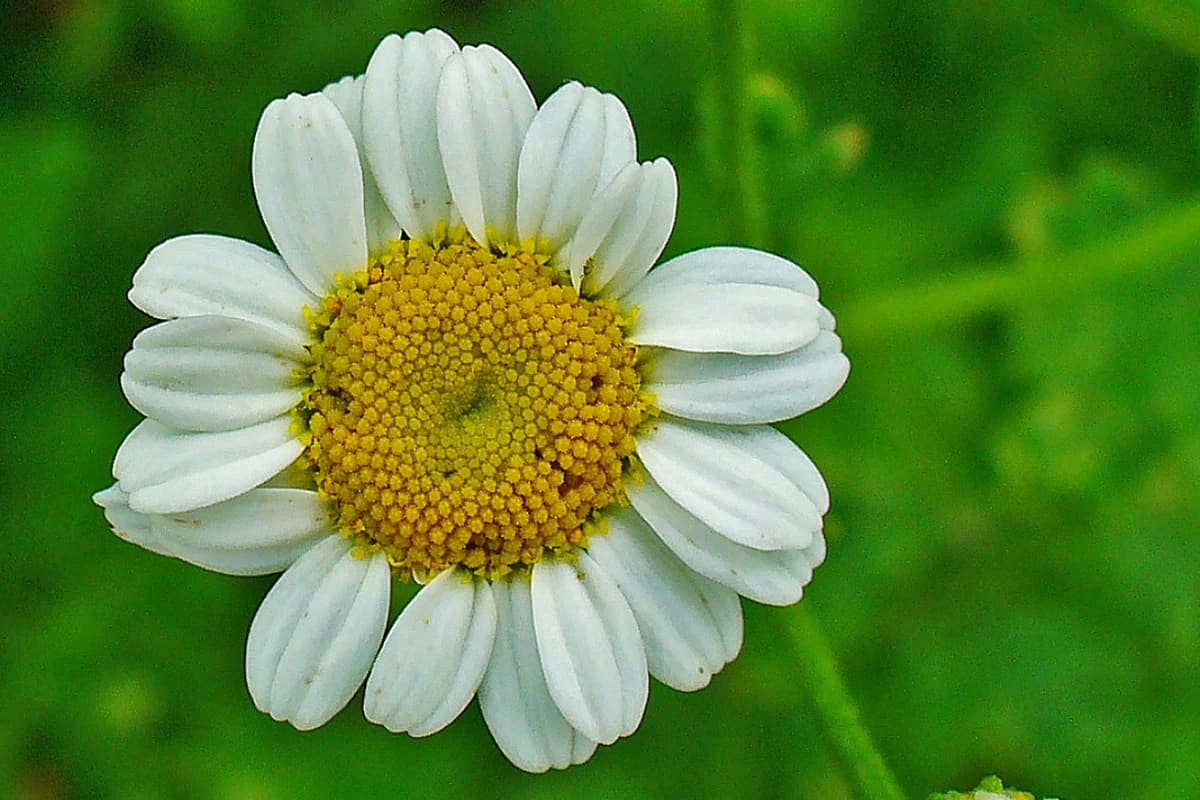
About This Plant
Feverfew (Tanacetum parthenium) is a short-lived aromatic perennial in the Asteraceae family, grown for daisy-like cut flowers, self-seeding cottage gardens, and dried aerial parts rich in parthenolide. It prefers bright, well-drained, moderate-fertility conditions and benefits from airflow, careful watering, and deadheading when self-seeding is not desired.
How to Grow Feverfew
Learn how to grow Feverfew from seed to harvest in 84 days. Beginner difficulty. Complete nutrient guide, pH/EC requirements, and growing conditions for soil & container.
Sources cited: 13.
Nutrient Requirements by Growth Stage
Direct feverfew hydroponic NPK ppm trials remain scarce, so the payload uses medium-confidence values from field fertilizer, nutrient-medium, and cut-flower guides. PanAmerican and Evanthia start plugs at 50-100 ppm N and finish around 100-175 ppm N, with fertilizer EC commonly 0.8-1.2 mS/cm but lower EC preferred…
Sign in to view nutrient requirements
A free account unlocks NPK targets for all four growth stages, micronutrient levels, a per-stage nutrient calculator, and the full nutrition guide. Signing up takes one click. Truleaf is a free, non-profit project, and every new account helps it grow. No spam, ever.
Growing Environments
Feverfew is suitable outdoors, in containers, and in greenhouses. NC State lists it for containers, patios, naturalized areas, cottage gardens, and cutting gardens in full sun to partial shade with good drainage…
Temperature
Feverfew is best grown under cool to mild conditions. Manitoba and LSU guidance support light-exposed seed germination at about 18-21 C, while controlled studies used 25/17 C day/night or 25 C in vitro and greenhouse acclimatization at moderate warmth. For production, use 15-25 C with 21 C as a practical target; protect fall plantings from hard freezes and avoid hot humid sites where foliage and flower quality decline.
Humidity
No single feverfew relative-humidity optimum is validated across systems. The Mg/Mn growth-chamber study used 40-45% RH, while micropropagated plantlets were acclimatized under greenhouse conditions around 60-70% RH before transfer…
Light
Feverfew seed should remain exposed to light or only lightly pressed into media, according to Manitoba and LSU production guidance. Outdoors, NC State supports full sun to partial shade, and cut-flower guidance favors full sun…
Airflow
Airflow is a production control, not an optional nicety. The Matricaria crop manual explicitly states that good air circulation is important, that plants should dry quickly after irrigation to avoid Botrytis, and that Pythium/Fusarium risks increase in year-round production without sanitation…
Sign in to view environmental requirements
A free account unlocks exact temperature, humidity, light and airflow targets, including germination and growth ranges, DLI, photoperiod and PPFD, plus the full environment guide. Signing up takes one click. Truleaf is a free, non-profit project, and every new account helps it grow. No spam, ever.
Hydroponic System Compatibility
The evidence supports field soil, substrate containers, greenhouse benches, drip irrigation, and ebb-flow style container production more strongly than bare-root hydroponics. Feverfew was grown in soil, 4 L pots, plug trays, peat-perlite acclimatization pots, and nutrient medium under controlled research conditions…
Growing Media
Use a light, fertile, well-drained medium. Manitoba recommends well-drained soil at pH 6.0-6.7 with 6.3 optimum, NC State allows sandy, loamy, or high-organic soil with good drainage, and LSU uses well-drained moist soil for cut flowers…
Container Specs
Feverfew containers need drainage and enough volume for a 30-90 cm branching plant. Clemson greenhouse work moved seedlings from 60 mL cells into 4 L pots six weeks after germination, while micropropagation acclimatization used 200 mL pots only as a temporary stage…
Training & Support
Feverfew usually does not need trellising or heavy training. LSU reports Sunny Ball plants are upright and branched and do not require trellising, while NC State recommends deadheading or shearing spent blooms to control aggressive self-seeding…
Sign in to view system compatibility
A free account unlocks why each of the six systems fits or fails, plus growing media, container sizes, training methods, companion plants, and the full systems guide. Signing up takes one click. Truleaf is a free, non-profit project, and every new account helps it grow. No spam, ever.
Propagation
Feverfew is propagated mainly from seed, division, and basal cuttings. Manitoba and LSU both stress that seed needs light; sow 5-7 weeks before transplant for cut flowers or about two weeks before last frost for field starts…
Harvesting
Harvest timing differs by product. For medicinal aerial parts, Manitoba recommends swathing leaves and flowers at full bloom and leaving about 10 cm stubble for regrowth; Clemson work found afternoon harvest can increase parthenolide and that reduced-water regimes raised parthenolide while reducing field dry weight…
Planting Calendar
For temperate production, start light-exposed seed indoors in late winter or early spring, harden seedlings 3-7 days before transplant, and set plants out after frost risk. LSU recommends fall planting for Louisiana cut flowers, with winter protection below about 15 F, while Manitoba medicinal field production often…
Common Issues
The most supported feverfew risks are aphids, thrips, leaf miners, slugs/snails in cut-flower plots, crown/root rots, Botrytis under wet canopies, aggressive self-seeding, and contact dermatitis. Manitoba observed thrips and aphids in greenhouse trials but no major local field pest or disease problems, while LSU…
Get the full science-backed guide
By signing up, you help keep Truleaf free and support the growth of our nonprofit project. Your account unlocks full details for every plant issue—including symptoms, causes, step-by-step solutions, and prevention—plus the month-by-month planting calendar, the complete guide, and all research sources. It only takes one click. No spam, ever.