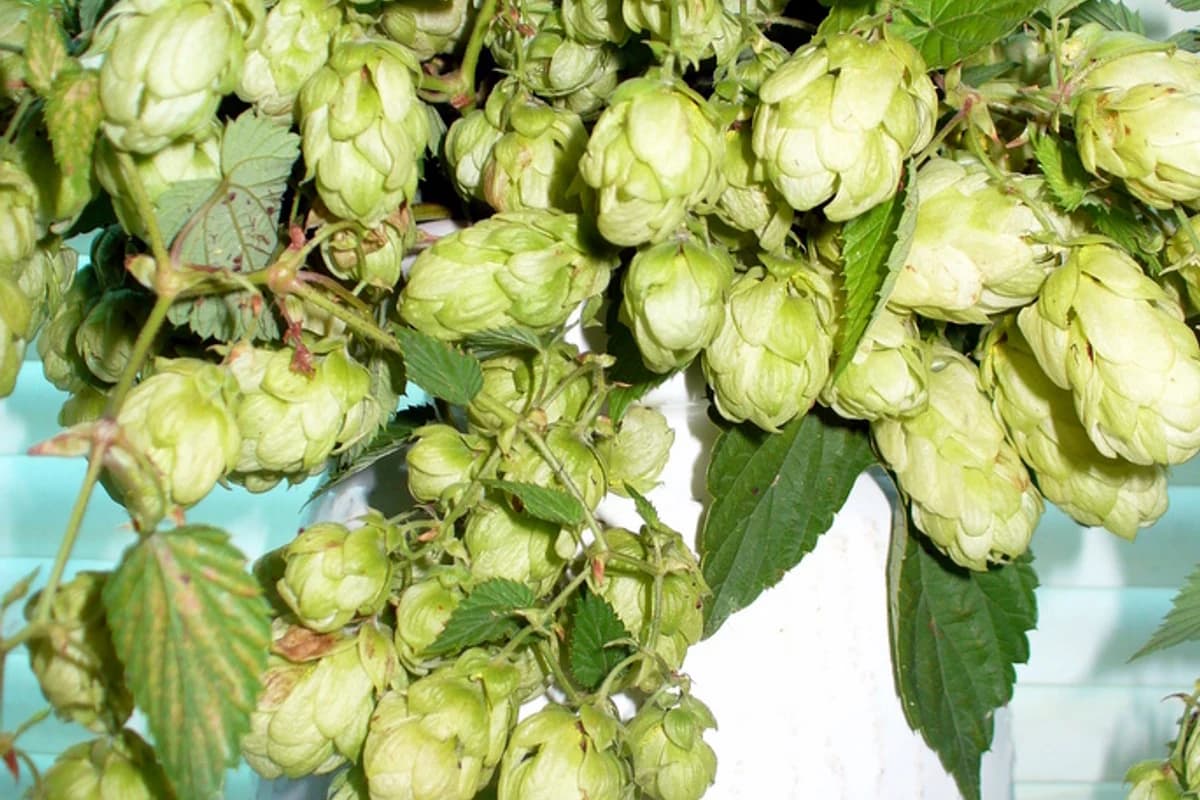
About This Plant
Hops (Humulus lupulus) is a hardy perennial bine grown for resinous female cones used in brewing. It needs long vegetative days, a strong trellis, deep well-drained media, steady moisture, and careful disease management because cone yield and quality are tightly linked to canopy health.
How to Grow Hops
Learn how to grow Hops from seed to harvest in 150 days. Advanced difficulty. Complete nutrient guide, pH/EC requirements, and growing conditions for soil & container.
Sources cited: 13.
Nutrient Requirements by Growth Stage
Hop fertility is front-loaded toward vegetative growth. NPK-R found the existing hydroponic NPK targets match a Cascade greenhouse hydroponic study using modified Hoagland A through 107 days, then Hoagland B for the reproductive period…
Sign in to view nutrient requirements
A free account unlocks NPK targets for all four growth stages, micronutrient levels, a per-stage nutrient calculator, and the full nutrition guide. Signing up takes one click. Truleaf is a free, non-profit project, and every new account helps it grow. No spam, ever.
Growing Environments
Outdoor soil and greenhouse production are the strongest fits for hops. OSU describes hop as adaptable across many climates but requiring considerable sun, well-drained soil, consistent moisture, and climbing support…
Temperature
Grow hops in cool to moderate conditions rather than hot greenhouse conditions. Protected production studies and extension guidance support roughly 13-24C for active growth, with 24C day and about 18C night as a practical controlled-environment setpoint. The original 15-20C range was directionally cool enough but too narrow for protected production. Avoid prolonged heat during cone development because temperature stress can reduce carbon balance, cone quality, and disease resilience.
Humidity
Use moderate relative humidity and dry foliage as the main management target. A 50-60% RH target is practical indoors, with 65% as a short-term upper edge only when air movement is strong…
Light
Hops are photoperiod-sensitive: long days support vegetative bine growth, while flowering begins after day length falls below roughly 15-16 hours. Use 16-17 hours of light for vegetative growth or indoor flower-delay management, then allow shorter days once the plant has enough height and nodes for cone production…
Airflow
Provide steady canopy air exchange and keep leaves dry. Extension guidance repeatedly links hop disease control with training, lower-leaf removal, dry foliage, and avoiding overhead irrigation…
Sign in to view environmental requirements
A free account unlocks exact temperature, humidity, light and airflow targets, including germination and growth ranges, DLI, photoperiod and PPFD, plus the full environment guide. Signing up takes one click. Truleaf is a free, non-profit project, and every new account helps it grow. No spam, ever.
Hydroponic System Compatibility
Drip-fed soil or substrate culture is the best-supported controlled system because it maintains aeration, supports heavy crowns, and keeps foliage dry. Hydroponic greenhouse hop production is documented, but checked sources support substrate-based systems more strongly than bare-root DWC or NFT…
Growing Media
Use deep, fertile, well-drained media. OSU recommends a well-drained sandy or silt loam and warns that hops dislike wet feet; sandy soils may need organic matter for moisture retention, while clay soils need improved aeration…
Container Specs
Container hops need far more root volume and support than annual herbs. Use at least 45 cm depth and width, with excellent drainage, but a larger 75 L or bigger container is preferable for multi-season production…
Training & Support
Training support is required. OSU notes commercial hops are produced on 18-20 ft trellises and 14-15 ft supports are sufficient for many home gardens when maximum yield is not required…
Sign in to view system compatibility
A free account unlocks why each of the six systems fits or fails, plus growing media, container sizes, training methods, companion plants, and the full systems guide. Signing up takes one click. Truleaf is a free, non-profit project, and every new account helps it grow. No spam, ever.
Propagation
Propagate brewing hops vegetatively from clean rhizomes or stem cuttings. USDA ARS notes that H…
Harvesting
Harvest by cone maturity, not a fixed day count. UF/IFAS describes harvest as generally August to September, with mature cones deep green, visibly yellow with lupulin, strongly aromatic, dry and papery, and releasing yellow lupulin when rubbed…
Planting Calendar
For temperate Northern Hemisphere growing, prepare the site and support in early spring, plant rhizomes or transplant rooted plants after hard frost risk, and train bines as they reach about 90 cm. Vegetative growth builds through spring and early summer; flowering usually occurs after day length drops below 15-16…
Common Issues
The previous issue list was directionally useful but over-prescribed humidity and fungicide fixes. Downy mildew, powdery mildew, spider mites, potassium deficiency, boron deficiency, and zinc deficiency are the best-supported issues from the reviewed sources…
Get the full science-backed guide
By signing up, you help keep Truleaf free and support the growth of our nonprofit project. Your account unlocks full details for every plant issue—including symptoms, causes, step-by-step solutions, and prevention—plus the month-by-month planting calendar, the complete guide, and all research sources. It only takes one click. No spam, ever.