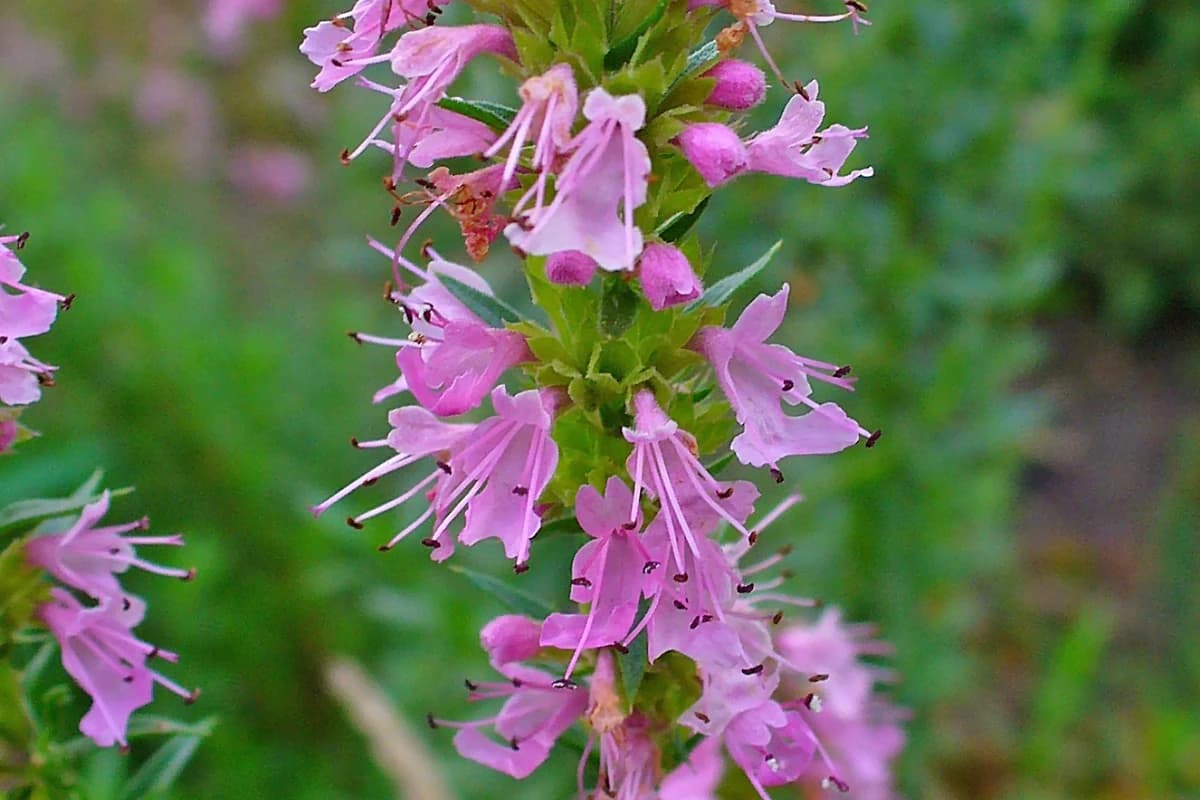
About This Plant
Hyssop is a woody Mediterranean perennial herb in the mint family grown for aromatic leaves and flowering tops used in teas, culinary seasoning, pollinator plantings, and medicinal-herb gardens. It performs best in bright light, lean well-drained media, moderate fertility, and low-to-moderate humidity.
How to Grow Hyssop
Learn how to grow Hyssop from seed to harvest in 90 days. Beginner difficulty. Complete nutrient guide, pH/EC requirements, and growing conditions for hydroponics, soil & greenhouse.
Sources cited: 15.
Nutrient Requirements by Growth Stage
The strongest hydroponic evidence is a Hyssopus officinalis nutrient solution containing about 98 ppm N, 31 ppm P, 106 ppm K, 98 ppm Ca, 24 ppm Mg, and 32 ppm S at pH 5.8 and EC 2.2 dS/m after the four-leaf stage. Seedlings were started at half strength…
Sign in to view nutrient requirements
A free account unlocks NPK targets for all four growth stages, micronutrient levels, a per-stage nutrient calculator, and the full nutrition guide. Signing up takes one click. Truleaf is a free, non-profit project, and every new account helps it grow. No spam, ever.
Growing Environments
Hyssop is suitable outdoors, in greenhouses, indoors, and in containers when light and drainage are managed. NC State lists container, patio, rock garden, herb garden, edging, and low hedge uses, with full sun to part shade and good to very dry drainage…
Temperature
Hyssop seed germination is best supported at warm temperatures: a temperature-gradient study found the highest germination percentage from 20-30C and fastest rate near 30C. For production after transplant, a hydroponic greenhouse study successfully held day/night temperatures near 22/18C, so 18-22C is a defensible controlled-environment target rather than a proven botanical optimum.
Humidity
The 70% RH used in a short hydroponic greenhouse trial shows hyssop can grow under moderately humid controlled conditions when roots are aerated and foliage is managed. Mature garden plants are drought-tolerant Mediterranean herbs that prefer dry-to-medium moisture and well-drained sites…
Light
Hyssop is a full-sun to part-shade herb outdoors. In the hydroponic trial, plants grew under a 16 hour photoperiod at 440 umol m-2 s-1, which calculates to about 25 mol m-2 d-1…
Airflow
Airflow is important because hyssop should not sit in humid, crowded foliage. The hydroponic study continuously aerated the nutrient solution, and extension/IPM guidance for herbs and ornamentals emphasizes spacing, pruning, sanitation, and air circulation to reduce mildew pressure…
Sign in to view environmental requirements
A free account unlocks exact temperature, humidity, light and airflow targets, including germination and growth ranges, DLI, photoperiod and PPFD, plus the full environment guide. Signing up takes one click. Truleaf is a free, non-profit project, and every new account helps it grow. No spam, ever.
Hydroponic System Compatibility
Hydroponics is possible because a peer-reviewed study grew hyssop in aerated nutrient solution at pH 5.8 and EC 2.2 dS/m. For routine production, drained substrate systems such as drip or ebb-flow are safer than stagnant water culture because hyssop is adapted to dry, well-drained conditions…
Growing Media
Outdoors, use neutral to alkaline, well-drained loam, sand, shallow rocky soil, or similarly lean media. In containers and greenhouse systems, use airy mixes such as coco or peat amended with perlite, or rockwool starts moved into a drained substrate…
Container Specs
Hyssop works well in containers if drainage is unrestricted. Use at least a 25 cm deep and 30 cm wide pot for one plant, with 7-10 L or more for multi-season vigor…
Training & Support
Hyssop is a short woody subshrub and does not need routine staking. Training is mostly pruning: Missouri Botanical Garden recommends pruning foliage back in early to mid-spring to keep plants compact, and NC State notes plants can be trimmed after flowering and used as edging or low hedges…
Sign in to view system compatibility
A free account unlocks why each of the six systems fits or fails, plus growing media, container sizes, training methods, companion plants, and the full systems guide. Signing up takes one click. Truleaf is a free, non-profit project, and every new account helps it grow. No spam, ever.
Propagation
Propagate hyssop by seed, cuttings, or division. Seed research supports warm germination at 20-30C with high germination percentages, and micropropagation literature notes germination beginning around 10-12 days under suitable conditions…
Harvesting
Harvest leafy flowering tops at beginning to full flowering, not by date alone. Hyssop quality changes with phenological stage, and FAO-indexed composition research reports different oil profiles across vegetative, budding, blooming, and ripening stages…
Planting Calendar
For temperate Northern Hemisphere gardens, start seed indoors in February-March, transplant or direct sow in April-May after frost risk, prune established plants in March-April, and harvest flowering tops from June through September. In production, treat 12-14 weeks to first flowering-top harvest as a planning window…
Common Issues
Hyssop is generally low-problem. NC State notes no serious pest or disease problems, with nematodes possible…
Get the full science-backed guide
By signing up, you help keep Truleaf free and support the growth of our nonprofit project. Your account unlocks full details for every plant issue—including symptoms, causes, step-by-step solutions, and prevention—plus the month-by-month planting calendar, the complete guide, and all research sources. It only takes one click. No spam, ever.