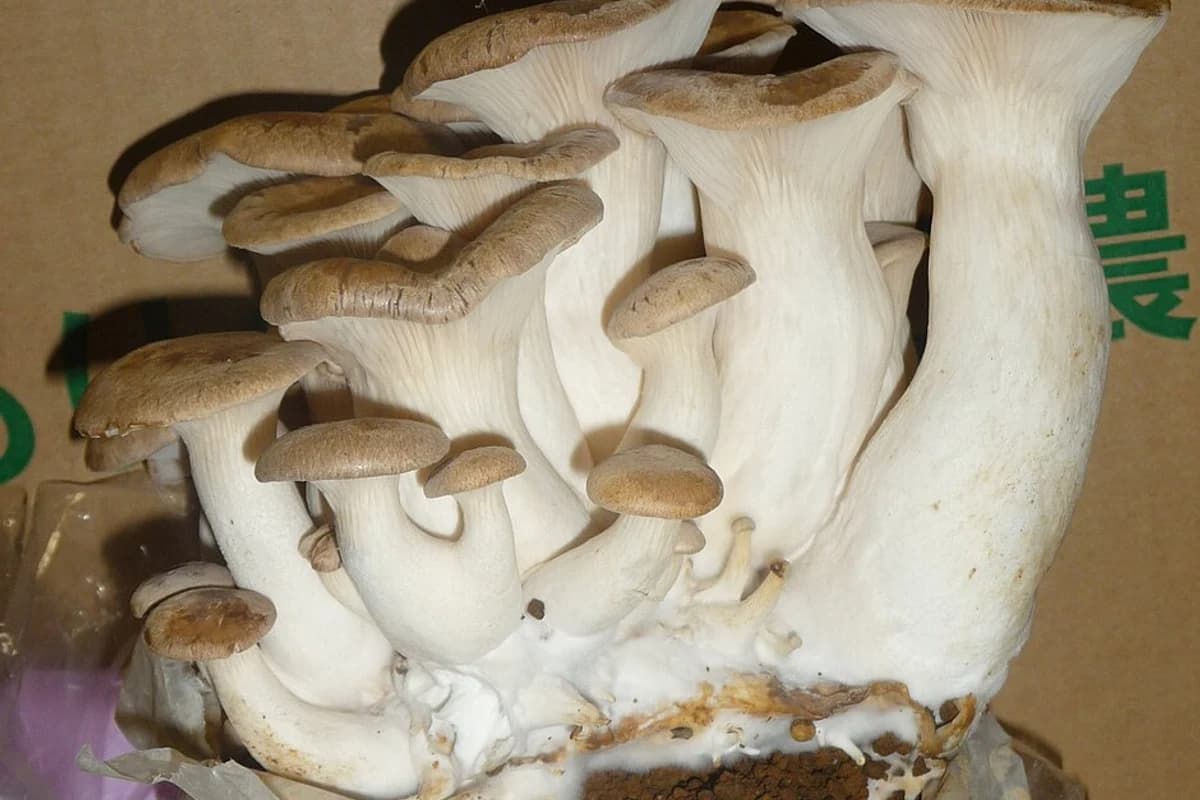
About This Plant
King Oyster (Pleurotus eryngii) is a wood-decay (white-rot) saprotrophic mushroom, not a vascular plant, prized for its thick, meaty white stem and firm texture. It is grown by solid-state fermentation on a sterilized, supplemented hardwood-sawdust substrate (blended with wheat bran and soybean meal for nitrogen) packed in bags or bottles, never in a hydroponic nutrient solution. Cultivation runs in two contrasting phases: a warm (24-25 C), dark spawn run while the mycelium colonizes the block, then a cool (10-18 C), humid, well-ventilated fruiting phase triggered by dropping temperature and lowering CO2. Fresh-air exchange is the master control of shape - low airflow gives long stems and small caps, ample airflow gives short stems and large caps. Yield is measured as biological efficiency (~74-87%), about 250-300 g per bag across three to four flushes.
How to Grow King Oyster
Learn how to grow King Oyster from seed to harvest in 40 days. Advanced difficulty. Complete nutrient guide, pH/EC requirements, and growing conditions for soil & container.
Sources cited: 23.
Nutrient Requirements by Growth Stage
King oyster is a cultivated fungus, so it is not fed a mineral N-P-K solution the way a hydroponic vegetable is - both the academic and extension nutrition lanes independently returned NPK NOT_APPLICABLE. No university extension, USDA or FAO source publishes a per-stage N-P-K schedule for mushrooms - none exists…
Sign in to view nutrient requirements
A free account unlocks NPK targets for all four growth stages, micronutrient levels, a per-stage nutrient calculator, and the full nutrition guide. Signing up takes one click. Truleaf is a free, non-profit project, and every new account helps it grow. No spam, ever.
Growing Environments
King oyster is an indoor, climate-controlled crop. It is grown in bags or bottles under managed temperature, humidity, CO2/fresh-air exchange and light, and container/bag culture is the standard high-yield format…
Temperature
King oyster is grown in two distinct thermal phases, and getting the split right is the single most important environmental control. The SPAWN RUN (mycelial colonization) is the warm phase: hold the supplemented-sawdust bags in the dark at 24-25 C until the block turns fully white, typically 20-35 days depending on formulation and bag size. Colonization tolerates 20-30 C - fastest near 30 C on agar - but commercial blocks are run at 24-25 C to limit contamination and heat build-up. FRUITING is the cool phase and is triggered by dropping the temperature after full colonization: induce primordia at 11-15 C and develop fruiting bodies at 15-18 C. Do not exceed 18 C during fruiting - warmer air makes the caps soft and the stems hollow, wrecking the dense texture king oyster is prized for. Growers who want extra-thick stems run the elongation stage as low as 10-13 C. The ~10 C swing between the warm spawn run and the cool fruiting room is the deliberate cue that starts pinning.
Humidity
King oyster runs dry, then wet. During colonization keep humidity low (~60% RH) to discourage bacterial blotch and mold while the mycelium runs through the block…
Light
Colonize in the dark; king oyster only needs light once you want it to fruit. During fruiting give 12 hours of light a day at roughly 800-2000 lux - indirect room light is plenty…
Airflow
Fresh-air exchange (FAE) is the master control of king oyster shape - for this species it matters as much as temperature. Sealed colonizing bags accumulate CO2, which the mycelium tolerates well, so colonization needs little airflow…
Sign in to view environmental requirements
A free account unlocks exact temperature, humidity, light and airflow targets, including germination and growth ranges, DLI, photoperiod and PPFD, plus the full environment guide. Signing up takes one click. Truleaf is a free, non-profit project, and every new account helps it grow. No spam, ever.
Hydroponic System Compatibility
King oyster is not grown hydroponically at all, and the pre-enrichment record was already correct in demoting every hydroponic system to unsuitable - it did not inherit the leafy-green blanket-true template. It is a wood-decay fungus produced by solid-state fermentation: a sterilized block of supplemented hardwood…
Growing Media
Grow king oyster on a supplemented sawdust block, not in a hydroponic medium like rockwool or clay pebbles. A proven mix is hardwood sawdust (or sugarcane bagasse / corncob) as the bulk carbon source, plus wheat bran and soybean meal for nitrogen, finished with about 1% lime and 1% gypsum, all hydrated to ~65%…
Container Specs
King oyster is grown in autoclavable polypropylene/polythene filter-patch bags or wide-mouth bottles rather than pots. Bags typically hold ~1-1.5 kg of wet substrate for home and small-farm scale (up to 3-6 kg in commercial rooms), filled to about two-thirds capacity with a cotton-plugged neck or filter patch and…
Training & Support
Not applicable. As a mushroom, king oyster has no vegetative canopy to train, prune, stake or trellis - it is a fungal fruiting body that emerges from a colonized substrate block…
Sign in to view system compatibility
A free account unlocks why each of the six systems fits or fails, plus growing media, container sizes, training methods, companion plants, and the full systems guide. Signing up takes one click. Truleaf is a free, non-profit project, and every new account helps it grow. No spam, ever.
Propagation
King oyster is not grown from seed - it is propagated as a fungus through a three-stage spawn chain, which is why cultivation is rated hard and the propagation method maps to 'spore' (no grain-spawn enum slug exists). First, a pure mother culture is maintained on malt-extract or potato-dextrose agar at 20-25 C…
Harvesting
King oyster is a flush crop (regrows = true). Harvest the whole cluster by twisting it off at the substrate surface while the cap is still convex to only just beginning to flatten, and BEFORE the gills release spores - a flattened, upturned cap signals spore drop, tougher flesh and shorter shelf life…
Planting Calendar
King oyster is not tied to an outdoor season - it is produced indoors year-round under climate control, because fruiting requires a cool 10-18 C window that must be supplied artificially in most climates. Each crop cycle runs about 4-6 weeks from inoculation to first flush, so growers schedule continuous or staggered…
Common Issues
The pre-enrichment record held only the CO2/FAE malformation issue (long thin stems, small caps from insufficient fresh air) - this is retained as the first entry, since it is the most common king-oyster fault and is fixed by increasing fresh-air exchange, light, and holding fruiting at 15-18 C. Four in-scope problems…
Get the full science-backed guide
By signing up, you help keep Truleaf free and support the growth of our nonprofit project. Your account unlocks full details for every plant issue—including symptoms, causes, step-by-step solutions, and prevention—plus the month-by-month planting calendar, the complete guide, and all research sources. It only takes one click. No spam, ever.