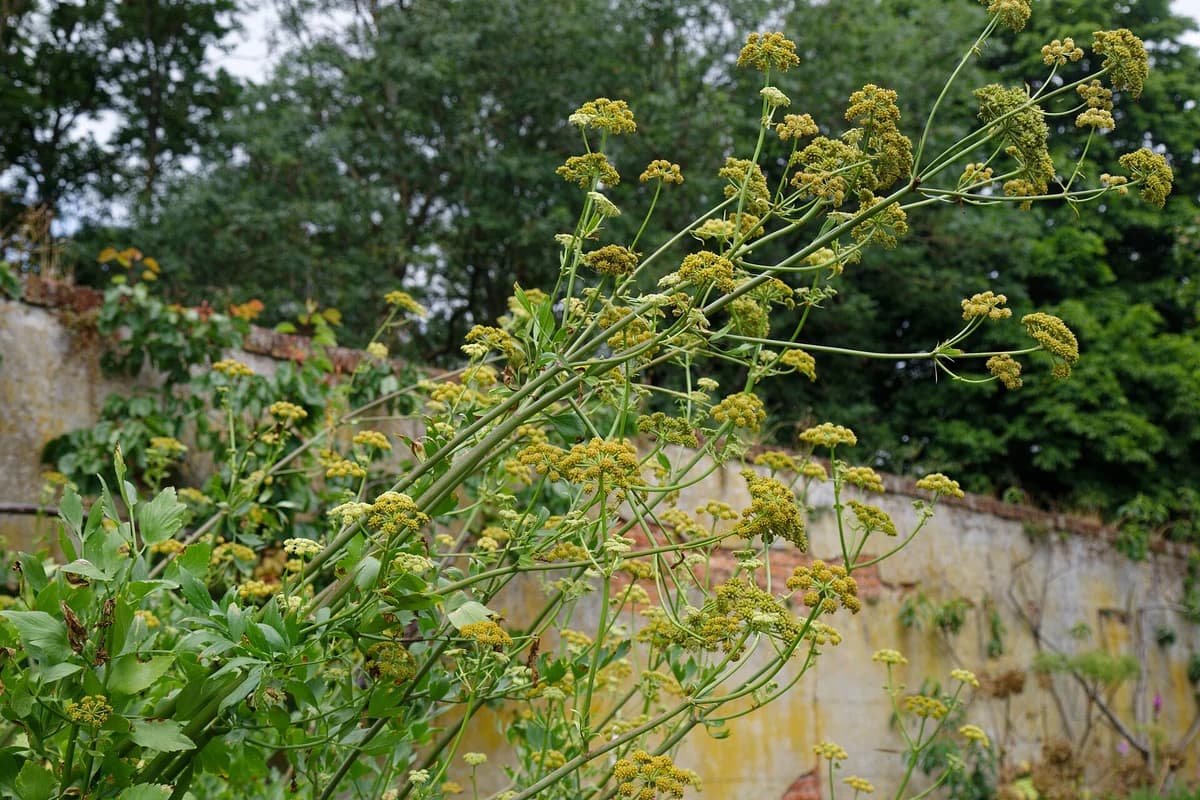
About This Plant
Lovage is a hardy perennial herb grown for celery-like leaves, blanched stems, aromatic seeds, and roots. It performs in field soil, containers, and controlled indoor production, but harvest timing and care differ by organ and plant age. Use even moisture without waterlogging, harvest leaves before flowering for best quality, and base fertility on soil or substrate testing because crop-calibrated hydroponic nutrient targets have not been verified.
How to Grow Lovage
Learn how to grow Lovage from seed to harvest in 60 days. Beginner difficulty. Complete nutrient guide, pH/EC requirements, and growing conditions for hydroponics, soil & greenhouse.
Sources cited: 20.
Nutrient Requirements by Growth Stage
Base field-grown lovage fertility on soil testing and the harvested organ. Ontario reports 45-75 kg N/ha as a regional starting range and warns that higher N can increase root nitrate…
Sign in to view nutrient requirements
A free account unlocks NPK targets for all four growth stages, micronutrient levels, a per-stage nutrient calculator, and the full nutrition guide. Signing up takes one click. Truleaf is a free, non-profit project, and every new account helps it grow. No spam, ever.
Growing Environments
Lovage is verified in outdoor field soil, indoor controlled rooms, greenhouse pots, and containers. Indoor evidence covers 50-day leaf and rutin experiments, while greenhouse and container evidence includes propagation or 60-day vegetative production…
Temperature
Controlled indoor studies successfully grew lovage at 18 C at night and 23 C by day. One study maintained this cycle during 50 days of chamber cultivation, and the other used the same day-night setpoints for indoor leaf production. Treat the cycle as a demonstrated production condition, not a physiological optimum. No retained complete source tests germination temperature or defines lower and upper tolerance limits.
Humidity
One controlled study held relative humidity at 70% with daily watering, while another used 68% at night and 78% by day with five-minute ebb-and-flood irrigation every second day. These are successful chamber settings paired with specific root-moisture regimes, not tested humidity limits or optima…
Light
For controlled leaf production, use a 16-hour light period. A study targeting fresh weight and rutin suggests about 220 micromol m-2 s-1 PPFD with a 1:1.7 blue-to-red ratio and 20% green light, equal to about 12.7 mol m-2 d-1…
Airflow
No retained complete controlled-environment source reports a lovage air-speed target, fan setting, or air-exchange rate. Space plants for access and canopy management, remove old foliage when leaf production stalls, and avoid presenting a numeric airflow prescription until direct evidence is available.
Sign in to view environmental requirements
A free account unlocks exact temperature, humidity, light and airflow targets, including germination and growth ranges, DLI, photoperiod and PPFD, plus the full environment guide. Signing up takes one click. Truleaf is a free, non-profit project, and every new account helps it grow. No spam, ever.
Hydroponic System Compatibility
Ebb-and-flood is directly demonstrated for 50-day indoor lovage in soil-filled trays flooded for five minutes every second day. Adjust frequency to substrate water retention and crop demand…
Growing Media
Use fertile, moist, well-drained soil for established plants. Controlled indoor work directly supports low-nutrient seedling substrate at pH 5.5 in soil-filled ebb-and-flood trays, while field trials document sandy and clay-loam soils without establishing those matrices as universal optima…
Container Specs
The retained evidence describes 30 cm emergence pots, pots and trays used in indoor light studies, one-litre peat pots for a 60-day greenhouse experiment, and vermiculite pots for micropropagated-plantlet hardening. These vessels do not establish a minimum permanent width, depth, volume, or material for mature…
Training & Support
No retained complete source establishes a trellis, cage, stake, or other structural-support requirement for lovage. Pruning is supported as optional seasonal care: remove flower stems when leaves are the priority, cut old foliage when summer production slows, and clear dormant top growth after frost or before spring…
Sign in to view system compatibility
A free account unlocks why each of the six systems fits or fails, plus growing media, container sizes, training methods, companion plants, and the full systems guide. Signing up takes one click. Truleaf is a free, non-profit project, and every new account helps it grow. No spam, ever.
Propagation
Propagate lovage routinely from seed or by dividing established roots. Lightly cover seed with sand, keep the seedbed moist, and remove any moisture-retaining cover when seedlings emerge…
Harvesting
Harvest timing depends on the organ and starting material. Seed-grown plants may support only a light leaf harvest in their second year, while purchased young plants may be lightly cropped in their first summer…
Planting Calendar
In warm-climate Northern Hemisphere gardens, direct-sow from fall through spring; one verified Egyptian field experiment sowed on 1 October. Transplanting is supported, but no separate month window is verified…
Common Issues
Verified problems include celery leaf mining fly and slug or snail feeding on young plants. Remove mined leaves and protect young plants with locally appropriate measures when slug or snail damage occurs…
Get the full science-backed guide
By signing up, you help keep Truleaf free and support the growth of our nonprofit project. Your account unlocks full details for every plant issue—including symptoms, causes, step-by-step solutions, and prevention—plus the month-by-month planting calendar, the complete guide, and all research sources. It only takes one click. No spam, ever.