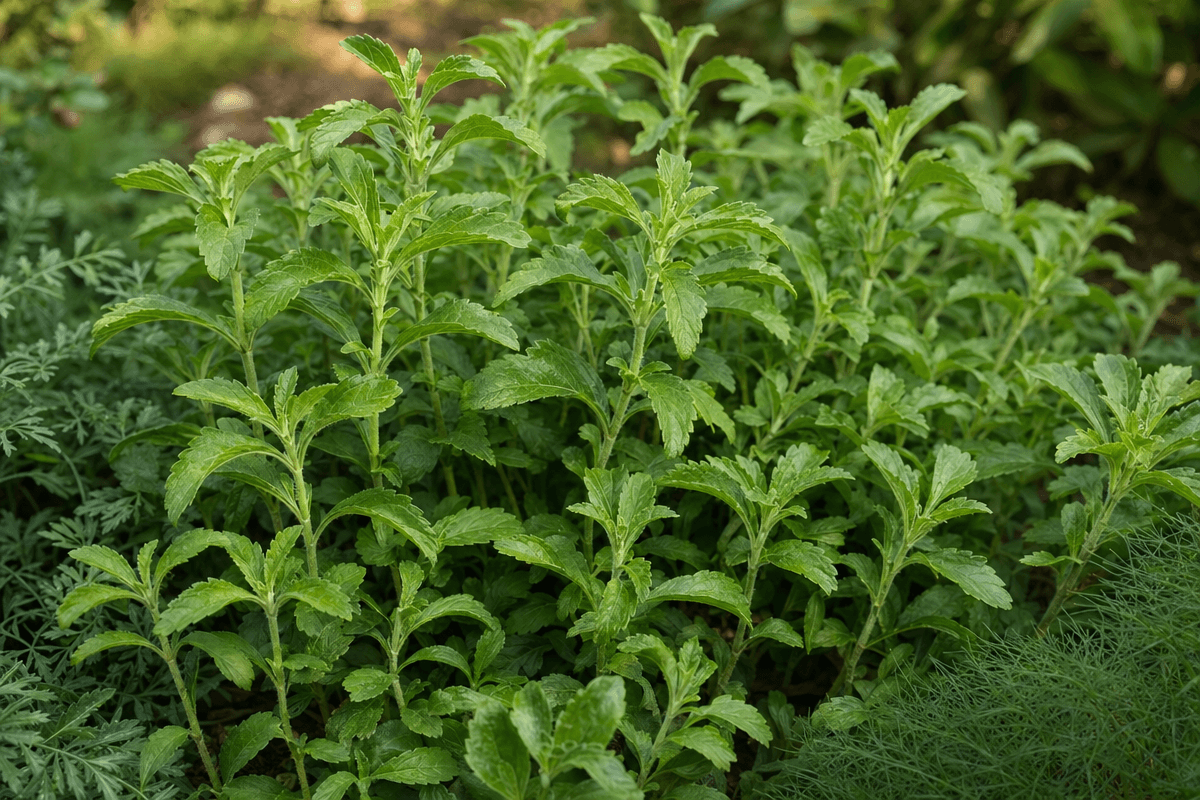
About This Plant
Stevia is a sweet-leaf herb grown for steviol glycosides and benefits from warm bright conditions, controlled nitrogen, and repeated pruning to delay flowering.
How to Grow Stevia
Learn how to grow Stevia from seed to harvest in 111 days. Beginner difficulty. Complete nutrient guide, pH/EC requirements, and growing conditions for hydroponics, soil & greenhouse.
Sources cited: 35.
Nutrient Requirements by Growth Stage
Stevia has a distinctive macronutrient profile: it is a high-potassium, moderate-nitrogen, low-phosphorus leaf crop with a critical N-quality tradeoff. Nutrient uptake measurements from Mediterranean field trials recorded 35.6 kg N, 4.8 kg P, and 59.9 kg K per tonne of dry leaf -- an N:P:K ratio of approximately…
Sign in to view nutrient requirements
A free account unlocks NPK targets for all four growth stages, micronutrient levels, a per-stage nutrient calculator, and the full nutrition guide. Signing up takes one click. Truleaf is a free, non-profit project, and every new account helps it grow. No spam, ever.
Growing Environments
Stevia rebaudiana is adaptable to all four growing environments with distinct advantages in each. Greenhouse production is the most extensively documented in peer-reviewed literature, with multiple controlled studies conducted at 25C day/22C night and 40-60% RH…
Temperature
Stevia performs best in warm, stable conditions. For germination, maintain substrate temperature between 20-28C, with 25C identified as the clear optimum across multiple accession studies. In growth chambers and greenhouse trials, the standard protocol is 25C day / 22C night, with transcript analysis confirming that genes controlling steviol glycoside biosynthesis are maximally expressed at 25C and suppressed below 15C or above 35C. The existing datum of 22C as the single optimal was conservative -- 25C is better supported by peer-reviewed evidence. Growth slows significantly below 18C and plants suffer irreversible frost damage after sustained exposure to 0C or below. The upper growth limit extends to 30C under Mediterranean field conditions. For indoor and hydroponic production, targeting a day temperature of 24-26C with a 3-4C night drop is well-supported by the research record.
Humidity
A relative humidity range of 50-60% is consistent with greenhouse cultivation protocols documented in the literature, where day/night humidity was reported at 40-60%. Germination trials conducted at 50-70% RH confirm the lower bound is appropriate, and researchers note that humidity is the single most influential…
Light
Stevia rebaudiana is classified as an obligate short-day plant with a critical photoperiod of approximately 13 hours for flower induction. However, for leaf biomass and steviol glycoside production in controlled environments, the literature unanimously recommends a 16-hour photoperiod -- long days prevent early…
Airflow
No published academic studies establish stevia-specific airflow velocity requirements. The current range of 0.3-1.0 m/s is consistent with general controlled environment agriculture (CEA) guidelines for herb production, which recommend canopy-zone air movement of approximately 0.5-1.5 m/s to prevent humidity…
Sign in to view environmental requirements
A free account unlocks exact temperature, humidity, light and airflow targets, including germination and growth ranges, DLI, photoperiod and PPFD, plus the full environment guide. Signing up takes one click. Truleaf is a free, non-profit project, and every new account helps it grow. No spam, ever.
Hydroponic System Compatibility
Multiple hydroponic systems have been successfully used for Stevia rebaudiana cultivation. NFT has been directly tested and yields significantly higher biomass than soil-based methods…
Growing Media
Growing media selection significantly impacts stevia hydroponic performance. A dedicated optimization study evaluating rockwool, perlite, clay pebbles, and vermiculite found clay pebbles (hydroton/LECA) to be the top-performing medium for biomass yield and steviol glycoside concentration across nutrient EC levels of…
Container Specs
For container-grown stevia, select a pot at least 30 cm (12 inches) in both diameter and depth; 36 cm (14 inches) is preferred for mature plants. Ensure 3-5 drainage holes at the base and elevate the container slightly to prevent root waterlogging, to which stevia is particularly susceptible…
Training & Support
Stevia requires no staking or trellis support but benefits enormously from regular pinching and pruning. Begin pinching when the plant reaches 15-20 cm (6-8 inches) tall: remove the growing tip to force side branching…
Sign in to view system compatibility
A free account unlocks why each of the six systems fits or fails, plus growing media, container sizes, training methods, companion plants, and the full systems guide. Signing up takes one click. Truleaf is a free, non-profit project, and every new account helps it grow. No spam, ever.
Propagation
Stevia is most reliably propagated by stem cuttings, which root far more dependably than seeds. Take 10-15 cm (4-6 inch) apical shoot-tip cuttings with at least two nodes, retaining two pairs of leaves…
Harvesting
Stevia is a perennial herb that regrows vigorously after each harvest cut, making multi-year production economically attractive. The first harvest is typically taken 3-4 months after transplanting, once the plant approaches the pre-flowering stage -- the point of peak steviol glycoside concentration in the leaves…
Planting Calendar
Start stevia indoors 8-10 weeks before your last frost date -- typically late January to early March in temperate climates. Sow seeds (or root cuttings) under grow lights at 20-25C…
Common Issues
Stevia is relatively resilient but faces several significant threats. The most damaging disease is Septoria Leaf Spot caused by Septoria steviae, which can reduce yields by more than 50% in severe outbreaks…
Get the full science-backed guide
By signing up, you help keep Truleaf free and support the growth of our nonprofit project. Your account unlocks full details for every plant issue—including symptoms, causes, step-by-step solutions, and prevention—plus the month-by-month planting calendar, the complete guide, and all research sources. It only takes one click. No spam, ever.