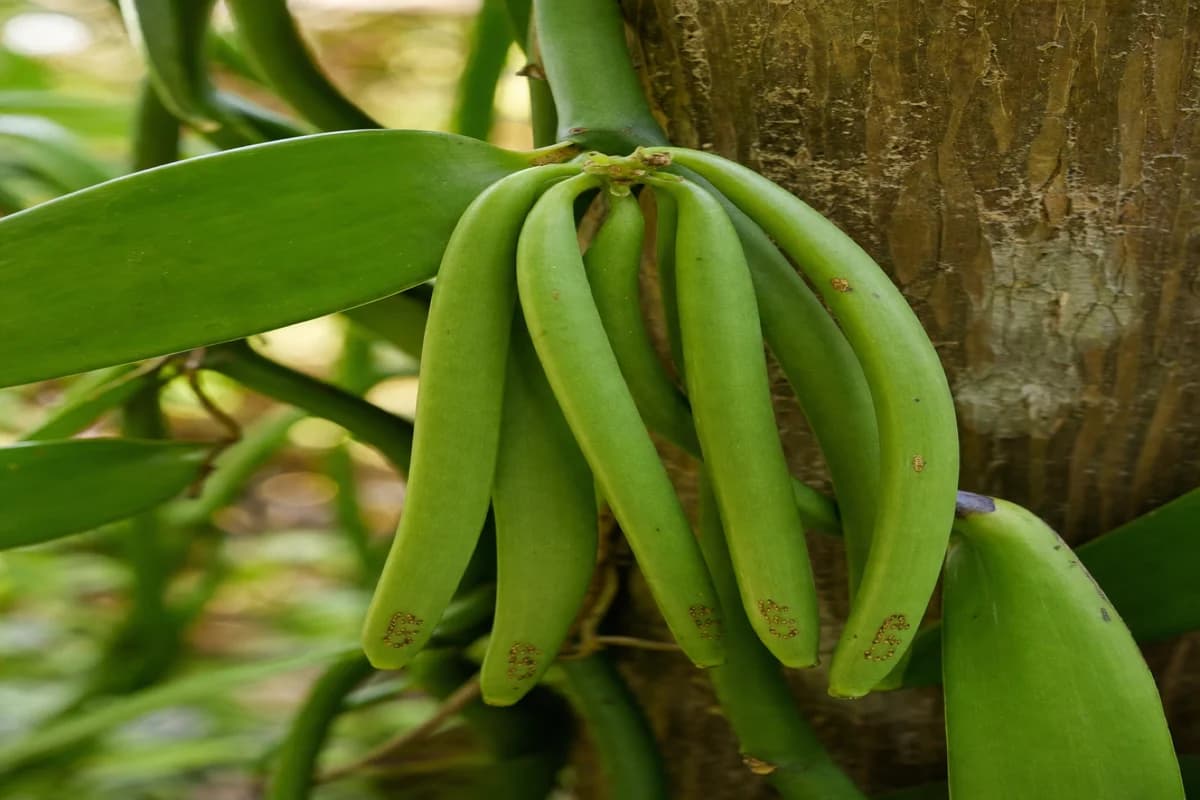
About This Plant
Vanilla planifolia is a tropical hemiepiphytic orchid vine cultivated for its aromatic seed pods, the world's second most expensive spice. Native to Mesoamerica, this perennial climber takes 3-4 years from cutting to first harvest and produces for 10-15 years. It requires warm temperatures (26-29C day, 15-20C night), high humidity (80% RH), and filtered light under 50-70% shade. As an epiphyte, vanilla has remarkably low nutrient requirements with K-dominant nutrition and EC of just 0.3-1.0 mS/cm. Flowering requires a deliberate 45-60 day dry stress period; each flower opens for only one day and must be hand-pollinated. Pods take 8-9 months to mature after pollination, then require a 6-9 month curing process to develop the characteristic vanillin aroma.
How to Grow Vanilla
Learn how to grow Vanilla from seed to harvest in 1095 days. Advanced difficulty. Complete nutrient guide, pH/EC requirements, and growing conditions for soil & container.
Sources cited: 24.
Nutrient Requirements by Growth Stage
Vanilla has remarkably low nutrient requirements reflecting its epiphytic orchid physiology. The NPK profile is strongly stage-dependent…
Sign in to view nutrient requirements
A free account unlocks NPK targets for all four growth stages, micronutrient levels, a per-stage nutrient calculator, and the full nutrition guide. Signing up takes one click. Truleaf is a free, non-profit project, and every new account helps it grow. No spam, ever.
Growing Environments
Vanilla can be cultivated across multiple environments, each requiring specific conditions. Outdoors, it is limited to frost-free USDA Zones 10-11 (tropical and subtropical climates) where it grows on tutor trees or trellis structures…
Temperature
Vanilla planifolia is a tropical vine requiring warm temperatures year-round. Optimal daytime growth occurs at 26-29C with nights ideally cooling to 15-20C. The absolute minimum tolerated is approximately 10C — frost is lethal — and the upper limit is 33C before heat stress. For cuttings and vegetative propagation, a temperature range of 21-30C is suitable. A deliberate temperature drop (combined with drought stress) is required to initiate flowering from year 3 onward. Night temperatures below 20C for 45-60 days help trigger the flowering response. Constant high temperatures without a cool-dry period prevent flower induction.
Humidity
Vanilla thrives in high humidity reflecting its tropical rainforest origins. Optimal relative humidity for vegetative growth is approximately 80% RH, with an acceptable range of 60% to 90%…
Light
Vanilla planifolia is an obligate understory shade plant with CAM (Crassulacean Acid Metabolism) photosynthesis. In its natural habitat it receives only 17-31% of full sunlight…
Airflow
Air circulation is essential for vanilla cultivation. In greenhouse production, efficient ventilation is needed to manage humidity, replenish CO2, and maintain healthy O2/CO2 ratios…
Sign in to view environmental requirements
A free account unlocks exact temperature, humidity, light and airflow targets, including germination and growth ranges, DLI, photoperiod and PPFD, plus the full environment guide. Signing up takes one click. Truleaf is a free, non-profit project, and every new account helps it grow. No spam, ever.
Hydroponic System Compatibility
Recent research by Vahl et al. (2026) represents the first systematic comparison of substrate-free hydroponic systems for Vanilla planifolia…
Growing Media
Vanilla requires substrates that balance moisture retention with exceptional drainage and aeration — mimicking the bark and litter of its host trees. Osorio et al…
Container Specs
For container cultivation, choose a pot at least 35 cm in both diameter and depth with multiple drainage holes — waterlogging is fatal to vanilla roots. Plastic, terracotta, or wooden planter boxes are suitable; avoid metal (heat accumulation)…
Training & Support
Support is non-negotiable for vanilla — as an epiphytic climbing orchid, the vine must always have a structure for aerial root attachment. In field settings, train vines up hardwood tutor trees (Gliricidia, Erythrina) or post-and-wire trellises no taller than 2 m…
Sign in to view system compatibility
A free account unlocks why each of the six systems fits or fails, plus growing media, container sizes, training methods, companion plants, and the full systems guide. Signing up takes one click. Truleaf is a free, non-profit project, and every new account helps it grow. No spam, ever.
Propagation
Propagate vanilla exclusively from stem cuttings — seeds are impractical due to a thick lignified seed coat that prevents reliable germination. Select healthy non-flowering vines and take cuttings 60-150 cm long containing a minimum of 2-3 nodes (8-10 internodes optimal for earlier flowering)…
Harvesting
Vanilla pods are ready for harvest approximately 9 months after hand pollination. The key maturity indicator is yellowing of the distal (blossom) tip while the pod body remains dark green and firm — do not wait for the pod to turn fully yellow or split…
Planting Calendar
Vanilla follows a climate-driven calendar tied to a mandatory dry/stress period. In tropical regions, plant cuttings at the onset of the monsoon (May-June) to exploit natural rainfall for establishment…
Common Issues
Fusarium root and stem rot caused by F. oxysporum f…
Get the full science-backed guide
By signing up, you help keep Truleaf free and support the growth of our nonprofit project. Your account unlocks full details for every plant issue—including symptoms, causes, step-by-step solutions, and prevention—plus the month-by-month planting calendar, the complete guide, and all research sources. It only takes one click. No spam, ever.