White Pepper vs Black Pepper vs Green: All One Plant
Black, white, green, and true-red peppercorns all come from one Piper nigrum berry. Here is how maturity and processing set the color, plus why store pink pepper is a different plant.
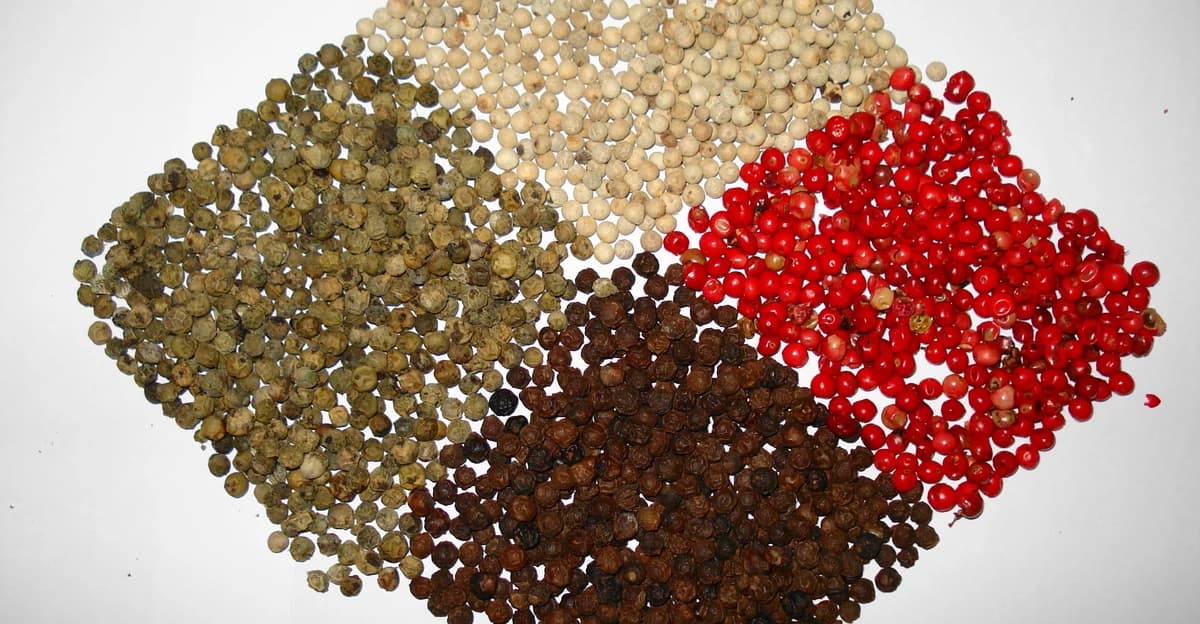
Key point: Black, white, green, and true-red peppercorns are all the fruit of one plant, Piper nigrum. What separates them is when the berry is picked and how it is handled afterward, not the species. The soft pink peppercorns sold in most stores are the exception: those usually come from a different plant entirely.
If you grow Piper nigrum, a single vine can give you more than one product. Pick the berries green and dry them one way and you get black pepper. Fix those same green berries fast and you keep them green. Let the berries ripen, strip the skin, and dry the pale seed and you get white pepper. The color is a record of the choices made at harvest and during processing.
One berry, four peppercorns
Every Piper nigrum spike carries berries that start green and turn red as they ripen. Growers and processors intercept that berry at different points and treat it in different ways. The table below is the whole story in one view.
| Peppercorn | Picked when | Core processing | What sets the color |
|---|---|---|---|
| Black | Immature, green berries | Often blanched briefly in hot water, then dried | The skin browns and wrinkles as it dries, through an enzyme reaction plus pigment breakdown |
| Green | Immature, green berries (same stage as black) | Fixed quickly to stop browning, by blanching, brining, or fast or freeze drying | The green is kept because the browning enzyme is switched off before it can act |
| White | Fully ripe berries | Outer skin removed, traditionally by soaking, then the pale inner seed is dried | The color is the seed itself, with the dark skin taken off before drying |
| Red (true) | Fully ripe red berries | Preserved at ripeness, usually brined or freeze-dried | The berry's own ripe-red color, kept rather than dried down to black |
Two of these come from the same green berry and split apart only because of processing. The other two come from the ripe berry. That is the frame worth holding onto: black and green are the young berry handled two ways, white and red are the ripe berry handled two ways.
Black pepper: the young berry, dried dark
Black pepper is made from immature green berries that are dried until the skin darkens and shrivels. The blackening happens during drying, so it is a processing outcome rather than a trait of a special "black" variety.
The color change runs on more than one track. The main one is an enzyme called polyphenol oxidase. When the berry's tissue is exposed to air, this enzyme reacts the berry's natural phenolic compounds with oxygen, and the products join up into dark pigments. Alongside that enzyme reaction, the green chlorophyll in the skin breaks down into brownish compounds and the berry's vitamin C degrades, and both changes push the skin further toward brown and black, especially under heat. No single one of these accounts for the full color; they work together.
This is also why many processors blanch the berries in hot water before drying. In one study, a short hot-water blanch lowered the enzyme's activity but did not shut it off, and the blanched pepper came out darker and more even in color than pepper dried straight in the sun. A separate line of work on heat-dried pepper points the same way: strong thermal drying deepens color through browning reactions between sugars and proteins. The practical takeaway is that a brief blanch before drying tends to give a darker, more uniform black.
Green peppercorns: the same berry, kept green
Green peppercorns start from the same immature berries as black pepper. The difference is that processors stop the browning before it can happen. Instead of letting the berry dry slowly and darken, they fix it fast, with a short dip in boiling water (about five minutes in one study), a brine, or rapid drying methods such as freeze drying. That heat or speed inactivates the browning enzyme early, so the skin cannot turn dark and the chlorophyll stays put.
How the berry is dried after fixing decides how green it stays. Work comparing drying methods on green pepper found that freeze drying held the color best, while heavier heat drying darkened the berries as browning reactions took over. So a green peppercorn is really a black-pepper berry that was caught early and locked in its green state.
White pepper: the ripe berry, with the skin removed
White pepper is a different starting point. Here the berries are left on the vine to ripen fully, then the dark outer skin is taken off, and only the pale inner seed is dried. The pale color is the seed. There is no blackening step because the skin that would have blackened is removed first.
Traditionally the skin is loosened by retting, which means soaking the ripe berries in water for roughly 7 to 15 days. During that soak, microbes and their enzymes break down the pectin that holds the skin together, and the softened skin can then be rubbed away. It works and it is cheap, but it has a real cost: long soaking makes the water foul-smelling, gives the pepper an off note, and creates polluting wastewater. Both the retting study and a separate white-pepper processing study flag the same odor and pollution problem, and both note that steaming and mechanical peeling are cleaner, faster alternatives that avoid the long soak.
So if you have ever wondered why white pepper sometimes carries a slightly fermented, barnyard note, traditional water retting is often the reason. Modern peeling methods are one way processors reduce it.
What makes traditional white pepper smell, and how peeling changes it
The off note in traditionally made white pepper is not a flaw in the berry. It is a by-product of how the skin is removed. During retting, the ripe berries sit in water while a shifting community of microbes and their enzymes takes the pericarp apart. Enzymes that break down pectin, the glue holding the skin's cells together, loosen the tissue until the pericarp cell walls collapse and the skin can be rubbed off. The same microbial activity that dissolves the skin also sours the water, which is why a long soak leaves the pepper with a fermented, barnyard note and produces foul-smelling, polluting wastewater.
That gives home and small-scale processors a clear lever. The longer the ripe berries steep, the more microbial by-products build up in and around the seed. Anything that removes the skin without a long soak avoids most of that flavor load.
| Skin-removal route | What happens to the skin | Trade-off |
|---|---|---|
| Long water retting (roughly 7 to 15 days) | Microbes and pectin-degrading enzymes break down the pericarp until it slips off | Cheap and low-equipment, but produces the fermented off note and foul, polluting soak water |
| Steaming or mechanical peeling | The skin is loosened or stripped without an extended microbial soak | Cleaner and faster, and it leaves a measurably different aroma profile than retted pepper |
Research comparing peeling methods found that how the skin is taken off measurably changes which aroma compounds survive in the finished white pepper, so the choice of method is a flavor decision, not only a matter of convenience. If you are making white pepper from your own ripe Piper nigrum and want to avoid the classic barnyard note, a shorter, cleaner peeling step is the part of the process to change first.
Red versus pink: an easy trap
There is a true red peppercorn, and it is genuinely Piper nigrum. It is simply the fully ripe red berry preserved at that stage, usually brined or freeze-dried, rather than dried down to black. True red peppercorns are uncommon on store shelves.
Here is the part that trips people up. The soft pink peppercorns sold in most spice aisles are usually not Piper nigrum at all. They are the dried berries of Schinus terebinthifolius, often called Brazilian pepper, which belongs to a completely different botanical family (Anacardiaceae) than true pepper (Piperaceae). The two share a common name and a general look, but they are unrelated plants with different origins.
The reason to be careful with the wording is that some commercial "pink" or "red" blends do mix in ripe Piper nigrum, so it is fair to say most store pink pepper is Schinus, not all of it. If you want a true red peppercorn from your own vine, you get it by letting Piper nigrum berries ripen red and preserving them, not by buying a jar labeled "pink."
How maturity and processing change the flavor
Because all of these come from one berry, flavor differences track back to ripeness and handling rather than to species. Ripening and processing measurably shift a peppercorn's aroma profile: as the berry matures and as it is soaked or steamed, certain aroma compounds rise and others fall, so the same berry can smell noticeably different depending on how it was processed.
White pepper is commonly described as sharper and more pungent but less aromatically complex than black. The usual explanation is that removing the skin concentrates the pungent inner seed while leaving behind some of the aromatic compounds carried in and near the skin. Treat that as the described quality view rather than a precise, measured ranking. The comparison is real in how these peppers are talked about and used, but a clean, replicated head-to-head measurement of pungency across types is not settled in the research, so it is better to describe the difference than to attach numbers to it.
Drying method matters too. Gentle drying tends to preserve more of a green peppercorn's aroma-active compounds, while heavier heat drives off volatile aroma at the same time as it deepens color. In short, both when you pick and how you dry leave a fingerprint on flavor.
Choosing a drying method for the color and aroma you want
Drying is where much of a peppercorn's final quality is decided, and the right method depends on what you are trying to make. The same heat that ruins a green peppercorn is what you want for a black one.
For green peppercorns, the goal is to keep color and aroma intact, so gentle, fast drying wins. A study comparing drying methods on green Piper nigrum berries found that freeze drying preserved color best, while heavier heat drying darkened the berries as browning reactions took over and drove off aroma-active compounds. So for green, a freeze dryer or the gentlest, quickest drying you can manage protects both the color and the smell; strong heat works against you on both.
For black pepper, browning is the point, so heat becomes a tool rather than a problem. A brief hot-water blanch before drying cut the berry's browning enzyme to roughly a quarter of its starting activity, yet the enzyme kept working through the whole process, and the blanched berries came out blacker and more uniform than berries dried straight in the sun. Thermal drying then deepens the color further through browning reactions between sugars and proteins.
| If you are making | Aim for | Avoid | Why |
|---|---|---|---|
| Green peppercorns | Freeze drying or fast, gentle drying to below about 12 percent moisture | Prolonged high heat | Preserves the green color and the aroma volatiles that heat destroys |
| Black pepper | A brief blanch (about 80 °C for two minutes in one study), then thermal drying to roughly 8 to 12 percent moisture | Slow, uneven low-temperature drying | Encourages the even enzymatic and non-enzymatic browning that makes a dark, uniform black |
The practical rule is to match the drying method to the outcome. Protect volatiles and color with speed and cold when you want green; encourage controlled browning with a blanch and heat when you want black.
What this means if you grow black pepper
If you have a Piper nigrum vine, the color of your peppercorns is a decision, not a fixed outcome:
- For black pepper, harvest berries while they are still green, optionally blanch briefly, then dry them until dark and wrinkled.
- For green peppercorns, harvest at the same green stage but fix them fast with a hot dip, brine, or quick or freeze drying so they never brown.
- For white pepper, let the berries ripen, remove the skin (cleaner steaming or mechanical peeling avoids the odor of long water soaking), and dry the pale seed.
- For true red peppercorns, let the berries ripen red and preserve them at that stage rather than drying them down.
One healthy vine can supply several of these, which makes Piper nigrum a rewarding plant to process at home once you know what each color asks for.
For growing the plant itself, see our black pepper growing guide and the hydroponic black pepper guide. You can also explore the black pepper plant profile.
Frequently asked questions
Are black, white, and green peppercorns different plants?
No. Black, white, green, and true-red peppercorns all come from the same plant, Piper nigrum. The differences come from when the berry is picked and how it is processed, not from separate species.
How is black pepper made?
Black pepper is made from immature green berries that are dried until the skin darkens and wrinkles. The darkening comes from an enzyme reaction (polyphenol oxidase acting on the berry's phenolic compounds) together with the breakdown of chlorophyll and vitamin C during drying. A brief hot-water blanch before drying tends to give a darker, more even color.
What is white pepper, and why does it smell different?
White pepper is the fully ripe berry with its dark outer skin removed, leaving the pale inner seed to dry. Traditionally the skin is loosened by soaking the berries in water for about 7 to 15 days, and that long soak can give white pepper a fermented, off-smelling note. Cleaner steaming and mechanical peeling methods reduce that.
Are green peppercorns unripe black pepper?
Essentially yes. Green peppercorns start from the same immature berries as black pepper, but they are fixed quickly (by blanching, brining, or fast or freeze drying) so the browning enzyme is stopped before the skin can turn dark, which keeps them green.
Are pink peppercorns the same as red peppercorns?
Usually not. True red peppercorns are ripe Piper nigrum berries preserved at full ripeness. The pink peppercorns sold in most stores are usually the berries of Schinus terebinthifolius (Brazilian pepper), a different plant in a different family. Some blends do mix in ripe Piper nigrum, so it is best to say most, not all, store pink pepper is Schinus.
Which is more pungent, black or white pepper?
White pepper is commonly described as sharper and more pungent but less aromatically complex than black, likely because removing the skin concentrates the pungent seed. This is the way these peppers are generally described and used; a precise, measured pungency ranking across types is not settled in the research.