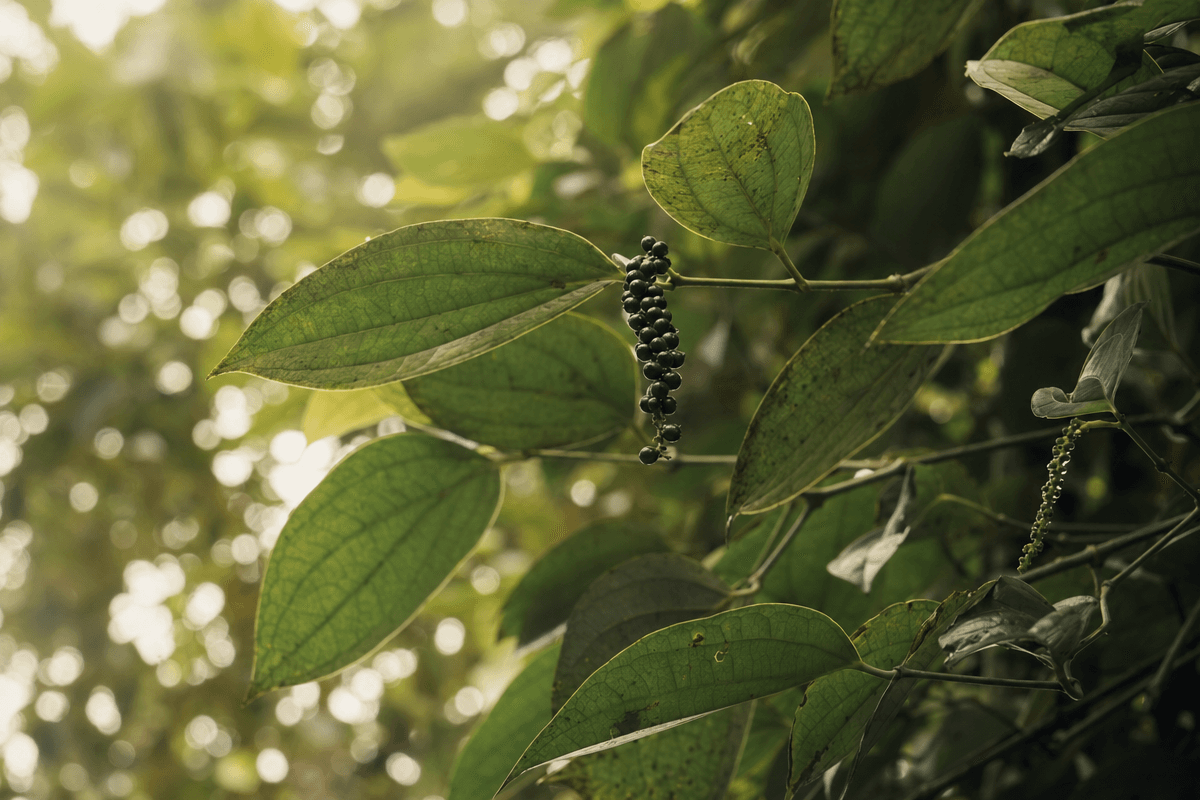
About This Plant
Black pepper (Piper nigrum) is a perennial woody climbing vine native to the Malabar Coast of India. Known as the 'King of Spices,' it is the world's most traded spice. The vine climbs via adventitious roots and can reach 3-10 m on supports. It requires tropical warmth, high humidity, and semi-shade — making it a challenging but rewarding crop for indoor and greenhouse growers. Berries ripen over 6-8 months on hanging spikes, producing black, white, or green peppercorns depending on harvest timing.
How to Grow Black Pepper
Learn how to grow Black Pepper from seed to harvest in 1095 days. Advanced difficulty. Complete nutrient guide, pH/EC requirements, and growing conditions for hydroponics, soil & greenhouse.
Sources cited: 9.
Nutrient Requirements by Growth Stage
Black pepper is a heavy feeder with nutrient uptake in the order N>K>Ca>Mg>P>S. For hydroponic cultivation, the Hoagland solution (N 210, P 31, K 235 ppm at EC 1.8) has been confirmed working for rootstock production…
Sign in to view nutrient requirements
A free account unlocks NPK targets for all four growth stages, micronutrient levels, a per-stage nutrient calculator, and the full nutrition guide. Signing up takes one click. Truleaf is a free, non-profit project, and every new account helps it grow. No spam, ever.
Growing Environments
Black pepper can be grown in multiple environments but demands tropical conditions in all settings. Outdoors: limited to USDA zone 12+ (frost-free tropics) or as a summer patio plant moved indoors before temperatures drop below 15C…
Temperature
Black pepper is a tropical vine requiring consistent warmth. Germination requires 25-35C, with the optimum at 30C -- no germination occurs at 20C or below, and germination is severely inhibited above 35C. Active growth occurs between 20-35C, with 23-32C the productive range and 28C the widely cited optimum. Night temperatures should not drop below 15-18C, as growth ceases below 18C. Root growth requires soil/substrate temperatures of 26-28C. The vine tolerates brief exposure to 10C but sustained cold below 15C causes significant damage. Frost is lethal. In indoor/greenhouse settings, maintain 24-29C year-round for consistent growth and fruiting.
Humidity
As a tropical understory vine, black pepper requires high humidity of 60-90%, with 80% optimal. The previous database value of 20-28% was critically wrong -- these were temperature values erroneously copied into the humidity field…
Light
Black pepper is a semi-shade species adapted to tropical forest understory conditions. It grows best with bright, indirect light or filtered sun -- 6-8 hours of strong filtered light daily…
Airflow
Moderate airflow of 0.3-0.8 m/s is recommended for black pepper. The lower threshold prevents CO2 depletion at leaf surfaces and reduces boundary layer humidity that promotes fungal pathogens…
Sign in to view environmental requirements
A free account unlocks exact temperature, humidity, light and airflow targets, including germination and growth ranges, DLI, photoperiod and PPFD, plus the full environment guide. Signing up takes one click. Truleaf is a free, non-profit project, and every new account helps it grow. No spam, ever.
Hydroponic System Compatibility
Black pepper has limited but proven hydroponic compatibility. Drip irrigation is the BEST system for mature vines -- large containers with coco coir substrate and automated drip delivery provide consistent moisture without waterlogging…
Growing Media
Excellent drainage is the most critical substrate requirement for black pepper -- waterlogging at the collar region is the primary cause of the devastating Phytophthora foot rot. For soilless growing: coco coir + perlite (70:30 or 60:40) provides the ideal balance of moisture retention, drainage, and aeration at the…
Container Specs
Start young cuttings in 3-gallon (11L) pots, scaling up to 10-20 gallon (38-76L) as the vine matures over years. Minimum depth of 35 cm accommodates the spreading root system…
Training & Support
Support is REQUIRED -- black pepper is a climbing vine that uses adventitious roots at each stem node to grip vertical surfaces. In cultivation, vines are trailed over support structures 5-6 m tall in field production…
Sign in to view system compatibility
A free account unlocks why each of the six systems fits or fails, plus growing media, container sizes, training methods, companion plants, and the full systems guide. Signing up takes one click. Truleaf is a free, non-profit project, and every new account helps it grow. No spam, ever.
Propagation
Stem cuttings are the strongly preferred propagation method for black pepper -- seed propagation is slow (4+ years to first harvest) and produces genetically variable offspring. For cuttings: select vigorous orthotropic (upright) stems 40-60 cm long with 3-6 nodes from healthy vines no older than 5 years…
Harvesting
Black pepper vines begin bearing fruit 3-4 years after planting cuttings, reaching full production at 7 years with an economic life of 12-20 years. Spikes are harvested when 1-2 berries at the base turn yellow/red -- before full ripeness, as overripe berries lose pungency and drop…
Planting Calendar
Black pepper is a tropical perennial with no strict seasonal planting window in controlled environments -- cuttings can be planted year-round indoors or in greenhouses. In field production, planting coincides with monsoon onset (May-June in India) to utilize rain for establishment…
Common Issues
Black pepper faces severe disease and pest pressures, especially in humid conditions. Phytophthora foot rot (P…
Get the full science-backed guide
By signing up, you help keep Truleaf free and support the growth of our nonprofit project. Your account unlocks full details for every plant issue—including symptoms, causes, step-by-step solutions, and prevention—plus the month-by-month planting calendar, the complete guide, and all research sources. It only takes one click. No spam, ever.