How to Grow Winged Bean: One Plant, Four Edible Harvests
A science-backed guide to growing winged bean (Psophocarpus tetragonolobus), the four-angled tropical legume where pods, leaves, flowers, and tubers are all edible. Covers seed scarification, trellising, the short-day flowering problem, nitrogen fixation and feeding, pests and diseases, and harvest, drawn from 20 peer-reviewed studies plus extension and reference-database guidance.
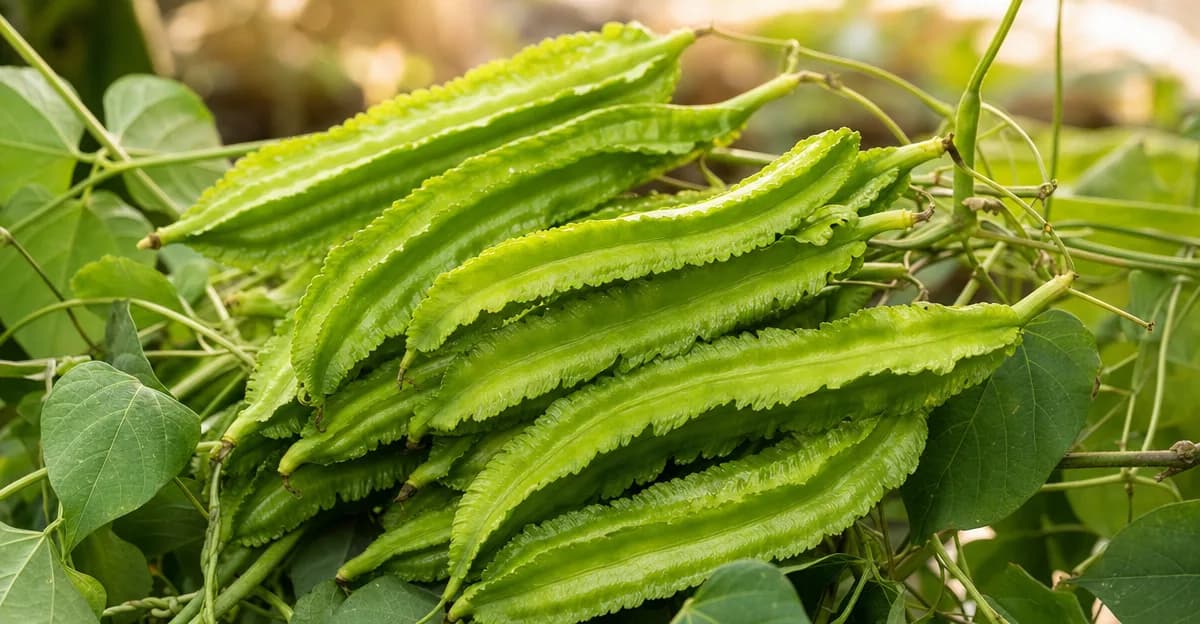
Key takeaway: Winged bean (Psophocarpus tetragonolobus) is a tropical climbing legume where the whole plant is edible: pods, leaves, flowers, and starchy tubers. It is one of the most prolific nitrogen fixers in the bean family, so it needs very little mineral nitrogen. It is also genuinely advanced to grow: seeds have a hard coat that resists germination, vines climb 3 to 5 m and need sturdy support installed before planting, and most traditional varieties will not flower unless days are shorter than about 12 hours. This guide covers seed scarification, trellising, the short-day flowering problem, feeding a nitrogen fixer, and harvest, drawn from 20 peer-reviewed studies plus extension and reference-database guidance.
Is winged bean hard to grow?
Honestly, yes. Winged bean is an intermediate-to-advanced crop, and it helps to know why before you start. Three things make it demanding.
First, the seed coat is hard and often needs mechanical or water treatment before it will absorb moisture and germinate. Second, it is an obligate climber that puts out vines of 3 to 5 m and produces poorly without a strong trellis. Third, and least obvious, it is a short-day plant: many traditional accessions simply will not initiate flowers when the daylength is longer than roughly 12 hours, which is a real obstacle for temperate summer growing.
None of these is a dealbreaker. Each has a workaround covered below, including day-neutral cultivars bred for higher latitudes. But winged bean rewards a grower who plans ahead rather than one who improvises.
Why grow the whole-plant legume
Winged bean earns its reputation as a near-complete food plant. Nearly every part is eaten: the immature four-angled pods as a green vegetable, the young leaves and shoots like spinach, the flowers as a garnish, and the underground tubers as a protein-rich root. A comprehensive review describes it as an underused species with unusually broad potential across food and nutrition.
The agronomic headline is nitrogen. Winged bean is one of the heaviest nodulators in the bean family — reference sources credit it with more nodule biomass per plant than most other legumes — which lets it meet much of its own nitrogen demand through symbiotic fixation. For a grower, that translates into a legume you feed lightly rather than heavily, provided you get the root symbiosis established.
Climate and temperature
Winged bean is a warm-season tropical crop with no frost tolerance at all. Growth is best around 27°C, with a comfortable working range of roughly 18 to 30°C; the plant tolerates 14 to 40°C but slows sharply at both extremes.
Temperature and daylength interact, and this matters for flowering. In controlled trials, some accessions failed to flower above about 30°C even under short days, with a 30/25°C day/night regime marking a risk threshold, while flowering was reliable at 27/22°C under a 10-hour daylength. The practical lesson: treat temperature and photoperiod together, not separately. A hot summer that pushes nights above the low 20s can suppress flowering even if days are short enough.
Light and the short-day problem
Winged bean needs full sun, with a minimum of 6 to 8 hours of direct light per day for healthy growth. The species is light-hungry but efficient at the low end: the one measured photosynthetic parameter is a light compensation point near 1.7 klux, reported by Lenz and Broughton in 1981.
The bigger issue is flowering. Winged bean is a short-day plant, and traditional varieties need daylengths below about 12 hours to initiate flowers; the critical daylength falls in roughly the 11 h 15 min to 12 h 15 min window. In temperate summers, where days run 14 to 16 hours, this can mean a lush vine that never sets pods.
There are two ways around it. The first is timing: grow so that the flowering window lands after the equinox, when days shorten below the threshold. The second, and more reliable for higher latitudes, is to choose day-neutral cultivars developed through breeding programs, which flower regardless of daylength and open winged bean up to temperate-zone production. If you garden well outside the tropics, seek out a day-neutral line before anything else.
One caution on numbers: no published DLI or PPFD target exists for this species. Any specific daily-light-integral or photon-flux figure you see quoted should be treated as approximate guidance rather than an established requirement.
Choosing seeds and varieties
Seed choice is where a temperate grower makes or breaks the season. The single most important trait is photoperiod response: day-neutral cultivars flower at any daylength, while traditional short-day accessions need shortening days. Beyond that, genotypes vary widely in pod morphology and tuber production, so a variety bred for pods will differ from one selected for tubers.
Winged bean also comes in different seed-coat colors, and coat permeability differs between them, which affects how you should pre-treat seed (see below). When you buy, note both the flowering type and the seed-coat description if the supplier provides it.
Planting: seed treatment and sowing
Winged bean is grown primarily from seed; stem cuttings under mist are a workable but secondary route.
Break the seed coat. The hard coat is the main barrier to germination. Two approaches work: mechanical scarification (nicking or lightly abrading the coat), or a warm-water pre-soak of roughly 12 hours before sowing. Under good conditions, expect emergence in 5 to 7 days, though germination across accessions and treatments can spread over 7 to 21 days.
But do not over-soak. Here the evidence carries a genuine tension worth respecting. A warm-water soak helps hard-coated seed, yet in the same body of germination research, prolonged imbibition of 8 hours or more caused injury in permeable-coat varieties, dropping germination to around 55%. The reconciliation is variety-dependent: hard-coated seed benefits from the longer soak, while thin-coated seed can be damaged by it. If you know your seed has a permeable coat, soak briefly or scarify instead. A related priming study found solid-matrix priming cut mean germination time from 4.63 to 2.01 days at 30°C, so priming is an option for growers who want faster, more even emergence.
Sow and inoculate. Plant seed about 2.5 cm deep, roughly 30 cm apart, in rows 90 to 120 cm wide. Because the nitrogen-fixing partnership is central to this crop, inoculate seed or soil with a cowpea-type Rhizobium to establish nodulation early. Optimal soil temperature for germination is 25 to 30°C.
Trellising and support
If you take one build seriously, make it the trellis. Winged bean is an obligate climber that grows vines of 3 to 5 m, and support must be sturdy and installed before planting, because the young roots are weak and disturbed easily. A practical trellis height is 1.5 to 2.5 m.
The climbing surface matters. Young vines grip fine materials such as string, wire, or netting; thick poles are too coarse for the tendrils to hold early on, so add a fine mesh or twine even on a heavy frame.
Trellising is not just tidiness, it changes what the plant makes. Trellised plants channel energy into pods and yield more of them, while un-trellised plants shift resources toward tuber production. That trade-off is a real decision: if pods are your goal, trellis well; if you want tubers, you can let the plant sprawl. As one illustration of how support drives the whole plant, a Malaysian trial measured total plant nitrogen accumulation of 6.3 g per plant on a 2 m support versus 2.1 g per plant without support, though that is a single-study figure and should not be generalized as a fixed rule.
Feeding a nitrogen fixer
The counterintuitive part of feeding winged bean is that you feed it lightly on nitrogen. Because it fixes so much of its own, the goal is to support the symbiosis rather than override it.
Go easy on nitrogen, and prefer nitrate. Applied urea can inhibit nitrogenase activity, especially before about 75 days after sowing, so heavy ammoniacal nitrogen is counterproductive; where you do supplement, nitrate-based nitrogen is gentler on fixation. Nitrogenase activity itself peaks around the onset of flowering, roughly 70 days after planting, then declines during pod fill.
A note on timing. Winged bean's flowering date is strongly genotype- and photoperiod-dependent and varies widely between accessions, so read these day-counts as line-specific benchmarks rather than fixed points on one clock. The roughly 70-day figure is the nitrogenase peak measured in a specific field trial; earlier-flowering accessions set harvestable pods in 60 to 80 days from sowing, about 2 to 3 weeks after their own (earlier) flowering. What holds across lines is the shape of the curve — fixation building toward flowering, then tapering through pod fill — not any single calendar day.
Phosphorus and potassium do the heavy lifting. Phosphorus is typically the first limiting nutrient for winged bean, and in a three-year field study, phosphorus plus potassium additions doubled pod and seed yield. Potassium directly enhances nitrogenase, with the effect strengthening around 30 to 60 days after sowing.
Hydroponic targets, with an honest caveat. There is no published hydroponic nutrient recipe specific to winged bean, and the available sources disagree. Merging academic values gives an approximate staged range: seedling around N 50 to 100, P 28 to 48, K 80 to 130 ppm; vegetative N 30 to 70, P 33 to 53, K 130 to 185; flowering N 30 to 70, P 38 to 58, K 155 to 210; fruiting N 40 to 80, P 35 to 55, K 155 to 210, at EC 1.5 to 3.0 dS/m (near 2.0 optimum) and pH 5.5 to 7.0 (near 6.0), with low salt tolerance. A related common-bean analog study suggests even lower flowering and fruiting nitrogen, around 20 to 50 ppm. Recommended NPK ratios span a wide band, from about 0-2-1 in a lab study, to roughly 1-2-3 from the academic merge, to about 1:1.5:5 from extension sources. Treat these as a range with real uncertainty rather than a single recipe, and note the consistent theme across all of them: keep nitrogen modest and potassium generous.
A stage-timed feeding protocol keyed to the nitrogen fixer's clock
The section above gives you the levels; this gives you the timing. Winged bean's nitrogen-fixing machinery runs on a developmental clock, and feeding against that clock is where growers either waste fertilizer or suppress the very symbiosis they mean to support. Match each move to where the plant is in its cycle.
At sowing — establish the partnership. Inoculate with a cowpea-type Rhizobium at planting, so nodulation is underway before the plant's own nitrogen demand ramps up. Correct phosphorus now too: P is typically the first limiting nutrient for this crop, and building nodules is metabolically expensive.
Sowing to about day 75 — protect nitrogenase. This is the window where applied urea does the most harm. Ammoniacal nitrogen inhibits nitrogenase activity, especially before roughly 75 days after sowing, so keep any mineral nitrogen modest and favor nitrate where you supplement at all. Across the 30-to-60-day span, lean on potassium — its enhancement of nitrogenase strengthens through this window.
Around day 70 / flowering onset — the fixation peak. Nitrogenase activity peaks near the onset of flowering, roughly 70 days after planting. The plant is now meeting most of its own nitrogen demand, so this is the moment to hold nitrogen lowest and let phosphorus and potassium carry yield — the pairing that doubled pod and seed yield in a three-year field trial.
Pod fill onward — taper, don't push. Nitrogenase activity declines during pod fill, but the crop's whole-plant nitrogen is already largely banked. A modest nitrate top-up supports finishing pods without overriding the symbiosis.
If you run hydroponics, layer the staged ppm ranges from the section above onto this same clock, and keep the honest caveat in view: there is no winged-bean-specific recipe, so treat the numbers as a starting band and let vigor and nodulation tell you whether to ease nitrogen down further.
Growing systems and media
Winged bean grows in soil or soilless media that drains freely; use a medium at pH 5.5 to 7.0, such as LECA, perlite, or a 70:30 coco-perlite blend, and avoid waterlogging, which invites tuber rot.
The hydroponic evidence base is thin and worth naming plainly. The only published hydroponic study is a nutrient-film (NFT) trial by Chow and Price in 1989, which found exponential biomass accumulation from about 10 days after planting, ion depletion within 5 days of each replenishment (so frequent monitoring is essential), and roots that accumulated calcium, potassium, phosphorus, iron, and manganese more than the shoots. Other recirculating systems such as deep-water culture, ebb-and-flow, and drip are reasonable by general legume analogy only, not by species-specific evidence, so approach them experimentally; the Kratky method is unsuitable given the plant's size, long cycle, and nutrient demand.
For container growers, extension guidance recommends a large pot in the 15 to 20 gal range (roughly 45 to 50 cm deep and 40 to 50 cm wide) with excellent drainage and enough stability to anchor a trellis. That container spec comes from a single extension source, so treat it as sensible guidance rather than a hard minimum.
Humidity and airflow
Winged bean is native to hot, humid tropical conditions, and general guidance places relative humidity in the 60 to 80% band (around 70% ideal). That figure is inferred from the plant's native range rather than from controlled humidity trials, so treat it as guidance. High humidity favors growth and nitrogen fixation but also raises fungal-disease pressure, so good air circulation is essential. Any specific airflow velocity you see quoted is a general horticultural guideline, not a species-specific requirement.
Harvesting pods and tubers
Winged bean is a continuous-harvest crop, and picking often is what keeps it productive.
Pods. Pods are typically ready 60 to 80 days from sowing, about 2 to 3 weeks after flowering, when they reach 15 to 22 cm and are bright green and tender. Pick before about 25 days post-flowering, after which the pod wall turns fibrous and stringy. Harvest every 2 to 3 days to sustain production and encourage the plant to keep setting pods. Yields run roughly 0.25 to 0.70 kg of fresh pods per plant.
Tubers. If you are growing for the root, dig tubers at the end of the season, roughly 120 to 240 days after sowing, when the plant is winding down. Reported tuber yields span a wide 80 to 392 g per plant, a range that largely reflects genotype differences. Tuber formation itself is promoted by short days and cooler temperatures — the same seasonal shift that triggers flowering — so the bulk of tuber growth tends to come late in the season as days shorten.
Storage. Fresh pods keep 2 to 5 days refrigerated, and up to about 21 days at 10°C and 90% relative humidity; blanch and freeze for longer keeping.
Pests and diseases
Warmth and humidity that suit winged bean also suit its pathogens, so vigilance and airflow are part of the routine.
Diseases. Leaf spot (Pseudocercospora psophocarpi) is the most serious leaf disease reported in Papua New Guinea, cutting pod length and yield. False rust (Synchytrium psophocarpi) produces orange pustules and is established across Southeast Asia, with a first report recently in Taiwan. Collar rot from Rhizoctonia solani, Fusarium, and Macrophomina can cause seedling mortality.
Pests. Flower-bud thrips (Megalurothrips sjostedti) and the bean pod borer (Maruca vitrata) are major causes of flower and pod loss. Aphids can vector bean mosaic virus, and root-knot nematodes (Meloidogyne) and bacterial wilt (Ralstonia solanacearum) round out the pressures.
Management. An integrated approach combining cultural practices, biological controls, and resistant varieties is the recommended strategy rather than reliance on any single tactic.
Advanced troubleshooting: a vine that grows but won't deliver
The single most common winged-bean disappointment is a lush plant that never pays off — all leaf and no pods, or flowers that drop before they set. Work the diagnosis in this order, because the fixes are completely different.
Vigorous vine, no flowers at all. Suspect daylength first. Traditional accessions are short-day plants and will not initiate flowers until days fall below about 12 hours, in a critical window near 11 h 15 min to 12 h 15 min. If your days are still long, the plant is behaving normally — wait for the season to shorten, or accept that you have the wrong type and need a day-neutral cultivar. If days are already short and it still won't flower, look at heat: flowering can be suppressed above roughly 30°C even under short days, with a 30/25°C day/night regime marking the risk threshold. Excess nitrogen is the third suspect, since an over-fed vine favors foliage over flowers — another reason to keep mineral N modest.
Flowers form but pods don't set. Now suspect the flower-and-pod pests. Flower-bud thrips (Megalurothrips sjostedti) and the bean pod borer (Maruca vitrata) are major causes of flower and pod loss, and they are easy to miss until the flowers are already dropping. Rule these in or out before blaming pollination or heat.
Weak growth despite feeding. Suspect the symbiosis rather than the fertilizer. If nodulation never established — no inoculant, the wrong Rhizobium, or mineral nitrogen high enough to suppress it — the plant cannot reach its main nitrogen source. Check the roots for nodules; if they are few or absent, re-inoculate and cut back on applied N.
All tubers, few pods (or the reverse). This is usually not a disease at all but the support trade-off: trellised plants channel energy into pods, un-trellised plants shift toward tubers. If you want pods and are getting tubers, the fix is a better trellis, not a spray.
On the disease front. Leaf spot (Pseudocercospora psophocarpi) and false rust (Synchytrium psophocarpi) both thrive in the warm, humid conditions the crop itself prefers, so the durable answer is the integrated one — cultural practice, airflow, biological control, and resistant varieties together, not any single tactic.
Growing calendar: temperate versus tropical
Temperate growers should start seeds indoors about 4 to 5 weeks before the last frost at 25 to 30°C, then transplant only after frost has passed and seedlings are hardened off; plan for a minimum of about 120 frost-free days. Crucially, pair this with a day-neutral cultivar, because traditional short-day types will not flower while summer days exceed 12 hours.
Tropical growers can direct-sow at the onset of the wet season, around September to October in many regions. In both settings, pruning vine tips at roughly 1.8 to 2.1 m encourages lateral branching and a bushier, more productive canopy.
Getting the most from four harvests: the pod-versus-tuber decision
Winged bean's selling point is that one plant yields pods, leaves, flowers, and tubers — but pods and tubers pull against each other, and deciding which you are optimizing for changes how you grow.
Choose the genotype first. Varieties differ widely in pod morphology and tuber production; a line bred for pods is not the same as one selected for tubers, so pick to your goal before you plant. Reported tuber yields span a wide 80 to 392 g per plant, a range driven largely by genotype rather than by management.
Then let support settle the trade-off. Trellising is the master switch: trellised plants channel energy upward into pods and yield more of them, while plants left to sprawl shift resources into tuber formation. A Malaysian trial makes the whole-plant effect concrete — total plant nitrogen accumulation was 6.3 g per plant on a 2 m support versus 2.1 g per plant without support, though that is a single-study figure rather than a fixed rule.
Time the tubers to the season's turn. Tuber formation is promoted by short days and cooler temperatures — the same seasonal shift that triggers flowering — so the bulk of tuber growth comes late, as days shorten. If tubers are the goal, plan so the plant is still standing into that window, and dig at roughly 120 to 240 days.
Push the canopy for pods. Where pods are the aim, pruning vine tips at roughly 1.8 to 2.1 m encourages the lateral branching that carries more pods, and picking every 2 to 3 days keeps the plant setting new pods rather than maturing old ones. Expect roughly 0.25 to 0.70 kg of fresh pods per plant across the season.
Frequently asked questions
Is winged bean easy to grow?
No, it is intermediate to advanced. It needs consistent warmth of 18 to 30°C, full sun, a sturdy trellis built before planting, and, for most varieties, shortening days to trigger flowering. The payoff is a vigorous, nitrogen-fixing plant where pods, leaves, flowers, and tubers are all edible.
Why won't my winged bean flower?
The most common reason is daylength. Traditional varieties are short-day plants and will not initiate flowers until days fall below about 12 hours. High night temperatures can compound the problem, since flowering may be suppressed above roughly 30°C even under short days. If you grow in a temperate summer, use a day-neutral cultivar to sidestep the issue entirely.
Do I need to fertilize winged bean with nitrogen?
Very little. Winged bean is one of the strongest nitrogen fixers among legumes and largely feeds itself once nodulation is established, so inoculate with a cowpea-type Rhizobium and go easy on nitrogen. Heavy urea can actually inhibit nitrogen fixation, so where you supplement, favor phosphorus and potassium, which raised yields in field trials.
Should I soak winged bean seeds before planting?
For hard-coated seed, yes: scarify or pre-soak in warm water for about 12 hours to break dormancy. But do not over-soak thin-coated seed, since prolonged imbibition of 8 hours or more can injure permeable-coat varieties and cut germination to around 55%. Match the treatment to your seed type.
Can I grow winged bean hydroponically?
You can, but manage expectations. The only published hydroponic study used NFT and found rapid biomass growth alongside fast nutrient depletion that demanded frequent monitoring. Other recirculating systems are plausible by legume analogy only, and there is no species-specific nutrient recipe, so keep nitrogen modest, potassium generous, and treat the setup as an experiment.
Quick-reference growing card
| Parameter | Value |
|---|---|
| Botanical name | Psophocarpus tetragonolobus |
| Common names | Winged bean, goa bean, four-angled bean, asparagus pea, dragon bean |
| Difficulty | Advanced |
| Temperature | 18–30°C optimum near 27°C; frost-tender |
| Light | Full sun, 6–8 h direct |
| Flowering trigger | Short-day (<~12 h); use day-neutral cultivars in temperate zones |
| Propagation | Seed; scarify or soak ~12 h; inoculate with cowpea-type Rhizobium |
| Support | Obligate climber, 3–5 m vines; trellis 1.5–2.5 m built before planting |
| Feeding | Low N (prefer nitrate), generous P and K |
| Pods ready | 60–80 days from sowing, 15–22 cm, harvest every 2–3 days |
| Pod yield | ~0.25–0.70 kg/plant |
| Tubers | Dug at 120–240 days; 80–392 g/plant (genotype-dependent) |
| Media / pH | Free-draining; pH 5.5–7.0; no waterlogging |
For personalized nutrient recommendations, try our nutrient manager. To identify nutrient problems, see our plant nutrient deficiency chart.