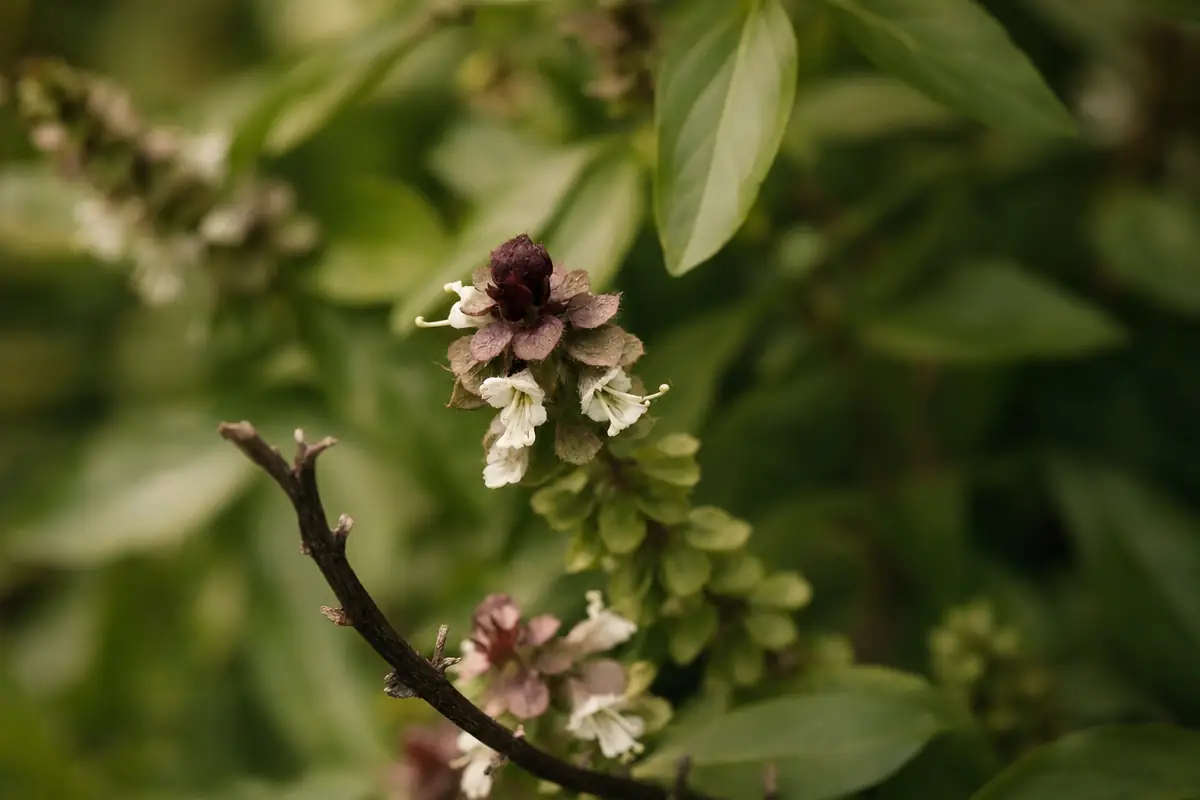
About This Plant
Thai basil is a warm-season aromatic basil with purple stems, anise-like fragrance, and strong suitability for hydroponic, container, greenhouse, and outdoor leaf production. It grows quickly under warm, bright conditions and responds best to repeated tip harvests before heavy flowering.
How to Grow Thai Basil
Learn how to grow Thai Basil from seed to harvest in 50 days. Beginner difficulty. Complete nutrient guide, pH/EC requirements, and growing conditions for hydroponics, soil & greenhouse.
Backed by 16 peer-reviewed citations.
Nutrient Requirements by Growth Stage
The current Thai basil NPK values are lower than production-oriented basil evidence. Hydroponic basil performs well across EC 0.5-4.0 dS/m, but most practical basil recipes cluster around moderate EC and adequate N, P, K rather than very dilute formulas…
Sign in to view nutrient requirements
A free account unlocks NPK targets for all four growth stages, micronutrient levels, a per-stage nutrient calculator, and the full nutrition guide. Signing up takes one click. Truleaf is a free, non-profit project, and every new account helps it grow. No spam, ever.
Growing Environments
Thai basil is suitable for indoor, outdoor, greenhouse, and container production. Outdoor plants need sun, warmth, fertile well-drained soil, and protection from frost…
Temperature
Thai basil is a warm-season basil type and should be managed like other productive Ocimum basilicum crops: seed and young plant production is reliable around 20-30C, while vegetative production performs best in warm rooms or greenhouses around 22-28C. Hydroponic basil trials used greenhouse day/night temperatures near 29/24C with 65% RH and produced rapid growth, while Thai and other basil types also performed in floating raft culture under warm protected conditions. Growth slows sharply in cool conditions, and extension guides warn to transplant only after frost risk has passed and nights stay warm. The existing 21-29C range is therefore close, but a broader 18-32C growth tolerance and 26C practical optimum better reflects controlled-environment studies.
Humidity
A moderate humidity target of 50-70% is appropriate for Thai basil. The small-scale hydroponic basil study used 65% RH in both greenhouse and indoor environments, while Thai basil floating raft work measured normal leaf gas exchange under greenhouse humidity near 55%…
Light
Thai basil can be grown under a 16-hour photoperiod, but the current 100 umol/m2/s intensity is a low propagation-level value rather than a production target. In the Thai Magic LED study, basil seedlings started near 150 umol/m2/s, then Thai Magic developed marketable quality under rising low-light conditions around…
Airflow
Thai basil does not need strong wind, but it needs enough air movement to thin the humid leaf boundary layer. Gentle horizontal airflow around 0.3-0.6 m/s is appropriate for indoor and greenhouse production, especially overnight when leaf wetness drives downy mildew sporulation…
Sign in to view environmental requirements
A free account unlocks exact temperature, humidity, light and airflow targets, including germination and growth ranges, DLI, photoperiod and PPFD, plus the full environment guide. Signing up takes one click. Truleaf is a free, non-profit project, and every new account helps it grow. No spam, ever.
Hydroponic System Compatibility
Thai basil is compatible with the major hydroponic formats listed in the database. Thai basil specifically performed in a closed-loop floating raft system, which maps to DWC or deep-flow culture, at high density with oxygenated nutrient solution…
Growing Media
Thai basil can start in rockwool, phenolic foam, coco plugs, or seed-starting substrate, then move into substrate-free hydroponics or well-drained container media. Published basil hydroponic work used phenolic foam propagation cubes, floating raft trays, NFT channels, deep-flow systems, and substrate systems…
Container Specs
Thai basil is compact enough for containers but still needs drainage and root volume. Use at least a 20 cm deep and 20 cm wide container for one plant, with 5 L as a minimum and 8-10 L preferable for repeated harvesting…
Training & Support
Thai basil does not require stakes or trellises, but pruning and topping are core production practices. Pinch or cut the main stem just above a node once plants have several sets of true leaves; this breaks apical dominance and produces a bushier canopy with more harvestable tips…
Sign in to view system compatibility
A free account unlocks why each of the six systems fits or fails, plus growing media, container sizes, training methods, companion plants, and the full systems guide. Signing up takes one click. Truleaf is a free, non-profit project, and every new account helps it grow. No spam, ever.
Propagation
Thai basil is easy to propagate from seed or stem cuttings. Extension guidance for basil recommends sowing seed about 6 mm deep, keeping the medium warm and moist, and expecting germination in about 5-10 days under warm conditions…
Harvesting
Thai basil should be harvested as a cut-and-come-again leaf herb before heavy flowering. Start once plants have several true leaf pairs and enough height to leave active nodes below the cut, commonly around 30-50 days from sowing depending on light and temperature…
Planting Calendar
For temperate outdoor production, sow Thai basil indoors 6-8 weeks before the last frost or direct sow only after soil has warmed and frost danger has passed. In much of the Northern Hemisphere, that means indoor sowing from February to April, transplanting in May or early June, and direct sowing in May-June…
Common Issues
Thai basil shares the main disease and pest risks of sweet basil. In hydroponics, Pythium root rot is the critical system disease; brown slimy roots, poor lateral roots, and nutrient-deficiency-like yellowing point to oxygen or sanitation failures, so maintain high dissolved oxygen, clean reservoirs, and moderate…
Get the full science-backed guide
By signing up, you help keep Truleaf free and support the growth of our nonprofit project. Your account unlocks full details for every plant issue—including symptoms, causes, step-by-step solutions, and prevention—plus the month-by-month planting calendar, the complete guide, and all research sources. It only takes one click. No spam, ever.