El Niño: 12 Water-Saving Methods for Growers
Compare 12 water-saving methods for El Niño conditions by savings, cost, space, and crop fit, from mulch and drip irrigation to Kratky, DWC, and NFT.
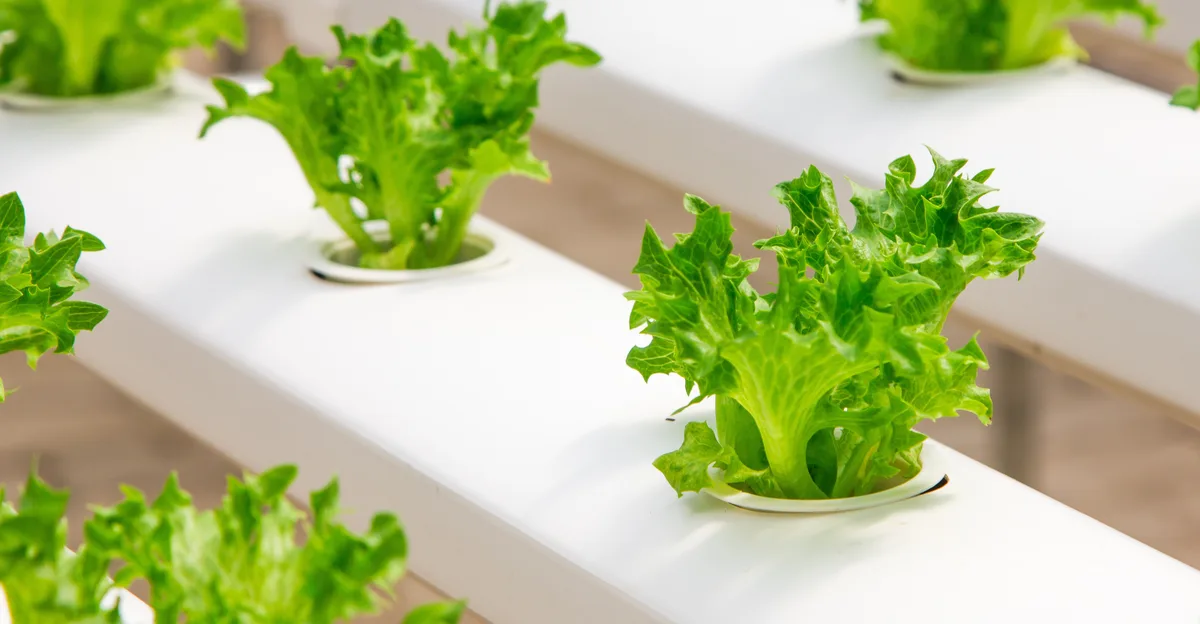
Image: Jatuphon Buraphon via Wikimedia Commons (CC0 1.0). Lettuce growing in NFT hydroponic channels.
Key takeaway: The best method depends on what you grow, how much space you have, and how much maintenance you can take on. In one modeled Arizona comparison, NFT hydroponic lettuce used 20 L of water per kilogram of crop, versus 250 L/kg for conventional lettuce. That works out to 92% less water. Soil-based methods delivered smaller but useful reductions: 37% in a preliminary commercial sweet-corn field comparison, 19-20% with irrigation-scheduling tools, and 40.23% for buried clay pots compared with drip in one cabbage trial.
Those percentages are benchmarks, not guarantees. Crop, weather, soil, system design, and the comparison method all change the result. A balcony gardener can save a meaningful amount with one olla or a Kratky jar. An 800 m² farm may gain more from fixing its irrigation schedule before buying a new growing system.
This guide is part of the El Nino 2026 growing series. Pair the method you choose with drought-tolerant vegetables and the El Nino crop calendar for a lower-water planting plan.
Compare the 12 methods
The table uses the closest quantified result we could verify. “Water saving” may mean less applied irrigation, a lower water footprint, or more crop per liter. Those measures answer different questions, so the evidence column names the metric and comparator.
| Method | Published evidence example | Relative setup cost (editorial) | Space | Best fit |
|---|---|---|---|---|
| 1. Organic mulch | 3.6% lower basin blue water footprint in one model | Low | Pots to fields | Almost every soil grower |
| 2. Surface drip | 37% less applied water than furrow irrigation in one preliminary sweet-corn field comparison | Medium | Beds to farms | Rows, beds, polytunnels |
| 3. Subsurface drip | 8.5-21.8% higher tomato water productivity than surface drip | High | Beds to farms | Permanent high-value rows |
| 4. Scheduled irrigation | 19-20% less applied water over a vegetable crop cycle | Low to medium | Beds to farms | Existing irrigation systems |
| 5. Buried clay pots | 40.23% less water than drip in one cabbage trial | Low | Containers and small beds | Balconies, gardens, small plots |
| 6. Wicking beds | Shallow beds used 6% more to 9% less water with 62-73% higher yield; a deep bed used 22% less with 11% lower yield | Medium | Containers and raised beds | Urban growers and patios |
| 7. Kratky hydroponics | Commonly under 20 L/kg lettuce; as low as 11 L/kg reported | Low | Shelves and balconies | Leafy greens at home |
| 8. Deep Water Culture | NFT consumed 23.7-51.9% more water than DWC in a two-season lettuce study | Medium | Small tanks to rafts | Lettuce and leafy greens |
| 9. Nutrient Film Technique | 92% less water per kilogram than conventional lettuce in one modeled Arizona comparison | High | Narrow channels | Repeated leafy-green crops |
| 10. Recirculating drip hydroponics | No method-specific soil comparison in the reviewed sources | High | Buckets to greenhouses | Tomatoes, peppers, cucumbers |
| 11. Ebb-and-flow hydroponics | No method-specific soil comparison in the reviewed sources | High | Benches and trays | Seedlings, herbs, compact crops |
| 12. Aeroponics | About 64.6% higher water-use efficiency than NFT in one lettuce study | Very high | Towers or chambers | Experienced growers |
Cost labels are editorial estimates for the smallest practical version of each method, before land, labor, energy, and ongoing inputs. They are not price quotes. Actual costs change with scale, location, materials, and existing infrastructure.
The 92% figure belongs to the modeled NFT lettuce scenario that Barbosa and colleagues compared with conventional lettuce. It is not a benchmark for Deep Water Culture (DWC), Kratky, recirculating drip, or ebb-and-flow. These systems handle water differently. A leaking reservoir or a system that dumps nutrient solution can erase much of the advantage.
Build a method scorecard from your own water data
Published results can help you shortlist methods, but they cannot rank them for your site. The studies in this guide measure three different outcomes: applied irrigation, water footprint, and crop produced per unit of water. Keep those measures separate in your scorecard.
Start with the methods that fit your crop and space. Then record the same fields for each candidate:
| Field | What to record | Why it matters |
|---|---|---|
| Water added | Every irrigation, reservoir top-up, and refill in liters | Gives you the total external water input |
| Saleable harvest | Crop weight after removing damaged or unmarketable produce | Prevents low yield from looking efficient |
| Water discarded | Runoff, drained nutrient solution, and reservoir changes | Separates crop use from avoidable loss |
| Labor | Time spent filling, checking, cleaning, and repairing | Exposes methods that save water but add too much work |
| Reliability | Leaks, blocked emitters, pump stops, dry channels, and missed irrigations | Shows whether the method works under normal operating conditions |
| Energy | Pump, aeration, cooling, and lighting use | Keeps a water saving from hiding a larger operating burden |
Use two calculations:
Water per harvest = total water added (L) ÷ saleable harvest (kg)Water productivity = saleable harvest (kg) ÷ total water added (m³)
Choose one calculation and use it throughout the comparison. Do not average it with a water-footprint percentage or an applied-irrigation reduction. The Barbosa comparison, for example, reports liters per kilogram and also found much higher energy demand in its hydroponic scenario. The wicking-bed study shows why harvest belongs beside water use: one design saved 22% water but reduced yield by 11%.
Set limits before choosing a winner. A balcony method may need to fit a fixed footprint and tolerate a missed check. A farm method may need to work with existing rows, filters, and labor. Eliminate candidates that fail those limits, then compare water per harvest, waste, labor, reliability, and energy among the methods that remain.
Six soil and container methods
1. Cover bare soil with organic mulch
Mulch slows evaporation from the soil surface and reduces the number of weeds competing for water. Apply a layer around established plants while keeping the material away from stems. Compost, shredded leaves, straw, and clean crop residue can all work when they are suitable for the crop and local pest conditions.
The most relevant 2019 study modeled 10 crops across Lebanon's Upper Litani Basin. Organic mulch reduced the blue water footprint by 3.6%. Combining mulch with drip reached 4.7%. These basin-scale results are lower than many garden claims because they measure consumptive water use across crops and seasons. The authors warn that the effect changes with climate, soil, crop, and management.
Choose it if: You grow in pots, raised beds, or soil and want the lowest-cost first move.
2. Put surface drip beside the root zone
Drip line applies water in small amounts near each plant. It leaves the paths and spaces between rows relatively dry, which cuts runoff and limits water delivered to weeds.
In a preliminary UC Cooperative Extension comparison across 11 commercial sweet-corn fields in the Imperial Valley, the six drip-irrigated fields used 37% less water on average than the five furrow-irrigated fields. Marketable yield was 5% higher. The unusually large saving came from sandy soil and a high-water furrow baseline. Check emitters for clogging and measure the output before copying another farm's run time.
Choose it if: You have crop rows, beds, or a polytunnel and can inspect filters and emitters.
3. Bury the drip line for permanent rows
Subsurface drip places the line below the soil surface. Water enters the root zone with less exposed wet soil, but installation and repair are harder. It works best where rows remain in a stable layout.
A 2024 tomato study found 8.5-21.8% higher water productivity with subsurface drip than with surface drip at the tested soil-moisture thresholds. Yields were slightly lower, so the result describes more crop per unit of water rather than a matching reduction in the water bill.
Choose it if: You manage permanent high-value rows and can map, flush, and repair buried lines.
4. Schedule irrigation from soil moisture
A precise delivery system still wastes water when it runs too long. A tensiometer, soil-moisture sensor, or crop water chart can tell you when the root zone needs water. Check more than one point because a single sensor may miss a dry or wet section.
In a small-scale vegetable trial, a water chart and tensiometer reduced irrigation by 19% and 20% over the full crop cycle compared with the growers' usual practice. During the intervention period, the reductions were 26% and 22%. The growers still applied more water than the crop model recommended, which shows why equipment needs a clear response rule.
Choose it if: You already irrigate and want to find waste before replacing the whole system.
5. Bury an unglazed clay pot
An olla is an unglazed clay vessel buried up to its neck and filled with water. Moisture seeps through the porous wall into nearby soil. Cover the opening to reduce evaporation and keep debris and animals out.
In a Rwandan cabbage trial, buried clay pots used 40.23% less water than drip irrigation. Water productivity reached 36.17 kg/m³ for the clay pots and 25.4 kg/m³ for drip. Pot porosity, soil texture, crop spacing, and local weather change the seepage rate. Start with one small area and watch the wetting radius before adding more pots.
Choose it if: You have a balcony container, a small garden bed, or an isolated group of thirsty plants.
6. Grow in a wicking bed
A wicking bed stores water below the soil. Capillary movement carries it upward as the root zone dries. The covered reservoir reduces direct surface loss and lengthens the time between refills.
The design matters more than the label. In a tomato experiment, shallow wicking beds used from 6% more water to 9% less water than precision surface-irrigated pots, while yield increased 62-73%. A deeper bed saved 22% water but reduced yield by 11%. Wicking treatments needed fewer than 26 watering events, compared with 40-50 for the surface-irrigated pots.
Choose it if: You want fewer watering trips and can build a level, well-drained reservoir with an overflow.
Six soilless methods
Closed hydroponic systems can reduce external water inputs by keeping water inside a covered reservoir or returning drainage to the tank. Plants still transpire, so no system eliminates crop water use. The largest savings come from preventing runoff, drainage, and exposed-surface evaporation.
The Barbosa lettuce comparison reached 20 L/kg in NFT and 250 L/kg in conventional production. It also found far higher energy demand in the hydroponic scenario. If your system needs pumps, cooling, or lights, include energy and failure risk in the decision.
7. Start with a Kratky container
The Kratky method holds a plant above a non-circulating nutrient reservoir. As the plant drinks, the water level falls and creates a moist air gap around part of the root system. A properly sized lettuce setup can finish with its initial water and nutrients.
University of Hawaii trials report common water-use efficiency below 20 L/kg of lettuce and a recorded low of 11 L/kg. Typical heads used 3-6 L of nutrient solution, with no pump or electricity. Small reservoirs heat quickly and concentrate salts, so protect the container from light and start with good-quality water.
Choose it if: You are growing a few lettuce heads or herbs on a balcony. Use our Kratky method guide for the full setup.
8. Use Deep Water Culture for a stable reservoir
In DWC, roots hang into an aerated nutrient solution. The larger water volume changes temperature and nutrient concentration more slowly than a small channel. The air pump adds equipment and power use.
In a two-season butterhead lettuce study, NFT consumed 51.9% more total water than DWC in fall and 23.7% more in summer. That is a direct comparison between two hydroponic designs, not a soil-savings percentage. The result also changed with season, so do not treat DWC as automatically more efficient in every climate or setup.
Choose it if: You want a forgiving leafy-green system and can keep the air pump running.
9. Run a Nutrient Film Technique channel
NFT sends a shallow stream of nutrient solution down a sloped channel and back to a reservoir. It uses little water inside the channel and fits many plants into a narrow footprint. Roots can dry quickly when flow stops.
The 92% Arizona comparison used NFT, so it is relevant to this method under the study's conditions. It does not show that NFT always beats other hydroponic designs. In a separate two-season comparison, NFT consumed 51.9% more total water than DWC in fall and 23.7% more in summer. Judge water efficiency by harvested crop per liter, not by the small volume visible in the channel.
Choose it if: You plan repeated leafy-green crops and can monitor flow. Our NFT hydroponics guide covers channel design and operating checks.
10. Recirculate drip drainage for fruiting crops
Recirculating drip hydroponics sends nutrient solution to a pot or bucket filled with an inert substrate. The drainage returns to a tank instead of leaving the system. Tomatoes, peppers, and cucumbers get more root support than they would in a shallow NFT channel.
No method-specific soil comparison in the reviewed sources supports a savings percentage for this design. Capturing and reusing drainage prevents a major loss pathway, while run-to-waste drip hydroponics belongs in a different water category. Measure tank top-ups and discarded solution so the word “recirculating” describes what the system does in practice.
Choose it if: You grow larger fruiting plants and can manage nutrient concentration as the solution returns.
11. Flood and drain a reusable tray
An ebb-and-flow system pumps solution into a tray, then drains it back to a covered reservoir. It can water many small pots or seedlings at once. A level tray and reliable drain prevent standing water.
No independent soil comparison in the reviewed sources supports a unique savings percentage for this method. Its water advantage comes from returning drainage to the reservoir. Track how often you replace the reservoir and how much remains trapped in pots or plumbing.
Choose it if: You raise seedlings, herbs, or compact crops on a bench and want one shared reservoir.
12. Consider aeroponics when high water-use efficiency justifies the complexity
Aeroponics sprays or mists nutrient solution onto roots inside a dark chamber. It can deliver high water-use efficiency, but nozzles, pressure, filtration, and backup power add failure points.
A 2026 lettuce study reported about 64.6% higher water-use efficiency for optimized aeroponics than NFT under its test conditions. This result compares two hydroponic methods, not aeroponics with soil. The extra complexity rarely makes sense for a first home system.
Choose it if: Water has very high value, you have technical support, and crop loss during a pump or nozzle failure is an acceptable risk.
Find where a recirculating system loses water
Recirculation returns drainage to the reservoir. Total water retention still depends on crop use, evaporation, leaks or overflow, and solution that you discard.
Establish a repeatable reservoir check
Mark a reference level on the tank and take each reading at the same point in the operating cycle. Record water added, visible leaks, overflow, and any solution removed for cleaning or replacement. Weigh the saleable harvest at the end of the crop so you can calculate liters per kilogram.
Keep maintenance water in the total. A full reservoir replacement is an external water input even when the system recirculates between replacements. If you exclude discarded solution, a system with frequent resets can appear more efficient than it is.
Trace an unexpected loss
| What you observe | Likely loss path | Check next |
|---|---|---|
| The level falls during an isolated leak test without plants connected | Tank, fitting, valve, or pipe leak | Dry the outside surfaces, isolate sections, and inspect below the reservoir |
| The supply runs, but less solution returns to the tank | Overflow, blocked return, trapped water, or a disconnected line | Follow the whole return path while the pump runs |
| The tank needs frequent correction or replacement | Accumulation, contamination, or an operating rule that causes discard | Record the reason and volume for every partial or full change |
| Water per kilogram rises while the crop still looks healthy | Longer crop time, lower saleable yield, evaporation, or an unrecorded loss | Compare crop duration, harvest weight, reservoir cover, and maintenance records |
| An NFT channel dries soon after flow stops | Pump, power, blockage, or distribution failure | Test alarms and backup actions before the next crop |
Compare designs with harvested crop and total input, not the amount of water visible at one moment. In the two-season lettuce study, NFT used more total water than DWC, and the gap changed between fall and summer. That result is a reason to measure your setup, not a rule that every DWC system will beat every NFT system.
Once you find the dominant loss, change one part of the system and repeat the same measurement. A reservoir cover addresses evaporation. A repaired return addresses leakage. A new change-out rule addresses discarded solution. Keeping those paths separate tells you whether the fix reduced water per kilogram or moved the loss somewhere less visible.
Which method fits your space?
For a Lisbon balcony
Start with mulch in every soil container. Add one olla to a larger tomato or pepper pot, or build one wicking planter if daily summer watering is the main problem. Choose Kratky for lettuce and herbs when you have shade and a dark reservoir. For lettuce, allow 3-6 L of solution per plant; size herb reservoirs to the species and intended harvest period.
A balcony does not need six systems. Pick one soil method and one small hydroponic trial. Measure each refill for a month. The method that saves water without becoming a chore is the one to expand.
For an 800 m² Alentejo farm
Audit the existing irrigation first. Meter each zone, test emitter output, and schedule from root-zone moisture. The scheduling trial saved about one-fifth of applied water without replacing the delivery system. Add surface drip and mulch where furrows or sprinklers still wet unplanted ground.
Use subsurface drip only for stable, high-value rows where the installation can stay in place. Trial ollas or wicking beds in a small block before scaling them. A recirculating hydroponic section can protect leafy-green production, but it brings nutrient management, pumps, sanitation, and energy demand.
A one-week water audit
You can compare methods only after you know the starting point.
- Record every input. Read the water meter, count watering cans, or measure reservoir top-ups for seven days.
- Map the crop area. Separate productive beds from paths and empty soil.
- Check the root zone. Dig or probe after watering to see how deep and wide the wetting front reaches.
- Find losses. Look for runoff, blocked emitters, leaking fittings, exposed wet soil, and discarded hydroponic solution.
- Change one method. Add mulch, shorten the schedule, or test one recirculating container.
- Measure again. Compare liters per bed, plant, or kilogram harvested using the same unit.
Water efficiency is crop per unit of water. A method that cuts irrigation by 20% and cuts harvest by 30% has made the water problem worse. Keep yield, crop quality, labor, and energy beside the water number.
Frequently asked questions
Can a garden use 90% less water?
A modeled NFT lettuce comparison reached 92% less water per kilogram than conventional lettuce production. Soil methods in this guide produced smaller savings in their studies. Your result depends on the crop, climate, baseline method, leaks, and whether drainage returns to the system.
Does drip irrigation always save 37%?
No. The 37% result came from a preliminary comparison of six drip and five furrow sweet-corn fields in California's Imperial Valley. Sandy soil and the furrow baseline helped produce an unusually large difference. Meter your own system and adjust the schedule to root-zone moisture.
Are wicking beds 90% more water efficient?
The controlled tomato study did not confirm that popular claim. Its shallow designs ranged from 6% more water to 9% less water, while a deeper design saved 22% and lost 11% yield.
Is hydroponics the best choice during drought?
Hydroponics is strong when you need high output from a small area and can keep water recirculating. Mulch, drip, irrigation scheduling, ollas, and wicking beds cost less and keep existing soil production in place. Many growers can test two simple soil methods before deciding whether a hydroponic rebuild is justified.