How to Harvest Thyme: One Cut Doubles Your Stems
Never cut into old wood — that one rule doubles thyme's stem count. Learn the science-backed harvest technique, when to cut for peak flavor, and how to keep one plant producing for years.
Thyme (Thymus vulgaris) is a perennial subshrub that produces fresh, aromatic stems for 3-5 years from a single planting — but only if you follow one critical rule: never cut into the old, woody growth. Unlike basil or mint, where you can cut stems back almost to the base and get vigorous regrowth, thyme's woody sections cannot produce new shoots. Cut below the green growth line and you're left with dead stumps. Cut above it — into the soft, green stems just above a leaf node — and within two weeks the plant pushes out two new shoots from every cut point, growing denser and bushier with each harvest. This guide covers the science behind thyme's branching response, the exact technique that maximizes regrowth, and how to time your harvest for peak essential oil content.
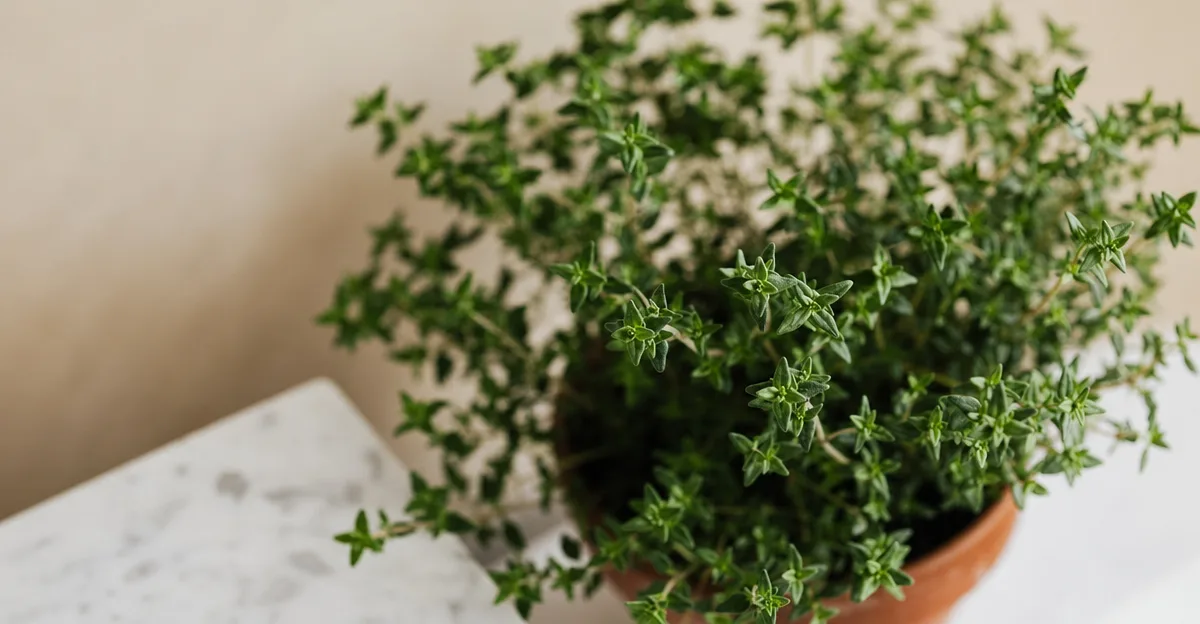
Why thyme punishes the wrong cut
Thyme is not a typical herb. It's a woody subshrub — part shrub, part herb — that develops a permanent woody framework at its base while producing soft, green, harvestable growth from the tips. This dual nature is what makes thyme both wonderfully productive (it lives for years) and unforgiving of bad technique (one bad cut can kill an entire branch).
The key difference from herbs like basil and mint:
-
Basil and mint have entirely green, herbaceous stems. Every node along the stem contains dormant buds that can sprout new growth. You can cut these plants back to a few inches above the soil and they'll regenerate from any point.
-
Thyme develops lignified (woody) tissue at its base as it matures. Once a stem segment becomes woody — identifiable by its brown, bark-like appearance and rigid texture — it loses the ability to produce new buds. The living green tissue where new growth originates exists only in the upper portions of each stem.
This is why the universal rule for thyme harvest is: always cut in the green zone, always above a leaf node, never into brown wood.
The science: how thyme branches after cutting
When you cut a thyme stem above a leaf node, you're removing the apical meristem — the growing tip that produces auxin, the hormone responsible for suppressing lateral bud development. This phenomenon, called apical dominance, keeps the plant growing upward from its tips rather than branching outward.
Remove that tip and the suppression lifts. Recent research has shown this process is more complex than the classical auxin model suggests — sucrose availability at the cut site triggers a rapid increase in cytokinin levels in the lateral buds, which initiates outgrowth within hours of cutting. The sugar reserves stored in the remaining stem and root system fuel this burst of new growth.
The practical result: every cut above a node activates the two dormant buds sitting at that node (one on each side of the stem). One stem becomes two. Cut those two stems at their next harvest, and you have four. This exponential branching is why regularly harvested thyme plants are dramatically bushier and more productive than unharvested ones — and why the stems you harvest are softer, more aromatic, and richer in essential oils than old growth left untouched.
When your thyme is ready to harvest
First-year plants
In the first growing season after planting, harvest very lightly — take only a few sprigs at a time after the plant has established strong root growth (typically 3-4 months after planting from seed, or 6-8 weeks after transplanting). The goal in year one is root establishment, not production. Heavy harvesting in the first year weakens the plant and reduces its productive lifespan.
Established plants (year 2+)
Once established, thyme is ready to harvest when:
- Stems are at least 10-15 cm (4-6 inches) long with plenty of green, leafy growth
- The plant is actively growing — spring through early autumn in most climates
- Just before or at early flowering — this is when essential oil content peaks at its highest concentration (up to 2.42% by weight)
Growth stage and flavor
Research on Thymus vulgaris essential oil shows that phenological stage significantly affects both oil yield and composition:
| Growth stage | Essential oil content | Thymol concentration | Flavor quality |
|---|---|---|---|
| Pre-flowering (vegetative) | 1.5-2.0% | Moderate | Fresh, herbaceous |
| Beginning of blooming | 2.42% (peak) | High | Peak aromatic intensity |
| 50% blooming | 2.0-2.4% | Very high | Best balance of quantity and quality |
| Full blooming | 1.8-2.2% | 74.8% (peak) | Strongest thymol punch |
| Seed ripening | 0.67% | Declining | Weak, spent |
The practical takeaway: harvest when flower buds are visible but most haven't opened yet. You get the highest oil content with excellent thymol concentration — maximum flavor per sprig.
Step-by-step: how to harvest thyme correctly
What you need
- Clean, sharp scissors or micro-tip pruners (sterilize with rubbing alcohol between plants)
- A bowl or basket for cut stems
- Knowledge of where the green zone meets the woody base on your plant
The technique
-
Identify the green-to-wood transition line. Look at each stem from the tip downward. You'll see soft, flexible, green growth at the top transitioning to rigid, brown, woody growth at the base. Your cuts must always stay above this line — leave at least 5 cm (2 inches) of green growth above the woody section.
-
Find a leaf node. Nodes are the points where leaves or leaf pairs emerge from the stem. They're spaced every 1-2 cm along thyme stems. Each node contains dormant lateral buds.
-
Cut 1-2 cm above a leaf node. Use a clean, angled cut. Don't cut directly at the node — leave a small stub above it to prevent dieback into the node tissue. The lateral buds at that node will activate and produce two new stems within 10-14 days.
-
Take the top 10-15 cm (4-6 inches) of each stem. These are the youngest, most aromatic sections. The lower portions are woodier and less flavorful.
-
Never remove more than one-third of the plant's total green growth in a single harvest session. The remaining foliage powers regrowth through photosynthesis.
-
Work around the entire plant. Harvest evenly from all sides rather than stripping one section bare. This maintains a balanced shape and even light distribution.
What NOT to do
- Never cut into brown, woody stems. They will not regrow. You'll be left with dead stubs.
- Never pull or tear stems. This damages the plant tissue and creates ragged wounds prone to disease. Always use clean cuts.
- Never harvest more than one-third at once. This starves the plant.
- Never strip leaves off without cutting the stem. While you can run your fingers down a stem to strip leaves, this is only appropriate for already-cut stems during food prep — not on the living plant, where it damages the stem and wastes the node-based branching opportunity.
When and how often to harvest
Time of day
Harvest thyme in the morning between 9:00 and 11:00 AM, after dew has evaporated but before midday heat. The essential oils — thymol, carvacrol, p-cymene, and gamma-terpinene — are most concentrated in the leaf glands before the day's heat causes volatilization.
Frequency
In the active growing season (spring through early autumn), you can harvest established thyme plants every 2-4 weeks. Each harvest stimulates branching, and the new growth needs 2-3 weeks to reach harvestable length.
| Season | Harvest frequency | Notes |
|---|---|---|
| Spring (March-May) | Every 2-3 weeks | Peak growth period; most productive window |
| Early summer (June-July) | Every 2-3 weeks | Harvest before/during flowering for peak flavor |
| Late summer (August-September) | Every 3-4 weeks | Growth slows; reduce harvest intensity |
| Autumn (October) | Final light harvest | Stop harvesting 4-6 weeks before first frost to allow hardening |
| Winter | Do not harvest | Plant is dormant or semi-dormant; harvesting weakens winter hardiness |
Seasonal total harvests
A well-managed thyme plant produces 3-5 substantial harvests per growing season, with commercial growers commonly achieving up to three cuts at monthly intervals from a single crop. Home gardeners practicing light, frequent harvesting (a few sprigs at a time) can harvest continuously throughout the growing season.
Seasonal Harvest Calendar
This calendar maps a thyme planting in temperate climates (USDA zones 5-9). Indoor and hydroponic growers can harvest year-round.
| Period | Stage | Action | Expected yield |
|---|---|---|---|
| Year 1, months 1-3 | Establishment | No harvesting. Let roots establish. Water regularly, ensure full sun (6-8 hours). | -- |
| Year 1, months 4-6 | Light harvest | Take only 2-3 sprigs at a time, no more than once every 3-4 weeks. | 5-10 g per harvest |
| Year 2, spring | Full production begins | Begin regular harvesting every 2-3 weeks. Cut top 10-15 cm of stems above leaf nodes. | 15-30 g per harvest |
| Year 2, early summer | Pre-bloom harvest | Prime harvest window. Flower buds forming but not yet open. Maximum essential oil content. | 20-40 g per harvest |
| Year 2, mid-summer | Post-bloom pruning | After flowering, cut back by one-third. This is both harvest and maintenance — prevents woodiness and stimulates fresh growth. | 30-50 g (combined harvest + pruning) |
| Year 2, late summer-autumn | Late season | Reduce harvest frequency. Final harvest 4-6 weeks before first frost. | 10-20 g per harvest |
| Year 3-5 | Peak production | Plant is at maximum size. Spring and early summer are most productive. Annual post-bloom shearing maintains vigor. | 25-50 g per harvest, 5-8 harvests per season |
Cumulative yield: A single established thyme plant produces approximately 100-300 g of fresh herb per growing season. A 1-meter row of thyme (3-4 plants spaced 30 cm apart) can yield 400-1,200 g annually.
Replacement timing: After 3-4 years, thyme plants become increasingly woody with reduced leaf production and weaker aroma. Take stem cuttings from the current plant in early summer to propagate replacements, then swap out the old plant in the following spring.
The post-bloom pruning: your most important cut
The single most important harvest of the year happens immediately after flowering (typically mid-summer). This is when you combine harvesting with structural maintenance:
-
Shear the entire plant back by one-third of its total height, cutting all stems back to the same level just above the woody base. Use bypass pruners or sharp scissors.
-
Shape the plant into a dome or mound. This ensures all parts receive equal light, preventing the center from becoming bare and woody.
-
Remove any dead or crossing stems that block airflow to the interior.
This annual shearing accomplishes three things:
- Prevents progressive woodiness — without this cut, stems lignify further each year until the entire plant is woody and unproductive by year three
- Stimulates a dense flush of new growth — the branching response produces far more harvestable stems for late-season and following-year harvests
- Redirects energy from seed production to vegetative growth and root storage, extending the plant's productive lifespan
Skip this pruning and your thyme will become leggy, sparse, and increasingly woody at the center — the #1 reason thyme plants fail after just 2-3 years.
Thyme varieties and harvest differences
There are over 350 species in the genus Thymus, but only a handful are commonly grown for culinary harvest. The harvest technique is the same across all types — cut in the green zone, above a node — but growth habit and flavor differ:
| Variety | Scientific name | Growth habit | Best use | Harvest notes |
|---|---|---|---|---|
| Common thyme | T. vulgaris | Upright, 20-30 cm tall | All-purpose cooking | Easiest to harvest; upright stems give clear cut points |
| Lemon thyme | T. citriodorus | Mounding, 15-25 cm | Fish, chicken, desserts | Same technique; more delicate stems, handle gently |
| Creeping thyme | T. serpyllum | Prostrate, 5-10 cm | Groundcover, light culinary | Harder to harvest; stems are very short. Snip tips only |
| Orange thyme | T. fragrantissimus | Upright, 20-30 cm | Fruit dishes, tea | Harvest like common thyme |
| Caraway thyme | T. herba-barona | Low-spreading, 10-15 cm | Meat, roasted vegetables | Short stems; harvest sparingly |
For dedicated culinary production, common thyme and lemon thyme are the best choices — their upright growth produces the longest, most accessible stems for harvest.
For hydroponic growers: Thyme performs well in DWC and NFT systems, growing 25-30% faster than in soil. Maintain EC at 1.0-1.6 mS/cm and pH at 5.5-7.0. Provide 12-16 hours of light daily at 200-400 umol/m2/s. The harvest technique is identical to soil-grown plants — cut above nodes in the green zone, never remove more than one-third. Indoor hydroponic thyme can be harvested year-round since there's no dormancy period.
Storing your harvest
Thyme is one of the most storage-friendly herbs. Its low moisture content and sturdy leaves mean it holds flavor far longer than delicate herbs like basil or cilantro.
Fresh storage (1-2 weeks)
- Don't wash before storing. Moisture shortens shelf life. Wash just before use.
- Wrap loosely in a slightly damp paper towel, then place in a resealable bag with the top slightly open.
- Refrigerate at 2-4C (35-39F). Fresh thyme holds quality for 1-2 weeks this way.
Alternatively: stand stems upright in a small glass of water (like a bouquet), cover loosely with a plastic bag, and refrigerate. This method extends freshness to 2-3 weeks.
Drying (6-12 months storage)
Thyme is the ideal herb for drying — it retains its flavor better than almost any other herb when dried properly.
Air drying (best for flavor):
- Bundle 5-8 stems together with string
- Hang upside down in a dark, dry, well-ventilated area
- Dry for 1-2 weeks until leaves crumble easily between fingers
- Strip leaves from stems and store in an airtight jar away from light
Research shows that shade-drying and freeze-drying preserve the highest essential oil content, while sun-drying and high-heat oven methods (above 40C) degrade thymol and other volatile compounds significantly.
Dehydrator method: Set to 35-40C (95-105F). Stems dry completely in 12-24 hours. Lower temperatures preserve more essential oil.
Freezing (up to 6 months)
Place whole fresh sprigs directly into a freezer bag. Remove air and seal flat. When cooking, pull out frozen stems and strip leaves directly into the pot — they crumble off easily when frozen. Frozen thyme retains more flavor than dried for the first 3-4 months but degrades faster after 6 months.
Common harvesting mistakes
| Mistake | Why it hurts | Fix |
|---|---|---|
| Cutting into woody stems | Woody tissue cannot regenerate new growth — the branch dies | Always cut in the green zone, 5+ cm above the wood line |
| Removing more than one-third | Starves the plant of photosynthetic capacity, weakens root reserves | Take less, more often — frequent light harvests outperform infrequent heavy ones |
| Skipping post-bloom pruning | Plant becomes progressively woodier each year; by year 3 it's unproductive | Shear by one-third immediately after flowering every year |
| Harvesting in first year | Weakens root establishment, reduces productive lifespan | Harvest very lightly (2-3 sprigs) only after month 4 |
| Harvesting in late autumn | New growth triggered by cutting can't harden before frost, causing winter damage | Stop harvesting 4-6 weeks before your average first frost date |
| Harvesting in afternoon heat | Essential oils have partially volatilized; flavor is weaker | Harvest between 9-11 AM for maximum oil content |
| Pulling or tearing stems | Creates ragged wounds that invite disease | Always use clean, sharp scissors or pruners |
When Thyme Stops Growing Back: Diagnostic Guide
If your thyme isn't producing new growth after harvesting, work through these checks.
No new growth within 3 weeks of cutting
Check 1: Did you cut into the wood? Examine the cut stems. If they're brown, rigid, and bark-like below your cut, you went too low. Woody thyme stems do not regenerate. The affected branches are dead — but the plant may still produce new growth from other stems that retain green tissue. In severe cases, the plant may send up entirely new shoots from the crown in spring, but this is slow and unreliable.
Check 2: Is the plant dormant? Thyme slows dramatically below 10C (50F) and goes semi-dormant in winter (USDA zones 5-7). If you harvested in late autumn or winter, growth won't resume until spring temperatures consistently reach 15C (59F). Don't harvest dormant thyme.
Check 3: Root health. Thyme demands excellent drainage and despises wet feet. If the soil stays waterlogged, roots rot and the plant can't fuel regrowth. Check that soil drains within minutes of watering. For container plants, ensure drainage holes are clear. In hydroponic systems, maintain dissolved oxygen above 5 mg/L.
Check 4: Light levels. Thyme requires full sun — at least 6-8 hours of direct sunlight daily, or a DLI of 15+ mol/m2/day. Plants in shade produce thin, leggy stems with weak essential oil content and poor regrowth vigor. Move to a sunnier location or supplement with grow lights.
Plant becoming woody and unproductive
This is the natural aging process. After 3-4 years, thyme plants become progressively woodier regardless of pruning. Solutions:
-
Propagate from cuttings. Take 8-10 cm semi-hardwood cuttings in early summer. Strip lower leaves, dip in rooting hormone, and plant in well-drained medium. Roots form in 3-4 weeks. This creates a genetic clone of your plant at its youthful, productive stage.
-
Layer existing stems. Bend a low, flexible stem to the ground and pin it down with a wire staple. Cover the pinned section with soil, leaving the tip exposed. Roots form at the buried nodes within 4-6 weeks. Cut from the parent and transplant.
-
Replace entirely. After 5-6 years, even well-maintained thyme plants decline. Replace with fresh nursery stock or your own propagated cuttings.
Thin, leggy growth with weak aroma
Insufficient light or over-fertilization. Thyme is a Mediterranean herb adapted to lean, well-drained soils in full sun. Too much nitrogen produces rapid, soft, flavorless growth. Reduce fertilization (thyme needs very little — a light application of balanced fertilizer once in spring is sufficient) and ensure maximum sun exposure. In hydroponic systems, keep nitrogen at 105-150 ppm — lower than most herbs.
Commercial Thyme Production
For growers producing thyme at commercial volumes, harvest method, timing, and post-harvest handling directly impact essential oil content, shelf life, and market value.
Yield benchmarks
Research on organic thyme cultivation over three years documented the following yields:
- Year 1: Lower biomass as plants establish; essential oil content highest (up to 2.8% for linalool chemotype)
- Year 2: Moderate biomass with good oil yield
- Year 3: Peak above-ground dry biomass (up to 2.94 Mg/ha for linalool chemotype, 1.39 Mg/ha for thymol type)
Essential oil yield varied by chemotype: the linalool chemotype ranged from 2.80% (year 1) to 1.53% (year 3), while the thymol type ranged from 1.20% to 0.47%. The inverse relationship between biomass and oil concentration means total oil yield per hectare can remain relatively stable across years.
Harvest scheduling at scale
Commercial operations typically harvest 2-3 times per growing season at monthly intervals:
- First cut (late spring): When 50% of plants show flower buds. This produces the highest-quality essential oil with peak thymol content.
- Second cut (mid-summer): Post-bloom regrowth, approximately 30-40 days after first cut. Oil content is slightly lower but leaf quality remains high.
- Third cut (early autumn): If growing conditions allow. This final cut should be lighter — leaving adequate green growth for winter hardening.
Cutting height: Research shows optimal results at 10 cm above ground level, balancing maximum herbage yield with plant recovery. The highest drug leaf yield (3.107 t/ha) was achieved at full flowering with 10 cm cutting height.
Chemotype selection for market
Over 20 distinct chemotypes of T. vulgaris have been documented through essential oil analysis. For commercial production:
- Thymol chemotype: Most common (46% of commercial samples). Thymol content typically 47-51% of total oil. Highest demand for food flavoring, antimicrobial products.
- Linalool chemotype: Second most common. Characterized by linalool (75%+) and linalyl acetate. Preferred for cosmetics, aromatherapy, and milder culinary applications.
- Geraniol and carvacrol chemotypes: Niche applications in perfumery and specialized food products.
Post-harvest handling
For fresh-market thyme:
- Harvest in early morning when essential oil content peaks
- Hydrocool immediately to 2-4C
- Bundle and pack in modified atmosphere packaging for retail
- Target shelf life: 14-21 days when handled correctly at 0-2C with 90-95% RH
For essential oil production:
- Shade-dry or freeze-dry for maximum oil retention (fresh herb yields ~1.05% oil; shade-dried retains ~0.95%; sun-dried drops to ~0.7%)
- Distill within 24 hours of harvest for fresh-herb oil, or within 1 week if properly dried
- Steam distillation is standard; hydrodistillation also common at smaller scales
Putting it all together
Thyme asks very little of you — full sun, lean soil, decent drainage, and one simple rule at harvest time: cut in the green, never in the wood. Follow that rule and a single plant produces fresh, intensely aromatic stems for 3-5 years, getting bushier and more productive with each harvest.
The technique is straightforward: snip stems 10-15 cm from the tips, cutting just above a leaf node, and never take more than one-third of the plant at once. Harvest in the morning for peak flavor, time your main harvests just before flowering for maximum essential oil content, and don't forget the annual post-bloom shearing that keeps woodiness at bay.
For the strongest flavor, the sweet spot is the "50% bloom" stage — when flower buds are present but most haven't opened yet. At this point, essential oil content peaks at over 2% by weight and thymol concentration is at its highest.
After 3-4 years, when the plant inevitably becomes woody despite your best pruning, propagate fresh cuttings and start the cycle again. One productive thyme plant generates dozens of cuttings — enough to keep you in thyme indefinitely.
For detailed growing parameters including temperature, humidity, EC, pH, and light requirements, see the full thyme growing profile. If you're looking for more harvesting guides, see how the technique differs for basil (where pinching above nodes doubles stem count), mint (where aggressive cutting makes stems bushier), and rosemary (where the same "never cut old wood" rule applies).