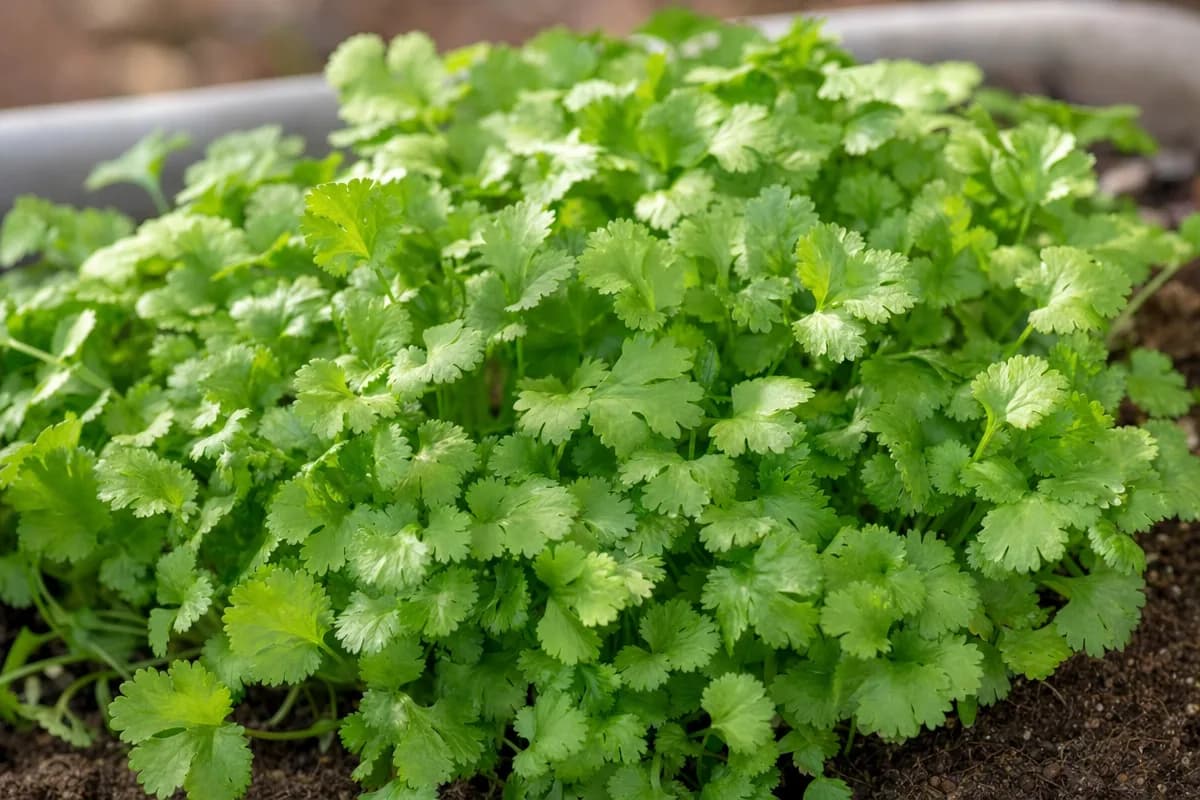
About This Plant
Cilantro is a cool-season herb grown for fresh leaves and bolts quickly under heat or long days, so high-quality production depends on cool temperatures and moderate light.
How to Grow Cilantro
Learn how to grow Cilantro from seed to harvest in 45 days. Beginner difficulty. Complete nutrient guide, pH/EC requirements, and growing conditions for hydroponics, soil & greenhouse.
Sources cited: 14.
Nutrient Requirements by Growth Stage
Cilantro is a low-to-moderate feeder. Currey et al…
Sign in to view nutrient requirements
A free account unlocks NPK targets for all four growth stages, micronutrient levels, a per-stage nutrient calculator, and the full nutrition guide. Signing up takes one click. Truleaf is a free, non-profit project, and every new account helps it grow. No spam, ever.
Growing Environments
Cilantro adapts to all four growing environments. Indoor plant factories produce the most consistent results — Nguyen et al…
Temperature
Cilantro is a cool-season herb that thrives at 15-24C (59-75F) and bolts rapidly above 24C. Seed germination occurs over 13-25C, with optimal emergence at 18-21C (65-70F) in 7-14 days. In controlled environments, Nguyen et al. (2019) achieved maximum plant biomass at 25C air temperature with 25C root-zone temperature using a 16-hour photoperiod. However, for leaf production longevity, maintaining air temperature at 18-22C is recommended to delay bolting. Night temperature of 15-18C is beneficial. Growth ceases below 10C, and frost kills the plant. The optimal setpoint of 20C balances growth rate with bolt prevention in indoor and greenhouse systems.
Humidity
Maintain relative humidity at 50-80%, with 65% as the optimal setpoint. Nguyen et al…
Light
Cilantro responds strongly to light quantity. Currey et al…
Airflow
Maintain gentle air circulation at 0.3-1.0 m/s around cilantro plants. Adequate airflow is critical for promoting transpiration-driven calcium uptake, which prevents the tip burn (calcium deficiency) documented by Clade et al…
Sign in to view environmental requirements
A free account unlocks exact temperature, humidity, light and airflow targets, including germination and growth ranges, DLI, photoperiod and PPFD, plus the full environment guide. Signing up takes one click. Truleaf is a free, non-profit project, and every new account helps it grow. No spam, ever.
Hydroponic System Compatibility
Cilantro is compatible with all major hydroponic systems due to its small stature, moderate nutrient demand, and short crop cycle. NFT is commercially proven — Currey et al…
Growing Media
Coco coir is the preferred substrate for cilantro, providing excellent moisture retention and drainage balance for the taproot system. A blend of 70% coco coir + 30% perlite is ideal, offering good drainage with adequate water-holding capacity…
Container Specs
Use containers at least 20 cm (8 inches) deep to accommodate cilantro's taproot; 25-30 cm (10-12 inches) is recommended for optimal root development. Multiple commercial and extension sources consistently recommend 8-12 inch deep containers…
Training & Support
Cilantro requires no staking, trellising, training, or structural support of any kind. Vegetative plants are compact at 20-45 cm and fully self-supporting…
Sign in to view system compatibility
A free account unlocks why each of the six systems fits or fails, plus growing media, container sizes, training methods, companion plants, and the full systems guide. Signing up takes one click. Truleaf is a free, non-profit project, and every new account helps it grow. No spam, ever.
Propagation
Cilantro is propagated exclusively by seed. Each spherical fruit (mericarp) contains two seeds — gently crush or roll to split before planting for faster, more uniform germination…
Harvesting
Begin harvesting outer leaves when plants reach 15 cm (6 inches) tall, typically 35-45 days after sowing. Use the cut-and-come-again technique: snip stems at 2.5 cm (1 inch) above ground level, leaving the growing crown intact for regrowth…
Planting Calendar
Cilantro is a cool-season crop best grown in spring (March-May) and fall (August-October) in temperate climates. Sow seeds indoors in February-March or August-September, 2-3 weeks before transplanting outdoors…
Common Issues
Cilantro's primary challenge is bolting — premature flowering triggered by temperatures above 24C and day lengths exceeding 14 hours. Slow-bolt cultivars ('Santo', 'Calypso', 'Leisure') and cool-season planting mitigate this…
Get the full science-backed guide
By signing up, you help keep Truleaf free and support the growth of our nonprofit project. Your account unlocks full details for every plant issue—including symptoms, causes, step-by-step solutions, and prevention—plus the month-by-month planting calendar, the complete guide, and all research sources. It only takes one click. No spam, ever.