Water Quality for Hydroponics: The Step Most Growers Skip
Most growers jump straight to nutrients, but source water quality decides whether your hydroponic system thrives or struggles. Learn the science behind TDS, chlorine, chloramine, hard water, and RO — plus the exact parameters to hit before you mix.
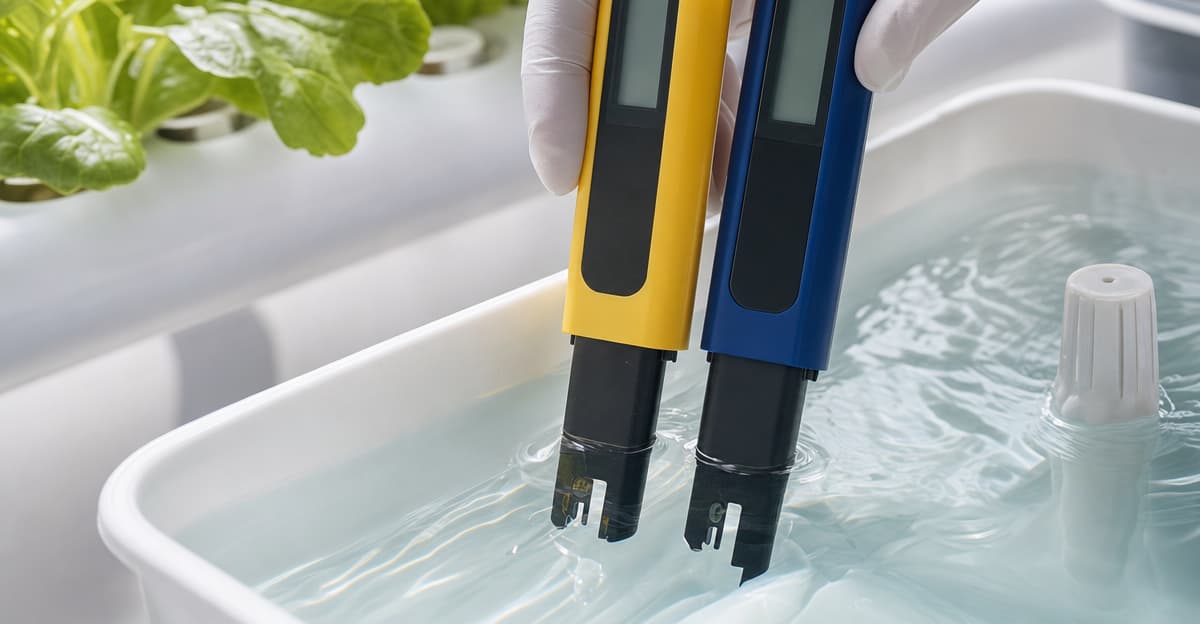
Key takeaway: Your source water is the foundation of every nutrient solution you will ever mix. Starting with water that has unknown mineral content, high chloramine levels, or excessive hardness means your carefully measured nutrients will interact with dissolved substances you cannot see and did not account for. The single most important step in hydroponics is knowing exactly what is in your water before you add anything to it. Test first, treat if necessary, then mix your nutrients onto a clean baseline.
Why Source Water Is Step Zero
Most hydroponic guides jump straight to nutrients, pH, and EC. That skips the most important variable: what is already dissolved in your water before you open a bottle of fertilizer.
Every water source carries dissolved minerals, treatment chemicals, and trace contaminants. When you add hydroponic nutrients to water that already contains 200 ppm of calcium and 80 ppm of magnesium, you are not starting from zero. You are starting from an unknown baseline that shifts your nutrient ratios, raises your EC before you have added a single milliliter of concentrate, and can precipitate nutrients out of solution before they ever reach a root.
Sonneveld and Voogt (2009), in their foundational work Plant Nutrition of Greenhouse Crops, established that the quality of source water is one of the primary factors determining the success or failure of soilless cultivation. They documented how even moderate levels of sodium and chloride in source water accumulate in recirculating systems to concentrations that inhibit calcium uptake and reduce yields.
Langenfeld et al. (2022) reinforced this in their comprehensive review published in Sustainability, emphasizing that daily monitoring of electrical conductivity (EC) — which begins with knowing your source water EC — is the critical management tool for any hydroponic system. EC is primarily driven by macronutrient ion concentrations, with micronutrients contributing less than 1%. If your source water already contributes significant EC, you have less room to add the nutrients your plants actually need.
The practical consequence: if you do not test your source water, you cannot mix an accurate nutrient solution. Everything downstream — pH stability, nutrient availability, EC targets — depends on this single measurement.
What Your Source Water Should Look Like
The University of Missouri Extension (G6984) provides the most widely referenced baseline parameters for hydroponic source water. These thresholds define "suitable" water — water that gives you maximum room to build a nutrient solution without interference from existing dissolved solids.
| Parameter | Target Range | Why It Matters |
|---|---|---|
| pH | 5.5–7.0 | Extreme values require more acid/base to reach the 5.5–6.5 working range |
| EC | 0.2–0.8 mS/cm | Higher values mean unknown minerals occupy your EC budget |
| Alkalinity | 40–160 ppm CaCO₃ | Buffers pH — too high requires excessive acid, too low gives unstable pH |
| Sodium (Na) | < 50 ppm | Accumulates in recirculating systems; inhibits Ca uptake |
| Chloride (Cl) | < 70 ppm | Leaf burn, root damage at high levels |
| Sulfate (SO₄) | < 90 ppm | Competes with phosphorus uptake |
| Boron (B) | < 0.5 ppm | Narrow safe range; toxic at low thresholds |
| Fluoride (F) | < 1 ppm | Causes chlorosis and tip necrosis in sensitive species |
| Calcium (Ca) | < 150 ppm | Above this level, nutrient ratios are difficult to balance |
| Magnesium (Mg) | < 75 ppm | Same issue as calcium — throws off formulation |
| Iron (Fe) | < 1 ppm | Precipitates at higher pH; clogs drip systems |
| Manganese (Mn) | < 1 ppm | Same precipitation and clogging problem as iron |
| Dissolved Oxygen | > 6 ppm | Root function and nutrient uptake require oxygenated water |
University extension guidelines generally recommend that your source water measure below 1.0 mS/cm (approximately 500 ppm TDS) to give you adequate room to add fertilizers without pushing total EC into problematic territory. Most nutrient formulas target a final EC of 1.2–2.5 mS/cm depending on crop and growth stage. If your source water starts at 0.8 mS/cm, you only have 0.4–1.7 mS/cm of headroom — and you do not know what ions are occupying that initial 0.8.
The only way to know your water quality is to test it. Contact your municipal water utility for an annual Consumer Confidence Report (CCR), or submit a sample to a laboratory that offers irrigation suitability testing. At minimum, test for pH, EC, alkalinity, calcium, magnesium, sodium, chloride, iron, and manganese.
Crop-Specific Water Quality Tolerances
The general parameters above are safe starting points, but individual crops vary significantly in their sensitivity to source water contaminants. The table below breaks down critical thresholds by crop group based on published extension guidelines and peer-reviewed research.
| Crop Group | Max Starting EC (mS/cm) | Na Tolerance (ppm) | Cl Tolerance (ppm) | Hardness Sensitivity | Notes |
|---|---|---|---|---|---|
| Lettuce & leafy greens | 0.4 | < 30 | < 50 | High | Most sensitive group; tip burn at lower chlorine levels than other crops |
| Herbs (basil, cilantro, mint) | 0.5 | < 40 | < 50 | Moderate–High | Basil particularly sensitive to Na accumulation in recirculating systems |
| Tomatoes | 0.8 | < 50 | < 70 | Moderate | Moderate salt stress can improve fruit flavor and Brix |
| Peppers | 0.7 | < 40 | < 60 | Moderate | More Cl-sensitive than tomatoes; watch for blossom end rot with Ca imbalance |
| Cucumbers | 0.5 | < 30 | < 50 | High | Among the most Na-sensitive fruiting crops |
| Strawberries | 0.5 | < 30 | < 40 | High | Extremely Cl-sensitive; RO water strongly recommended |
| Microgreens & sprouts | 0.3 | < 20 | < 30 | Very High | Short crop cycle means no time to recover from water stress |
Key insight: If you grow multiple crops from the same water source, target the thresholds of your most sensitive crop. A lettuce grower with 0.6 mS/cm starting EC faces a fundamentally different situation than a tomato grower with the same water — the lettuce grower has already consumed most of the usable EC budget before opening a nutrient bottle.
Municipal Tap Water: Usable, but Not Ideal
Tap water is the most common starting point for home and small-scale hydroponic growers. It is convenient, inexpensive, and usually safe — but "safe for drinking" and "suitable for hydroponics" are different standards.
Chlorine vs. Chloramine
Municipal water systems use one of two disinfectants: chlorine (Cl₂) or chloramine (NH₂Cl). This distinction matters more than most growers realize.
Chlorine is the simpler molecule. It dissipates naturally when water is exposed to air and UV light. Leaving a bucket of chlorinated water uncovered for 24–48 hours, or aerating it vigorously for a few hours, removes virtually all free chlorine. Concentrations above approximately 0.5 ppm can cause leaf yellowing and tip burn in sensitive crops like lettuce and herbs, but standard municipal levels at the tap (typically 0.5–2.0 ppm, with an EPA maximum of 4.0 ppm) are easily managed.
Chloramine is chlorine bonded to ammonia. It was designed to be more stable than chlorine — which is precisely the problem. Chloramine does not evaporate. Leaving water out overnight does nothing. Boiling is impractical at hydroponic volumes. You have three realistic options:
- Activated carbon filtration: A standard carbon block or catalytic carbon filter removes both chlorine and chloramine. This is the most practical solution for most growers. Catalytic carbon is more effective against chloramine than standard granular activated carbon.
- Ascorbic acid (vitamin C): One gram of ascorbic acid neutralizes approximately 1 ppm of chlorine in 100 gallons of water (USDA Forest Service); chloramine requires a slightly higher dose. It reacts quickly and is food-safe, but it lowers pH and the effect is not permanent in flowing systems.
- Reverse osmosis: RO membranes remove chloramine along with everything else, but the membrane itself is degraded by chloramine — an RO system used with chloraminated water must include a carbon pre-filter to protect the membrane.
How to find out which disinfectant your utility uses: Check your annual CCR, call your water provider, or use a chloramine-specific test kit (standard chlorine test kits do not always detect chloramine).
Hard Water
Hard water is defined by its calcium and magnesium content. The U.S. Geological Survey classifies water above 120 ppm CaCO₃ as "hard" and above 180 ppm as "very hard." In hydroponics, hard water creates two problems:
-
Nutrient ratio distortion. If your tap water delivers 130 ppm of calcium before you add nutrients, your CalMag ratio may be entirely wrong by the time you mix your fertilizer. You will almost certainly end up with excess calcium relative to magnesium and potassium, which can trigger magnesium deficiency symptoms even though magnesium is technically present in solution.
-
Scale and precipitation. High calcium combined with high pH causes calcium carbonate to precipitate out of solution. High bicarbonate alkalinity (above 160 ppm CaCO₃) acts as a pH buffer that fights your acid additions, requiring more phosphoric or nitric acid to reach the 5.5–6.5 range — and each acid addition introduces additional ions into your solution.
For growers with moderately hard water (120–200 ppm CaCO₃), you can often compensate by reducing the calcium in your nutrient formula and accounting for the existing ions. Above 200 ppm, most growers find it easier and cheaper in the long run to install an RO system than to constantly adjust formulations.
Fluoride
Most municipal systems add fluoride at 0.5–1.0 ppm for dental health. This concentration is generally below the threshold for plant toxicity in hydroponics, but fluoride is worth monitoring because it accumulates in recirculating systems. Sensitive species — including some ornamentals, spider plants, and dracaenas — can show fluoride toxicity as brown leaf tips and marginal necrosis at concentrations around 1 ppm in irrigation water. For food crops in a well-managed system with regular solution changes, municipal fluoride levels are rarely problematic.
Well Water: Test Everything, Assume Nothing
Well water quality varies enormously — not just between regions but between wells drilled 50 meters apart. Unlike municipal water, there is no treatment plant between your aquifer and your reservoir. You are the treatment plant.
Iron and Manganese
Dissolved ferrous iron (Fe²⁺) and manganese (Mn²⁺) are the most common well water problems in hydroponic systems. Both are soluble in their reduced state underground. When exposed to air — which happens the moment water enters your reservoir — they oxidize. Ferrous iron becomes ferric iron (Fe³⁺), which precipitates as insoluble rust-colored particles. Manganese oxidizes to manganese dioxide (MnO₂), a dark brown-black precipitate.
These precipitates clog drip emitters, coat root surfaces, and provide a substrate for iron-oxidizing bacteria that create slimy biofilms in lines and reservoirs. If your well water contains more than 0.3 ppm iron or 0.05 ppm manganese, you will need treatment — typically aeration followed by sediment filtration, or a dedicated iron removal system with oxidizing media.
High Alkalinity
Well water often has alkalinity above 200 ppm CaCO₃ due to dissolved limestone. High alkalinity acts as a powerful pH buffer that resists downward adjustment. You may need to add large volumes of acid to reach pH 5.8, which adds ions (phosphorus from phosphoric acid, nitrogen from nitric acid) that distort your nutrient formula. If alkalinity exceeds 300 ppm, consider blending with RO water or treating with sulfuric acid (which adds sulfur rather than nitrogen or phosphorus).
Sodium, Nitrates, and Variable Quality
Agricultural regions may have well water with elevated sodium (from irrigation runoff) or nitrates (from fertilizer leaching). Sodium above 50 ppm is a long-term problem in recirculating systems because plants absorb very little of it — a system starting at 50 ppm sodium can reach 250 ppm or more within weeks of recirculation. Sonneveld and Voogt (2009) documented the inhibitory thresholds at which sodium begins to suppress calcium uptake across a range of crop types.
Critical rule for well water: test at least twice per year, at different seasons. Aquifer chemistry shifts with rainfall, drought, and seasonal water table changes.
Reverse Osmosis Water: The Clean Slate
Reverse osmosis (RO) pushes water through a semipermeable membrane at high pressure, rejecting 95–99% of dissolved ions, bacteria, and particulates. The result is near-pure water with a TDS typically below 10 ppm and an EC near zero.
Why Growers Choose RO
- Complete control. You know exactly what is in your nutrient solution because you put it there. No guessing about background calcium, no unknown sodium, no chloramine to deal with.
- Consistency. Unlike tap or well water, RO output does not change with the seasons, municipal treatment adjustments, or aquifer fluctuations.
- Clean baseline. Starting near zero TDS means your full EC budget is available for nutrients. If your crop needs 1.8 mS/cm, you have 1.8 mS/cm of room instead of 1.0 mS/cm after subtracting source water contribution.
The Tradeoffs
- No buffering capacity. RO water has virtually zero alkalinity. This means pH can swing rapidly with small additions of acid or base. Any CO₂ absorbed from the air forms carbonic acid and drops pH without resistance. You may need to add potassium bicarbonate to restore some buffering capacity — hydroponic references typically recommend targeting 50–100 ppm alkalinity (as CaCO₃) to stabilize pH without excessive resistance to adjustment.
- CalMag supplement required. RO removes all calcium and magnesium. Every hydroponic formula assumes some baseline mineral content. When starting from zero, you must add a dedicated calcium-magnesium supplement (typically 100–150 ppm Ca and 30–60 ppm Mg) or use a nutrient formula specifically designed for RO water.
- Waste water. Conventional residential RO systems typically produce 3–5 gallons of reject water for every gallon of permeate. High-efficiency and WaterSense-certified units reduce this to 2–3:1, and commercial systems can approach 1:1, but waste remains a consideration for any operation.
- Membrane maintenance. Chloramine-treated source water requires a carbon pre-filter to protect the RO membrane. Membranes typically last 2–3 years with proper pre-filtration.
When RO Is Worth It
RO makes economic sense when your source water has any of the following: TDS above 300 ppm, sodium above 50 ppm, chloride above 70 ppm, or hardness above 200 ppm CaCO₃. For growers with already-clean source water (TDS below 100 ppm, low sodium, low chloride), the investment may not be justified — the tap water with a carbon filter may be perfectly adequate.
Other Water Sources
Rainwater
Rainwater is naturally low in dissolved minerals (typically 5–20 ppm TDS) and free of chlorine and chloramine. Schwarz, Grosch, and Gross (2004), publishing in Acta Horticulturae, studied rainwater quality specifically for hydroponic use and identified nutrient content, bacterial load, and algae as the primary quality variables in collected rainwater.
The practical considerations:
- pH: Rainwater is mildly acidic (pH 5.0–5.6) due to dissolved atmospheric CO₂. This is close to the hydroponic target range and usually requires only minor upward adjustment.
- Contamination: Collection surfaces (roofs, gutters) introduce bird droppings, dust, pollen, and potential heavy metals from roofing materials. First-flush diverters and fine mesh filtration are essential. Avoid collecting from roofs with lead flashing, copper gutters, or asbestos-containing materials.
- Pathogens: Unlike treated municipal water, rainwater carries no disinfectant residual. Bacterial and fungal contamination is a real risk, particularly for recirculating systems. UV sterilization of collected rainwater is recommended before use.
- Volume reliability: Seasonal rainfall variation makes rainwater an unreliable sole source for continuous production. Most growers use rainwater as a supplement to reduce RO waste or soften hard tap water by blending.
Distilled and Deionized Water
Both produce very pure water (near-zero TDS) but through different processes. Distilled water is boiled and condensed; deionized water passes through ion exchange resins. Both are functionally equivalent to RO water for hydroponics — clean baseline, no buffering, CalMag supplement required.
The difference is cost. Producing distilled or deionized water at hydroponic volumes (50–200+ gallons per week for even a small system) is significantly more expensive than RO, which is why these sources are generally limited to laboratory settings or very small-scale grows.
Softened Water: Never Use It
Water softeners work by exchanging calcium and magnesium ions for sodium ions. This is the opposite of what hydroponics needs. The result is water that has the same total dissolved solids as before — but the beneficial calcium and magnesium have been replaced with sodium, which accumulates in your system, inhibits nutrient uptake, and causes leaf scorch.
Do not use salt-softened water for hydroponics under any circumstances. If your home has a water softener, find an untreated tap before the softener (most installations have a bypass valve or an unsoftened outdoor spigot) or use RO.
Understanding TDS, EC, and PPM
These three measurements all describe the same thing — dissolved solids in your water — but they use different units and scales, which causes constant confusion.
Electrical Conductivity (EC) measures how well water conducts electricity, expressed in milliSiemens per centimeter (mS/cm) or deciSiemens per meter (dS/m). Pure water does not conduct electricity. The more dissolved ions present, the higher the conductivity. EC is the most accurate and universal measurement for hydroponics.
Total Dissolved Solids (TDS) is an estimate of the total mass of dissolved substances, expressed in parts per million (ppm) or milligrams per liter (mg/L). TDS meters do not actually measure mass — they measure EC and multiply by a conversion factor.
PPM (Parts Per Million) is just the unit used for TDS. Here is where the confusion lives: there are two common conversion factors.
| Scale | Conversion | Common In |
|---|---|---|
| NaCl scale | EC × 500 | Most TDS meters, general water testing |
| KCl scale | EC × 700 | Some European instruments, scientific literature |
An EC reading of 1.0 mS/cm equals 500 ppm on the NaCl scale or 700 ppm on the KCl scale. Same water, different number. If you are comparing readings between meters, you must know which scale each uses.
For practical purposes in hydroponics, EC is the standard. Academic literature, university extension guides, and commercial nutrient formulas all use EC (mS/cm). If your meter only displays ppm, divide by 500 (NaCl scale) or 700 (KCl scale) to get EC. When in doubt, use EC and eliminate the conversion entirely.
For your source water, aim for:
- Starting EC: Below 0.5 mS/cm is excellent, below 0.8 mS/cm is acceptable
- Starting TDS: Below 250 ppm (NaCl scale) is excellent, below 400 ppm is workable
Anything above 1.0 mS/cm / 500 ppm warrants investigation into what exactly is dissolved in your water before you decide whether treatment is needed.
How Water Source Affects Nutrient Absorption
Your source water does not just add background EC — it changes how nutrients behave in solution.
Ion Competition
Fathidarehnijeh et al. (2023), reviewing nutrient management strategies in their paper published in the Canadian Journal of Plant Science, highlighted that excess ions from source water compete with nutrient ions at root absorption sites. High calcium blocks magnesium uptake. High sodium competes with potassium. Elevated chloride interferes with nitrate absorption.
This is why two growers can use the same nutrient brand, the same concentration, and the same crop — and get different results. The grower with 180 ppm background calcium is feeding a fundamentally different solution than the grower starting from RO water, even if both measure the same final EC.
pH Drift
High-alkalinity water resists pH adjustment and drifts upward between corrections. The higher your source water alkalinity, the more frequently you will need to adjust pH — and each acid addition changes your nutrient ratios. Growers with very hard, high-alkalinity water often find themselves in a cycle of over-acidifying, over-correcting with base, and accumulating unwanted ions from both. Langenfeld et al. (2022) specifically identified this pH management burden as a key reason growers transition to purified water sources.
Precipitation
When calcium and sulfate concentrations are both high, they can combine to form insoluble calcium sulfate (gypsum) that drops out of solution. This removes both calcium and sulfur from your available nutrient pool. Similarly, DTPA-chelated iron — the most common form in hydroponic nutrients — loses stability above pH 6.5, allowing iron to precipitate out of solution and clog your system. Unchelated iron from source water precipitates at even lower pH values. EDDHA-chelated iron remains stable up to pH 10 but is more expensive and less widely used.
A Practical Decision Framework
The right water treatment depends on what you are starting with. Here is a straightforward decision path:
1. Test your source water. Get a lab analysis or at minimum measure EC, pH, and hardness.
2. If EC < 0.3 mS/cm and no chloramine: Your water is excellent. A simple carbon filter for chlorine removal is likely sufficient. Mix nutrients directly.
3. If EC 0.3–0.8 mS/cm: Usable for most crops. Get a full ion analysis to understand what is contributing to EC. Adjust your nutrient formula to account for existing calcium and magnesium. Use a carbon filter for chlorine/chloramine.
4. If EC > 0.8 mS/cm, or Na > 50 ppm, or hardness > 200 ppm: RO is strongly recommended. The cost of the system will be offset by nutrient savings, fewer pH problems, and better crop consistency.
5. If you have well water: Test everything. Treat iron/manganese if present. Test twice per year at different seasons.
6. If you are running a recirculating system: Start with the cleanest water you can afford. Sodium and chloride accumulate with every cycle. What starts as a minor background level becomes a yield-limiting factor within weeks in a closed loop.
Advanced Water Monitoring Protocol
Knowing your initial water quality is step one. Maintaining consistent water quality throughout a crop cycle requires a structured monitoring schedule — especially in recirculating systems where ion concentrations shift daily.
Recommended Testing Schedule
| Parameter | Frequency | Method | Action Threshold |
|---|---|---|---|
| pH | Daily (every fill/adjustment) | Calibrated pH meter | Outside 5.5–6.5 range |
| EC | Daily (every fill/adjustment) | Calibrated EC meter | Drift > 0.3 mS/cm from target |
| Source water EC | Weekly | EC meter before mixing | Change > 0.2 mS/cm from baseline |
| Sodium | Every 2 weeks (recirculating) | Lab test or ion-selective probe | > 50 ppm or rising trend |
| Chloride | Every 2 weeks (recirculating) | Lab test | > 70 ppm or rising trend |
| Full ion panel | Monthly (recirculating) or quarterly (drain-to-waste) | Laboratory analysis | Any ion > 120% of target |
| Source water full panel | Twice per year (well) or annually (municipal) | Laboratory analysis | Any parameter outside baseline table |
Recirculating System Drift Management
In recirculating systems, non-absorbed ions accumulate with every cycle. Langenfeld et al. (2022) emphasized that EC alone does not reveal which ions are rising — a stable EC reading can mask a dangerous shift from nutrient ions toward sodium and chloride.
The 30% rule: When your recirculating solution's total Na + Cl exceeds 30% of total dissolved solids, dump the solution and start fresh. Continuing to top off with nutrients while sodium and chloride accumulate creates a progressively toxic environment that EC monitoring alone will not detect.
Meter Calibration Protocol
Uncalibrated meters are worse than no meters — they create false confidence.
- pH meters: Calibrate with two-point calibration (pH 4.0 and 7.0 buffers) at least weekly, or before every use if your system is sensitive. Replace the probe annually or when calibration slope drops below 85%.
- EC meters: Calibrate with a 1.413 mS/cm or 2.764 mS/cm standard solution monthly. Check against a known reference solution between calibrations. Temperature compensation should be set to 25°C reference.
- TDS meters: Verify which conversion factor your meter uses (NaCl × 500 or KCl × 700) and record it permanently. Do not mix readings from different meters without converting to the same scale.
Water Treatment Equipment Selection Guide
Choosing the right treatment equipment depends on your source water problems, system scale, and budget. This guide covers the practical equipment decisions most growers face.
Carbon Filtration
| Filter Type | Chlorine Removal | Chloramine Removal | Flow Rate | Lifespan | Best For |
|---|---|---|---|---|---|
| Granular Activated Carbon (GAC) | Excellent | Poor | High (2–5 GPM) | 6–12 months | Chlorine-only municipal water |
| Carbon Block | Excellent | Moderate | Moderate (0.5–2 GPM) | 6–12 months | General-purpose; also removes sediment |
| Catalytic Carbon | Excellent | Excellent | Moderate (1–3 GPM) | 12–18 months | Chloraminated municipal water |
Sizing rule: For hydroponic use, carbon contact time matters more than flow rate. Size your filter so water passes through at no more than 2 GPM per cubic foot of carbon media. Undersized filters appear to work but leave residual chloramine that accumulates in reservoirs.
Reverse Osmosis Sizing
| System Scale | Daily Water Need | Recommended RO Size | Approximate Cost |
|---|---|---|---|
| Home/hobby (< 50 plants) | 5–20 gallons/day | 100–200 GPD residential | $150–$400 |
| Small commercial (50–500 plants) | 20–100 gallons/day | 200–500 GPD with storage tank | $300–$800 |
| Medium commercial (500–2000 plants) | 100–500 gallons/day | Commercial 500–1500 GPD | $800–$2,500 |
Always include a carbon pre-filter to protect the membrane, a sediment pre-filter (5 micron) to extend membrane life, and a pressure gauge to monitor membrane performance. A sudden drop in output flow at the same input pressure indicates membrane fouling or failure.
UV Sterilization
UV sterilization is essential for rainwater and recommended for well water. A 254 nm UV-C lamp rated at 40 mJ/cm² provides greater than 99.9% inactivation of bacteria, fungi, and algae. Size the UV unit for your maximum flow rate — undersizing reduces contact time and sterilization effectiveness. Replace UV lamps annually regardless of visible output, as UV-C intensity degrades before visible light output noticeably diminishes.
Essential Monitoring Equipment
| Instrument | Recommended Spec | Calibration Frequency | Budget Range |
|---|---|---|---|
| pH meter | ±0.01 resolution, ATC | Weekly (2-point) | $50–$150 |
| EC/TDS meter | ±0.01 mS/cm resolution, ATC | Monthly | $30–$100 |
| Dissolved oxygen meter | ±0.1 ppm resolution | Monthly | $80–$200 |
| Chlorine test kit | DPD or OTO colorimetric | N/A (single-use reagents) | $15–$30 |
| Chloramine test kit | DPD-based (total vs. free chlorine) | N/A (single-use reagents) | $20–$40 |
ATC = Automatic Temperature Compensation. Meters without ATC require manual temperature correction — a 10°C temperature difference introduces approximately 2% EC measurement error.
The Bottom Line
Water quality is not a one-time decision. It is the foundation that every nutrient calculation, pH adjustment, and EC reading stands on. Growers who invest time in understanding and optimizing their source water spend less time troubleshooting deficiencies, flushing reservoirs, and replacing clogged components.
Test your water. Know what is in it. Treat what needs treating. Then — and only then — start mixing nutrients on a baseline you actually understand. Your plants will tell you the difference.
For a deeper dive into what happens after your water is clean, see our guides on pH and EC management, hydroponic nutrients for beginners, and nutrient burn.