Year-Round Vegetable Garden: From 8 to 12 Months With Minimal Protection
Go from 8 months of harvests to a full 12 with this year-round vegetable garden plan. Covers two temperate climate tracks, a 3-year progression, month-by-month calendars, and crop rotation strategies — no heated greenhouse needed, just cold frames and row covers.
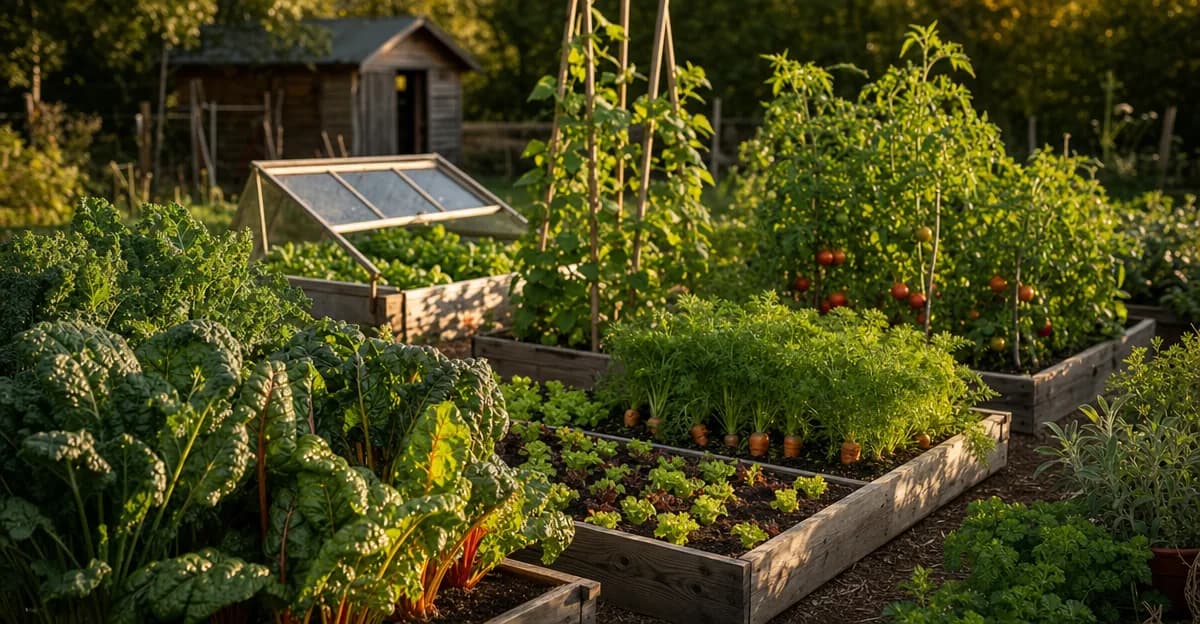
Most home gardens produce food for five or six months, then sit empty. The beds that overflowed with tomatoes in August are bare by November, and nothing new appears until May. That leaves roughly half the year without a single fresh harvest.
Gardeners call the worst stretch the hungry gap — the weeks between late February and mid-April when winter stores run out and spring crops are not ready yet. In the UK and maritime climates it is a well-known problem; in the continental US and Central Europe it simply goes unmentioned because most growers have already given up on winter harvests entirely.
The gap is not inevitable. With the right crops planted at the right time, a four-bed backyard garden in a temperate climate can produce something fresh every single month of the year. You will not need a heated greenhouse — but you will need cold frames and row covers to protect crops through the coldest months, especially in continental climates. No canning, no root cellar, no preserved foods — just edible produce picked and eaten the same week.
This guide shows you how to get there in three years.
How This Guide Works
This is not a single planting calendar. It is a progression plan built around two temperate climate tracks and a three-year timeline.
Two climate tracks run side by side throughout:
- Track A — Oceanic / Maritime (UK, Pacific Northwest US, coastal Western Europe). Mild winters rarely dropping below -5 °C (23 °F), cool summers, long but low-heat growing seasons. Winter growing is feasible with minimal protection.
- Track B — Continental Temperate (Midwest US, Central and Eastern Europe, southern Canada). Cold winters reaching -15 °C (5 °F) or lower, hot summers, shorter but more intense growing seasons. The November-to-March gap is severe without planning and infrastructure.
Identify your track and follow it through each year. If you are somewhere between the two — Zone 7 in the US Southeast, for example — read both tracks and lean toward whichever matches your winter low temperatures.
A note on light, not just temperature: At latitudes above roughly 50°N (northern UK, Scotland, Scandinavia, northern Canada), winter daylight drops below 8 hours. Below about 10 hours of light, most vegetables stop growing regardless of temperature — they survive but do not put on new growth. Eliot Coleman calls this the "Persephone period." If you garden above 50°N, the January–February harvests in this guide depend on crops planted and grown before the short days arrived. You are harvesting stored growth, not active growth. Plan your fall sowings accordingly — earlier than the calendars below suggest — and accept that fresh leafy growth will not resume until daylight exceeds 10 hours again in late February or March.
The three-year progression:
- Year 1 — Starter plan. Annual crops only, basic succession planting. Expect 7–8 months of fresh harvests (depending on your climate track) with a 4–5-month winter gap.
- Year 2 — Gap closing. Add perennials that need a year to establish, introduce cold frames, and refine succession intervals. Expect 10 months of coverage.
- Year 3 — Full coverage. Perennials are now producing, overwintering techniques are dialed in, and the hungry gap is solved. Twelve months of fresh harvests.
One rule applies throughout: every crop in this plan is eaten fresh from the garden. No storage crops. No potatoes kept in a bin for three months. No squash cured on a shelf. If it is not harvested and eaten within a week, it does not count.
This is deliberately the harder path. The conventional — and perfectly valid — way to eat from your garden through winter is to root-cellar carrots, cure squash, and store onions and garlic. If that is your goal, a much simpler plan will work. This guide takes the fresh-harvest-only constraint because it forces you to master succession planting, overwintering, and season extension — skills that, once learned, complement storage crops rather than replacing them.
The Mindset Shift: Plan Backwards From the Gaps
Most gardeners plan forward: they start with spring, plant what they want, and accept whatever harvest timeline results. The year-round approach works in reverse.
Start by identifying when your garden produces nothing. For most temperate gardens, there are three gap periods:
- The hungry gap (February–April) — The hardest to fill. Winter crops are exhausted, spring crops are not ready, and the soil is cold.
- The late-autumn gap (November–December) — Summer crops have finished, and only the hardiest greens remain.
- The deep-winter gap (January–February) — In continental climates, nothing survives outdoors without protection.
Once you know the gaps, work backwards: which crops can be harvested during those months, and when do they need to be planted? This is the rotation-based gap-filling method — and it is the organizing principle behind every calendar in this guide.
Year 1: The Starter Plan (8-Month Harvest Coverage)
Year 1 focuses on annual crops that are forgiving, fast-growing, and well-documented. The goal is not perfection — it is building the habit of staggered sowing and learning your garden's microclimate.
Track A (Oceanic / Maritime) — Year 1
| Month | What You Harvest | When It Was Planted |
|---|---|---|
| Mar | Overwintered spinach, early radishes | Oct (spinach), Feb (radish) |
| Apr | Radishes, lettuce, arugula, spring peas | Feb–Mar |
| May | Lettuce, radishes, peas, chard | Mar–Apr |
| Jun | Peas, lettuce, beets, chard, herbs | Mar–Apr |
| Jul | Bush beans, carrots, beets, zucchini, herbs | Apr–May |
| Aug | Tomatoes, beans, carrots, cucumbers, basil | Apr–Jun |
| Sep | Tomatoes, late beans, chard, kale, fall lettuce | May–Jul |
| Oct | Kale, chard, leeks, carrots, fall radishes | Jun–Aug |
| Nov–Feb | Gap — garden mostly dormant | — |
Your Year 1 gaps: November through February. That is four months with no harvest in Year 1, even in a mild maritime climate. Year 2 will start closing this.
Track B (Continental Temperate) — Year 1
| Month | What You Harvest | When It Was Planted |
|---|---|---|
| May | Radishes, lettuce, spinach, peas | Mar–Apr (under row cover) |
| Jun | Lettuce, peas, radishes, chard, herbs | Apr–May |
| Jul | Bush beans, beets, carrots, cucumbers | May–Jun |
| Aug | Tomatoes, peppers, beans, zucchini, basil | May–Jun |
| Sep | Tomatoes, peppers, carrots, beets, fall kale | May–Jul |
| Oct | Kale, chard, carrots, late beets | Jul–Aug |
| Nov | Kale (with row cover), leeks, parsnips | Jul–Aug |
| Dec–Apr | Gap — garden frozen | — |
Your Year 1 gaps: December through April — five months of nothing. The continental winter is harder, but Year 2's infrastructure will make a significant difference.
Year 1 Succession Planting Intervals
The foundation of continuous harvest is staggered sowing — planting small batches of the same crop every few weeks instead of one large planting. These intervals are based on guidance from the ATTRA continuous harvest publication and Johnny's Selected Seeds succession planting charts:
| Crop | Sow Every | Days to Harvest | Sowing Window |
|---|---|---|---|
| Lettuce (leaf) | 2–3 weeks | 30–45 days | Spring through early fall |
| Radishes | 10–14 days | 25–35 days | Spring and fall (bolts in heat) |
| Bush beans | 2–3 weeks | 50–60 days | After last frost through midsummer |
| Carrots | 3 weeks | 60–80 days | Spring through midsummer |
| Beets | 2–3 weeks | 50–65 days | Spring through midsummer |
| Spinach | 2–3 weeks | 35–45 days | Early spring, then again in fall |
| Arugula | 2 weeks | 21–40 days | Spring and fall |
| Peas | 2 weeks | 55–70 days | Early spring, again in late summer |
Start with just two or three of these in Year 1. Lettuce and radishes are the easiest — they mature fast, tolerate cool conditions, and forgive timing mistakes.
Master Succession Planting Schedule
The simple interval table above tells you how often to sow. This schedule tells you exactly when — organized around your last frost date (LFD) and first frost date (FFD). Print it, pin it to your potting shed wall, and check off each batch as you sow it.
All dates are expressed as weeks before or after your last frost date. To convert: if your LFD is May 1, then "LFD -6" means March 20.
Track A (Oceanic / Maritime) — LFD typically mid-March to early April
| Batch | Sow Date | Crop | Harvest Target | Notes |
|---|---|---|---|---|
| 1 | LFD -8 | Spinach, radishes | LFD -2 to LFD +2 | Direct sow under row cover |
| 2 | LFD -6 | Lettuce (leaf), arugula | LFD to LFD +4 | Start indoors or cold frame |
| 3 | LFD -4 | Peas, more lettuce | LFD +4 to LFD +8 | Direct sow peas; transplant lettuce |
| 4 | LFD -2 | Radishes (2nd batch), spinach (2nd) | LFD +3 to LFD +6 | Direct sow |
| 5 | LFD | Beets, chard, carrots | LFD +8 to LFD +12 | Soil temp must be above 7 °C |
| 6 | LFD +2 | Bush beans, lettuce (3rd) | LFD +10 to LFD +14 | Beans need soil above 15 °C |
| 7 | LFD +4 | Tomato/pepper transplants, basil | LFD +14 to LFD +18 | Harden off for 7–10 days first |
| 8 | LFD +6 | Zucchini, cucumbers, beans (2nd) | LFD +14 to LFD +18 | Direct sow or transplant |
| 9 | LFD +8 | Lettuce (4th), carrots (2nd), beets (2nd) | LFD +16 to LFD +22 | Switch to heat-tolerant lettuce varieties |
| 10 | LFD +12 | Kale (overwintering), Brussels sprouts | FFD to FFD +16 | These mature slowly — plan for fall/winter harvest |
| 11 | LFD +14 | Fall spinach, mache, arugula | FFD to FFD +12 | The critical fall sowing for winter harvest |
| 12 | LFD +16 | Lettuce (fall), radishes (fall) | FFD -2 to FFD +6 | Last succession before cold sets in |
Track B (Continental Temperate) — LFD typically mid-May
| Batch | Sow Date | Crop | Harvest Target | Notes |
|---|---|---|---|---|
| 1 | LFD -6 | Spinach, peas | LFD +2 to LFD +6 | Cold frame or heavy row cover required |
| 2 | LFD -4 | Lettuce (leaf), radishes | LFD to LFD +4 | Start lettuce indoors; direct sow radish under cover |
| 3 | LFD -2 | More lettuce, arugula | LFD +3 to LFD +6 | Transplant or cold frame |
| 4 | LFD | Beets, chard, carrots, peas (2nd) | LFD +8 to LFD +12 | Direct sow when soil reaches 10 °C |
| 5 | LFD +2 | Bush beans, radishes (2nd), lettuce (3rd) | LFD +8 to LFD +12 | Beans need soil above 15 °C |
| 6 | LFD +3 | Tomato/pepper transplants, basil, zucchini | LFD +12 to LFD +18 | After all frost risk; harden off first |
| 7 | LFD +6 | Beans (2nd), cucumbers, carrots (2nd) | LFD +14 to LFD +18 | Direct sow |
| 8 | LFD +8 | Lettuce (4th — heat tolerant), beets (2nd) | LFD +16 to LFD +20 | Shade cloth may help with lettuce |
| 9 | LFD +10 | Kale (overwintering), fall broccoli | FFD to FFD +12 | Start indoors, transplant at LFD +12 |
| 10 | LFD +12 | Fall spinach, mache, leeks (transplant) | FFD to FFD +16 | The critical fall sowing |
| 11 | LFD +14 | Lettuce (fall), radishes (fall), arugula | FFD -4 to FFD +4 | Under row cover from FFD onward |
How to use this schedule: Count the weeks from your last frost date and work forward. In Year 1, aim for Batches 1–9. In Year 2, add Batches 10–12 as you build overwintering confidence. By Year 3, every batch should be running on autopilot.
Year 2: Closing the Shoulder-Season Gaps (10-Month Coverage)
Year 2 makes three changes that extend your harvest window by roughly two months.
1. Plant Perennials That Need a Year to Establish
Some of the most valuable crops for filling gaps are perennials that produce nothing in their first year but become anchor crops for years afterward:
- Asparagus — Do not harvest until the third spring after planting crowns. Leave all spears to grow into ferns during Years 1 and 2. By Year 3, harvest for three to four weeks; by Year 4, harvest for six to eight weeks. A well-maintained bed produces for 15–25 years. Asparagus fills the critical April–May window when almost nothing else is ready.
- Rhubarb — Plant crowns in Year 1. Light harvest possible in Year 2 (take only a few stalks). Full harvest from Year 3 onward, providing fresh stalks from March through June. Hardy to -30 °C (-22 °F), making it ideal for Track B.
- Strawberries — June-bearing types planted in Year 1 produce their first significant crop in Year 2 (May–June). Everbearing types can produce from June through October.
- Berry bushes — Blueberries, raspberries, and blackberries planted in Year 1 begin modest fruiting in Year 2 and reach full production by Year 3, filling the summer months.
2. Introduce Cold Frames and Row Covers
This is the single biggest change in Year 2. A cold frame is nothing more than a bottomless box with a transparent lid — and it extends your growing season by two to four weeks on each end, according to the University of Vermont Extension.
What they do:
- Raise air temperature 5–10 °C (9–18 °F) above outdoor ambient on sunny days, though the benefit drops to 2–5 °C (4–9 °F) on overcast days and at night, according to University of Minnesota Extension research
- Protect crops from wind, frost, and heavy rain
- Allow overwintering of hardy greens that would otherwise be killed by freeze-thaw cycles
For Track A: A single cold frame lets you harvest lettuce, mache, spinach, and arugula through November and December — turning a 4-month gap into a 2-month gap.
For Track B: Two cold frames (or one plus floating row covers) let you extend kale and spinach harvests into December and start spring lettuce in March instead of May — closing at least 6 weeks on each end.
Floating row covers are even simpler: drape spunbonded fabric directly over crops. Lightweight covers (0.5 oz/yd²) provide 2–3 °C (4–5 °F) of frost protection; heavyweight covers (1.5–2.0 oz/yd²) provide up to 4–6 °C (7–11 °F), according to Michigan State University Extension.
3. Refine Succession Planting
In Year 2, tighten your succession intervals and add fall-planted overwintering crops:
- Sow fall spinach in September for harvest under protection through December–January. Spinach can survive to -18 °C (0 °F) with row cover protection.
- Plant overwintering kale in July for November–March harvest. Kale tolerates temperatures down to -7 °C (20 °F) unprotected, and a light frost actually improves its flavor by converting starches to sugars.
- Start leeks indoors in February, transplant in May. Leeks are practically unkillable — they survive to -12 °C (10 °F) and can be harvested all winter simply by pulling them as needed.
- Sow mache (corn salad) in September — one of the hardiest salad greens, surviving to -18 °C (0 °F). It fills the December–March window when no other salad green will grow.
Year 2 Coverage Update
| Track | Previous Coverage | Year 2 Coverage | Remaining Gap |
|---|---|---|---|
| A (Maritime) | Mar–Oct (8 months) | Nov–Oct (10 months) | Jan–Feb |
| B (Continental) | May–Nov (7 months) | Mar–Dec (10 months) | Jan–Feb |
The gap has shrunk from 4–5 months to roughly 2 months. Both tracks now struggle with the same window: the deep midwinter weeks of January and February.
Year 3: The Full 12-Month Harvest
Year 3 is where everything comes together. Your perennials are now producing, your overwintering technique is dialed in, and the remaining January–February gap can be closed with a handful of cold-hardy specialists.
Perennials Now Producing
- Asparagus fills April with its first real harvest (3–4 weeks of spears)
- Rhubarb produces stalks from March through June
- Strawberries cover May–June (June-bearing) or May–October (everbearing)
- Raspberries and blueberries fill July–August
These perennials are critical because they require almost no bed space once established, freeing your annual beds for rotation.
Solving the Deep-Winter Gap: January and February
The traditional hungry gap runs from late February through mid-April — but by Year 3, overwintered crops and early perennials already cover that window. The harder problem is the deep-winter gap: January and February, when temperatures bottom out and daylight is shortest. These last two months require the hardiest crops and, for Track B, cold frame protection.
Crops that survive the deep winter:
A caveat on hardiness figures: The temperatures below are approximate thresholds for well-hardened plants under favorable conditions. Actual survival depends on gradual cold acclimation, wind exposure, soil moisture, snow cover (which insulates), and the rate of temperature drop. A kale plant hardened off slowly through autumn may survive -15 °C under snow; the same plant hit by a sudden -12 °C windswept cold snap without snow cover may not. Treat these numbers as guides, not guarantees.
| Crop | Minimum Survival Temp | Protection Needed | Harvest Window |
|---|---|---|---|
| Mache (corn salad) | -18 °C (0 °F) | None (Track A), cold frame (Track B) | Nov–Mar |
| Kale — Siberian/Russian types | -15 °C (5 °F) | None (Track A), row cover (Track B) | Nov–Mar |
| Leeks | -12 °C (10 °F) | None (Track A), mulch (Track B) | Oct–Mar |
| Spinach — winter varieties | -18 °C (0 °F) with cover | Row cover (both tracks) | Nov–Feb |
| Parsnips | Ground freeze | Straw mulch | Nov–Feb |
| Brussels sprouts | -12 °C (10 °F) | None (Track A), row cover (Track B) | Nov–Feb |
| Purple sprouting broccoli | -7 °C (20 °F) | None (Track A), cold frame (Track B) | Feb–Apr |
Track A (Maritime) — January and February: Harvest overwintered leeks, kale, mache, winter spinach under row cover, and parsnips from beneath straw mulch. Purple sprouting broccoli planted the previous May begins producing florets in late February — a classic hungry-gap filler in the UK and Pacific Northwest.
Track B (Continental) — January and February: This is the hardest window. In a cold frame, mache, winter lettuce, and spinach will survive and grow slowly even when outdoor temperatures drop to -15 °C. Leeks survive under mulch and can be dug whenever the ground is not frozen solid. The pioneer grower Eliot Coleman demonstrated at Four Season Farm in Maine (Zone 5) that over 30 different vegetables can be harvested through winter using nothing more than unheated hoop houses, cold frames, and row covers — no supplemental heat required.
Year 3 Complete Month-by-Month Calendar
Track A (Oceanic / Maritime)
| Month | Fresh Harvest |
|---|---|
| Jan | Leeks, kale, mache, parsnips, winter spinach (under cover) |
| Feb | Leeks, kale, mache, purple sprouting broccoli (late Feb), rhubarb (forced) |
| Mar | Rhubarb, spinach, kale, early radishes, leeks |
| Apr | Asparagus, rhubarb, lettuce, radishes, spinach, peas, purple sprouting broccoli, fava beans (autumn-sown) |
| May | Asparagus, strawberries, fava beans, lettuce, peas, radishes, chard, herbs |
| Jun | Strawberries, peas, lettuce, beets, carrots, chard, herbs |
| Jul | Bush beans, blueberries, raspberries, carrots, beets, zucchini, herbs |
| Aug | Tomatoes, beans, raspberries, carrots, cucumbers, basil |
| Sep | Tomatoes, beans, blackberries, chard, kale, fall lettuce |
| Oct | Kale, chard, leeks, carrots, fall radishes, arugula, spinach |
| Nov | Kale, leeks, mache, spinach, Brussels sprouts, parsnips |
| Dec | Leeks, kale, mache, Brussels sprouts, parsnips, winter spinach |
Track B (Continental Temperate)
| Month | Fresh Harvest |
|---|---|
| Jan | Mache (cold frame), spinach (cold frame), leeks (mulched), parsnips (mulched) |
| Feb | Mache (cold frame), spinach (cold frame), leeks, early radishes (cold frame, late Feb) |
| Mar | Spinach (cold frame), kale (overwintered with cover), rhubarb, lettuce (cold frame, late Mar when nights stay above -8 °C) |
| Apr | Rhubarb, asparagus (late Apr), radishes, spinach, lettuce, peas |
| May | Asparagus, strawberries, lettuce, radishes, peas, spinach, rhubarb |
| Jun | Strawberries, peas, lettuce, beets, chard, herbs |
| Jul | Bush beans, blueberries, cucumbers, zucchini, carrots, herbs |
| Aug | Tomatoes, peppers, beans, raspberries, carrots, basil |
| Sep | Tomatoes, peppers, beans, kale, chard, fall lettuce |
| Oct | Kale, chard, leeks, carrots, beets, Brussels sprouts, arugula |
| Nov | Kale (row cover), leeks, parsnips, Brussels sprouts, mache (cold frame) |
| Dec | Kale (cold frame), leeks (mulched), mache (cold frame), spinach (cold frame), parsnips |
By Year 3, both tracks can produce something fresh in every month. Track A achieves this with minimal protection; Track B requires cold frames for January and February. No storage, no preserving — but not zero infrastructure either.
The Rotation System: Keeping It All Sustainable
Growing year-round from the same beds without rotation is a recipe for disease buildup and soil exhaustion. A simple three- or four-bed rotation prevents this.
Why Rotation Matters for Year-Round Gardens
Crops in the same botanical family share pests and diseases. When you plant tomatoes in the same bed year after year, soil-borne pathogens like Fusarium and Verticillium accumulate. Iowa State University Extension recommends waiting at least three to four years before planting the same family in the same location.
Be realistic about what rotation can and cannot do. A three- to four-year cycle is effective against many common pathogens (Fusarium, Verticillium, most nematodes), but some of the worst offenders outlast any practical rotation: clubroot spores (Plasmodiophora brassicae) persist 15–20 years in soil, and white rot sclerotia (Sclerotium cepivorum) can survive 20+ years. For these, rotation buys time but is not a cure — soil pH management (liming above 7.2 for clubroot) and strict hygiene matter more.
In a year-round garden, rotation also serves a second purpose: harvest continuity. Rotating a bed from legumes (which fix nitrogen) to heavy-feeding brassicas to root vegetables to alliums keeps the soil balanced without excessive fertilization.
The Four-Bed Rotation Plan
Divide your growing area into four beds and assign each a crop family group:
| Bed | Year 1 | Year 2 | Year 3 | Year 4 |
|---|---|---|---|---|
| A | Legumes & fruiting (beans, peas, tomatoes, peppers) | Brassicas (kale, broccoli, cabbage, Brussels sprouts) | Roots & alliums (carrots, beets, leeks, garlic) | Greens & misc (lettuce, chard, spinach, herbs) |
| B | Brassicas | Roots & alliums | Greens & misc | Legumes & fruiting |
| C | Roots & alliums | Greens & misc | Legumes & fruiting | Brassicas |
| D | Greens & misc | Legumes & fruiting | Brassicas | Roots & alliums |
Each bed moves one position forward each year. Within each bed, you can succession-plant multiple crops from the same family group throughout the season — for example, spring peas followed by summer beans in the legume bed, or spring radishes followed by summer carrots in the roots bed.
The major plant families for rotation:
- Brassicaceae (mustard family): broccoli, Brussels sprouts, cabbage, kale, radishes, arugula, turnips
- Fabaceae (legume family): bush beans, peas, snap peas, fava beans
- Solanaceae (nightshade family): tomatoes, peppers, eggplant
- Apiaceae (carrot family): carrots, parsnips, parsley, dill, cilantro
- Amaryllidaceae (allium family): leeks, garlic chives, scallions
- Asteraceae (daisy family): lettuce (all types)
- Amaranthaceae (amaranth family): beets, spinach, chard
Perennials (asparagus, rhubarb, berries) sit outside the rotation in permanent beds.
Six-Bed Advanced Rotation System
The four-bed system works well for small gardens, but a six-bed rotation gives you more flexibility and allows cover crop integration — a significant advantage for soil health in year-round production.
The Six-Bed Layout
| Bed | Year 1 | Year 2 | Year 3 | Year 4 | Year 5 | Year 6 |
|---|---|---|---|---|---|---|
| A | Legumes | Fruiting crops | Brassicas | Roots & alliums | Greens | Cover crop/fallow |
| B | Fruiting crops | Brassicas | Roots & alliums | Greens | Cover crop/fallow | Legumes |
| C | Brassicas | Roots & alliums | Greens | Cover crop/fallow | Legumes | Fruiting crops |
| D | Roots & alliums | Greens | Cover crop/fallow | Legumes | Fruiting crops | Brassicas |
| E | Greens | Cover crop/fallow | Legumes | Fruiting crops | Brassicas | Roots & alliums |
| F | Cover crop/fallow | Legumes | Fruiting crops | Brassicas | Roots & alliums | Greens |
The critical addition is the cover crop / fallow year. Each bed gets one year in six where it grows a soil-building cover crop instead of a food crop. This maintains soil organic matter, breaks pest and disease cycles, and fixes nitrogen (if using leguminous covers).
Cover Crop Options by Season
| Season | Cover Crop | Benefits | When to Terminate |
|---|---|---|---|
| Fall–Spring | Crimson clover | Nitrogen fixation, erosion control | Till under 3 weeks before spring planting |
| Fall–Spring | Winter rye | Weed suppression, biomass | Till under 2–3 weeks before planting |
| Summer | Buckwheat | Fast biomass, pollinator support, phosphorus mining | Mow at flowering (30–40 days) |
| Year-round | White clover (undersow) | Living mulch, nitrogen fixation | Manage by mowing; never fully terminates |
Soil Amendment Schedule
Match amendments to rotation groups for maximum efficiency:
- Before legumes: No nitrogen needed — legumes fix their own. Add rock phosphate if soil P is low.
- Before fruiting crops: Apply 2–3 cm of finished compost. Fruiting crops are heavy feeders that benefit from the previous legume bed's nitrogen contribution.
- Before brassicas: Apply compost plus a calcium source (lime or gypsum) if pH is below 6.5. Brassicas are calcium-hungry and susceptible to clubroot in acidic soils.
- Before roots & alliums: Light compost only — too much nitrogen causes forked carrots and soft leeks. Focus on loose, well-drained soil.
- Before greens: Moderate compost with balanced NPK. Greens are moderate feeders but need consistent nitrogen for leaf production.
- Cover crop year: Soil test in spring. Amend based on results before sowing the cover crop.
Season Extension Basics
You do not need a greenhouse. Three simple, inexpensive tools extend the harvest calendar by four to six weeks on each end of the season.
Cold Frames
A cold frame is a bottomless box — usually about 1.2 m × 0.6 m (4 ft × 2 ft) — with a hinged transparent lid. On sunny days the interior can be 5–10 °C (9–18 °F) warmer than outside air; on overcast nights the gain drops to 2–5 °C (4–9 °F). Face it south (or north in the southern hemisphere) for maximum sun exposure.
Best crops for cold frames: lettuce, spinach, mache, arugula, radishes, and kale seedlings.
Track A needs just one cold frame for winter lettuce and mache. Track B benefits from two — one for overwintering greens, one for starting spring transplants in February.
Slug warning (Track A especially): In maritime climates, slugs are the single biggest threat to overwintered salad under cold frames and row covers. The moist, sheltered environment you create for your crops is also ideal for slugs. Use beer traps, copper tape around cold frame edges, or iron phosphate bait (organic-approved) starting in autumn. Check under covers regularly — a slug problem caught early is manageable; one discovered in January when your mache is gone is not.
Floating Row Covers
Lightweight spunbonded fabric draped directly over plants without hoops. Self-ventilating, rain-permeable, and far simpler than any structure.
- Lightweight (0.5 oz/yd²): 2–3 °C (4–5 °F) of frost protection, 85–90% light transmission. Good for extending the fall lettuce harvest.
- Heavyweight (1.5–2.0 oz/yd²): 4–6 °C (7–11 °F) of frost protection. Use over kale, spinach, and leeks for midwinter survival in Track B.
Cloches
Individual glass or plastic covers placed over single plants. Useful for protecting newly transplanted seedlings in spring or extending the harvest of individual pepper or tomato plants in fall. Less practical for large-scale season extension but excellent for spot protection.
When Each Track Needs Protection
| Season Extension Tool | Track A Timing | Track B Timing |
|---|---|---|
| Row covers (spring) | Not needed — mild springs | March–April (protect early lettuce, peas) |
| Row covers (fall) | November–December (extend chard, spinach) | October–November (protect kale, chard) |
| Cold frame (winter) | November–February (lettuce, mache) | October–March (spinach, mache, lettuce) |
| Cloches (spring) | Not typically needed | April (warm soil for early transplants) |
Crop Quick-Reference Cards
For each recommended crop, here is the essential planting data you need to schedule your year-round garden.
Cool-Season Annuals (the backbone of shoulder seasons)
| Crop | Days to Harvest | Succession Interval | Hardiness | Gap It Fills | Rotation Group |
|---|---|---|---|---|---|
| Lettuce (leaf) | 30–45 | Every 2–3 weeks | Light frost | Mar–May, Sep–Nov | Asteraceae |
| Spinach | 35–45 | Every 2–3 weeks | To -18 °C (0 °F) with cover | Oct–Mar | Amaranthaceae |
| Mache | 45–60 | Once in Sep | To -18 °C (0 °F) | Nov–Mar | Caprifoliaceae (rotation-neutral) |
| Arugula | 21–40 | Every 2 weeks | Light frost | Mar–May, Sep–Nov | Brassicaceae |
| Radishes | 25–35 | Every 10–14 days | Light frost | Mar–May, Sep–Oct | Brassicaceae |
| Peas | 55–70 | Every 2 weeks | Light frost | Apr–Jun | Fabaceae |
Important: The days-to-harvest figures above apply to the main growing season (spring through early fall). In cold frames and under row covers during autumn and winter, maturation slows dramatically — lettuce that takes 35 days in June may take 60–80 days when sown in October, or stall entirely during the Persephone period. For overwintering sowings, plant early enough that crops reach near-harvestable size before day length drops below 10 hours; you are then harvesting stored growth through winter, not waiting for active development.
Warm-Season Annuals (summer core)
| Crop | Days to Harvest | Succession Interval | Season | Gap It Fills | Rotation Group |
|---|---|---|---|---|---|
| Bush beans | 50–60 | Every 2–3 weeks | After last frost | Jun–Sep | Fabaceae |
| Tomatoes | 65–85 (transplant) | None (stagger varieties) | Warm season | Jul–Sep | Solanaceae |
| Zucchini | 45–55 | One planting | Warm season | Jul–Sep | Cucurbitaceae |
| Cucumbers | 50–70 | One planting | Warm season | Jul–Aug | Cucurbitaceae |
| Basil | 30–60 | Every 3–4 weeks | Warm season | Jun–Sep | Lamiaceae |
Overwintering Crops (the gap fillers)
| Crop | Plant Date | Harvest Window | Hardiness | Gap It Fills | Rotation Group |
|---|---|---|---|---|---|
| Kale (Siberian) | Jul | Nov–Mar | To -15 °C (5 °F) | Nov–Mar | Brassicaceae |
| Leeks | Feb (indoor) → May (transplant) | Oct–Mar | To -12 °C (10 °F) | Oct–Mar | Amaryllidaceae |
| Brussels sprouts | May | Nov–Feb | To -12 °C (10 °F) | Nov–Feb | Brassicaceae |
| Parsnips | Apr–May | Nov–Feb | Ground freeze | Nov–Feb | Apiaceae |
| Purple sprouting broccoli | May–Jun | Feb–Apr | To -7 °C (20 °F) | Feb–Apr | Brassicaceae |
| Chard | Apr | Jun–Nov | To -6 °C (21 °F) | Jun–Nov | Amaranthaceae |
Perennials (establish once, harvest for years)
| Crop | First Harvest | Peak Window | Lifespan | Gap It Fills |
|---|---|---|---|---|
| Asparagus | Year 3 (light) | Apr–Jun | 15–25 years | Hungry gap |
| Rhubarb | Year 2 (light) | Mar–Jun | 15+ years | Hungry gap |
| Strawberries | Year 1–2 | May–Jun or May–Oct | 3–5 years | Late spring |
| Blueberries | Year 2–3 | Jul–Aug | 20+ years | Midsummer |
| Raspberries | Year 2 | Jul–Sep | 10–15 years | Midsummer |
Zone-Specific Variety Recommendations
Variety selection makes the difference between a crop that barely survives winter and one that thrives in it. These recommendations prioritize the overwintering and shoulder-season crops that are most critical for filling the hungry gap.
Cold-Zone Varieties (USDA 4–5 / Colder Than Typical UK)
These varieties are bred for extreme cold tolerance and short growing seasons:
| Crop | Recommended Variety | Why This One | Cold Limit |
|---|---|---|---|
| Kale | 'Red Russian' / 'Siberian' | Flat leaves shed snow; sweetens dramatically after frost | -15 °C (5 °F) |
| Spinach | 'Bloomsdale Long Standing' | Thick savoyed leaves resist freeze damage; slow to bolt | -18 °C (0 °F) with cover |
| Mache | 'Vit' | The industry standard for cold hardiness; compact rosettes | -18 °C (0 °F) |
| Leeks | 'Bandit' | Thick shanks; bred specifically for overwintering | -12 °C (10 °F) |
| Lettuce | 'Winter Density' | Semi-cos type; survives in cold frames when other lettuce fails | -6 °C (21 °F) with cover |
| Brussels sprouts | 'Diablo F1' | Late-maturing; holds well on the stalk through hard frost | -12 °C (10 °F) |
| Carrots | 'Napoli' | Nantes type; sweet after frost; stores well in ground under mulch | Ground freeze |
Moderate-Zone Varieties (USDA 6–7 / UK Zones 8–9)
The sweet spot for year-round growing — cold enough for vernalization, mild enough for extended harvest:
| Crop | Recommended Variety | Why This One | Notes |
|---|---|---|---|
| Kale | 'Winterbor F1' | Curly type; extremely productive through mild winters | Harvest outer leaves for continuous production |
| Purple sprouting broccoli | 'Red Fire' / 'Rudolph' | Early maturing (Feb–Mar); the classic hungry-gap filler | Sow May; transplant Jun; harvest Feb–Apr |
| Spinach | 'Tyee' | Downy mildew resistant; excellent for fall sowing | Sow Sep for Nov–Feb harvest |
| Leeks | 'Musselburgh' | Heritage variety; extremely hardy; thick stems | The UK standard for overwintering |
| Broad beans | 'Aquadulce Claudia' | Autumn-sown overwintering variety; harvest Apr–May | Sow Oct–Nov for earliest spring crop |
| Lettuce | 'Arctic King' | Butterhead bred for overwintering outdoors in the UK | Sow Sep; harvest Mar–Apr |
| Chard | 'Fordhook Giant' | Overwinters in Zone 7; regrows from roots in spring | Mulch crown heavily in Zone 6 |
Warm-Zone Varieties (USDA 8+ / UK Zone 9–10)
Year-round growing is easiest here, but heat becomes the challenge rather than cold:
| Crop | Recommended Variety | Why This One | Notes |
|---|---|---|---|
| Lettuce | 'Jericho' | Romaine bred for heat tolerance; slow to bolt | Succession sow year-round with shade cloth in summer |
| Spinach | 'Space' | Semi-savoy; one of the most heat-tolerant spinach varieties | Bolt-prone above 24 °C — use succession sowing |
| Kale | 'Lacinato' (Dinosaur) | Heat tolerant; productive through mild winters | Less cold-hardy but rarely matters in Zone 8+ |
| Arugula | 'Astro' | Fast maturing; somewhat heat tolerant | Sow every 2 weeks; shade in summer |
| Beans | 'Provider' | Sets pods in cool soil (15 °C); extends both ends of the season | Sow 2 weeks before LFD with row cover |
Frequently Asked Questions
Can you grow vegetables year round?
Yes. In temperate climates (USDA zones 5–8, or equivalent in the UK and Europe), a combination of succession planting, cold-hardy crop selection, and simple season extension tools like cold frames and row covers makes 12-month fresh harvests possible. It does take two to three years of planning and perennial establishment to achieve full coverage, but even Year 1 gardeners can harvest fresh produce for eight months.
What is the hungry gap in gardening?
The hungry gap is the period between late February and mid-April when the previous season's crops are exhausted and the new season's crops are not yet ready to harvest. The term comes from traditional British and Northern European agriculture. In a well-planned year-round garden, the hungry gap is filled by overwintered leeks, kale, mache, and purple sprouting broccoli, plus early-season perennials like rhubarb and asparagus.
What vegetables grow in winter without a greenhouse?
Several vegetables survive outdoors in winter with no greenhouse, just row covers or mulch. The hardiest include kale (to -15 °C / 5 °F), mache (to -18 °C / 0 °F), leeks (to -12 °C / 10 °F), parsnips (survive ground freeze under mulch), and Brussels sprouts (to -12 °C / 10 °F). Spinach can survive to -18 °C (0 °F) with row cover protection. Eliot Coleman demonstrated that over 30 vegetables can be grown through Maine winters (Zone 5) using only unheated structures.
How do I keep my garden producing all year?
Three strategies work together: succession planting (sowing small batches every two to three weeks so crops mature in waves), overwintering (planting cold-hardy crops in summer for winter harvest), and season extension (using cold frames and row covers to protect crops through the coldest months). Add perennials like asparagus and rhubarb to fill the early spring window. Plan backwards from your gaps — identify the months when nothing is producing, then find crops and planting dates that fill them.
What are the easiest vegetables to grow year round?
Kale, leeks, and chard are the most forgiving year-round crops. Kale tolerates both summer heat and hard winter frost. Leeks grow slowly but survive almost any temperature and can be harvested whenever you need them. Chard bridges the gap between cool-season greens and summer crops. For succession planting, lettuce and radishes are the easiest to start with — they mature fast, grow in cool conditions, and tolerate minor timing mistakes.