Blossom Drop: Why Indoor Tomato Flowers Won't Set Fruit
Flowers open, then yellow and fall without setting fruit — or the fruit that sets rots at the bottom. These are two different disorders that growers constantly confuse. This guide untangles blossom drop from blossom-end rot, explains what really drives fruit set in tomatoes, peppers, cucumbers, and strawberries indoors and in hydroponics, and gives you a diagnostic checklist. Grounded in peer-reviewed research and university extension guidance.
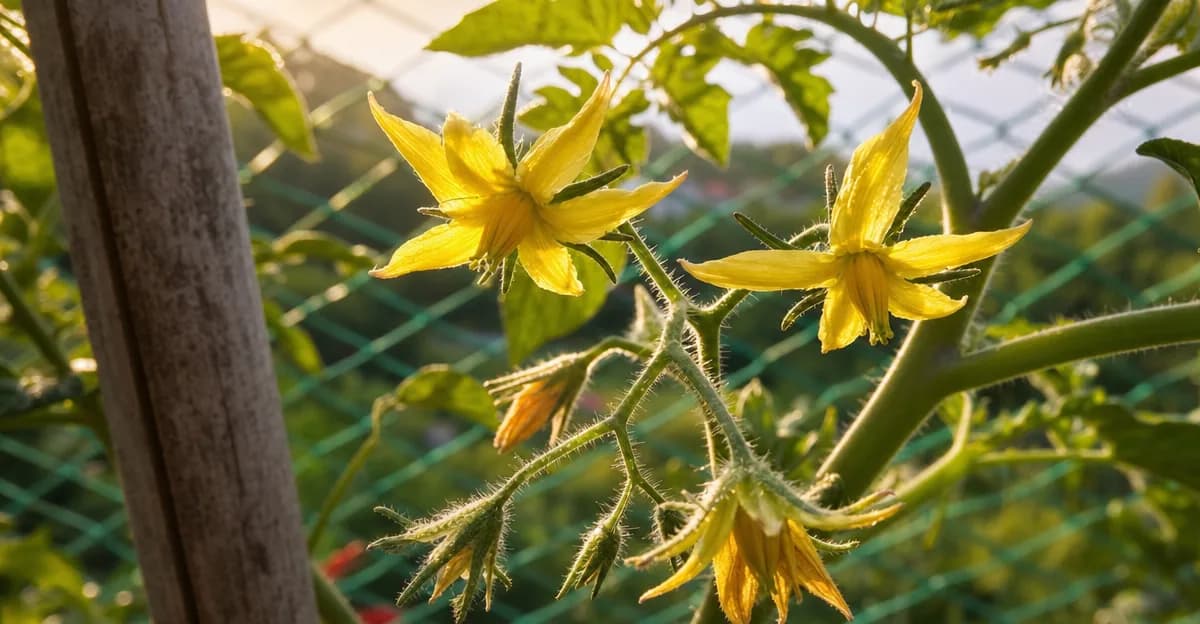
Your tomato plant is covered in flowers. Then, a few days later, the flowers turn yellow at the stem, hang limp, and drop — leaving a bare joint where a fruit should have swelled. Or the peppers bloom for weeks with nothing to show for it. Or fruit does set, then develops a sunken, leathery black patch on the bottom and rots from there. Any of these can make a healthy-looking plant produce almost no harvest, and growers understandably lump them together as "my plant won't fruit."
They shouldn't be lumped together, because they are two entirely different disorders with different causes and different fixes:
- Blossom drop (also called poor fruit set) is when flowers — or tiny just-formed fruit — abscise and fall before a fruit fills out. It is a physiological stress response, not a disease, and it happens before set.
- Blossom-end rot (BER) happens after set: a fruit that was pollinated and started growing develops a dark, sunken lesion at its blossom (bottom) end. It is a fruit-development disorder tied to how calcium and water move inside the fruit — and, despite its name, it is usually not fixed by adding more calcium.
This guide separates the two, walks through what actually drives each one, and finishes with a diagnostic checklist. It is written for indoor, greenhouse, and hydroponic growers, where the environment is under your control — which is both the problem (nothing is buffered) and the opportunity (you can fix it).
Part 1 — Blossom Drop: Flowers That Fall Before They Set
Blossom drop is the plant's way of cutting its losses. When a flower is stressed at the moment it needs to be pollinated and fertilized, the plant aborts it rather than invest in a fruit that won't develop. University extension services consistently frame poor fruit set not as a disease to be sprayed away but as a response to growing conditions. So the fix is almost never a bottle — it's finding which condition tipped over a threshold. There are four usual suspects.
Cause 1: Temperature — the leading cause
If you change only one thing, check temperature first. Heat is the single most-documented driver of blossom drop, because pollen is far more fragile than the plant that makes it. A tomato plant can look lush and green at temperatures that quietly render its pollen sterile.
The numbers are strikingly consistent across controlled-environment studies. In a classic USDA-ARS trial, tomato genotypes grown at an optimum 27/23 °C (day/night) set fruit normally, but at 35/23 °C the most heat-sensitive lines set 0% fruit while even heat-tolerant lines dropped to 45–65%. Work in commercial protected cultivation put the practical ceiling more precisely: a mean daily temperature of about 25–26 °C is the upper limit for proper fruit set in tomato, and shaving just 1–1.5 °C off daytime temperature (together with a modest humidity increase) measurably improved pollen viability.
Crucially, night temperature matters as much as day temperature — a point growers routinely miss because they only watch the afternoon peak. At a 26 °C day, tomato plants produced more viable pollen when night temperature was 18–22 °C than when it was 24–26 °C, and warm nights alone cut the number of flowers and fruit on the first cluster. A room that never cools down after dark can starve your fruit set even if the daytime figure looks acceptable. Extension guidance translates this into a field rule of thumb: days at or above roughly 32 °C (90 °F) combined with nights at or above roughly 21 °C (70 °F) produce sticky, nonviable pollen and blossom drop.
Peppers behave the same way, and there's an important subtlety. You might assume that hot, dry indoor air causes fruit-set loss by drying the plant out — but a University of Minnesota study on bell pepper isolated the two: at 33 °C, fruit set fell sharply while flower number held steady, and vapor pressure deficit (dryness) had no effect on its own. The loss is a direct temperature response of the pollen and developing fruit, not heat-induced water stress. Glasshouse pepper trials show the same temperature-response shape. The practical implication is blunt: for heat-driven pepper blossom drop, cooling is the fix — cranking up humidity to "rehydrate" the plant is aimed at the wrong process.
It's not only heat. Cold drops flowers too. Pepper flowers and small fruit abscise when night temperatures fall below about 15.5 °C (60 °F), and both tomato and pepper set poorly at the cold end of the range as well as the hot end. The lesson for indoor growers: fruiting crops have a genuine fruit-set window, and drifting off either edge — a hot sealed tent by day, an unheated garage by night — triggers the same abscission response.
What to do: Aim to keep the growing space inside roughly 18–26 °C for most of the day-night cycle, and treat the night temperature as a real target, not an afterthought. If you can only intervene in one place, bring the daytime peak down (shade cloth, more ventilation, dimming or raising lights) and give the room a chance to cool at night.
Cause 2: Humidity — the sweet spot, and why there's no single rule
Humidity is genuinely double-edged, and this is where a lot of well-meaning advice goes wrong. The reason is that humidity acts on two separate processes that pull in opposite directions.
On the pollination side, air that is too dry keeps pollen from being released and shed cleanly, while air that is too wet clumps the pollen so it can't move — extension guidance flags relative humidity above about 80% as a point where pollen no longer releases properly. The protected-cultivation study above found that raising daytime humidity from 50% to 70% (alongside slight cooling) improved pollen viability in hot, dry conditions. Glasshouse pepper work likewise shows that humidity extremes at either end disrupt flowering and seed set. The consensus is a sweet spot of roughly 50–70% relative humidity for pollination — not "more is better" and not "drier is better."
But — and this is the part that trips people up — very high humidity works against you later in the fruit's life, because it promotes blossom-end rot (more on that in Part 2). So there is no single "humidity good" or "humidity bad" rule. Aim for the 50–70% band for pollination, and avoid pushing into the very high 80–95% range, which helps neither process.
Cause 3: No bees, no wind — the indoor pollination gap
This is the cause that is unique to your situation and the easiest to overlook. Outdoors, wind shakes pollen loose and insects carry it between flowers. Under a roof — windowsill, grow tent, greenhouse, high tunnel — both of those disappear, and many fruiting crops simply cannot self-pollinate efficiently in dead-still air.
The evidence is direct. In a greenhouse tomato trial, unpollinated (bagged) flowers set poorly, while both bumblebee visitation and mechanical vibration raised seed count and fruit weight — with bee pollination roughly equalling hand pollination for seed set. Mechanical truss vibration reliably improves fruit set in still greenhouse air. So if your plants flower profusely but drop everything, and your temperatures are in range, the missing ingredient is often just pollen movement.
Timing matters here too: a tomato flower stays receptive for only about 50 hours after it opens, so pollination has to happen within that short window — which is why a once-a-week pass isn't enough. Vibrate or hand-pollinate every one to three days while plants are in bloom.
This is the hinge between "my plant won't fruit" and a fix you can do in seconds. Our companion guide to hand-pollinating indoor plants without bees walks through the exact technique for each crop type — buzzing tomatoes and peppers, brushing strawberries, and transferring pollen between the separate male and female flowers of cucumbers. If your fruit-set failure survives a temperature check, start there.
Cause 4: Light, over-vigor, and the assimilate budget
Sometimes the flowers are healthy and pollinated, and the plant still aborts them — because it can't afford to feed them. A flowering plant runs an energy budget: light-driven photosynthesis is the income, and every developing fruit is a competing expense. When the supply of assimilates (sugars) can't meet the demand of the fruit load, the plant sheds the weakest claimants.
Sweet pepper research shows abortion rises sharply when light-limited assimilate supply falls short of demand from a heavy fruit load — a source–sink limitation, not a nutrient deficiency. In tomato, fruit set on a truss depends on competition for assimilates, and the later, more distal flowers abort first when supply runs short. Light spectrum plays a role as well: a far-red-rich spectrum increased flower and fruit abortion in pepper, which is worth knowing if you run LED fixtures indoors. The practical read: under weak or overloaded lighting, expect the plant to shed some flowers no matter what else you do — improving light, or thinning an overloaded truss, does more than any spray.
There's a related, counterintuitive trigger: too much nitrogen. Over-fertilizing pushes lush vegetative growth that competes with flowers for the same assimilate pool, and extension guidance lists excessive nitrogen among the classic causes of poor blossom and fruit set. If your plants are dark green, tall, and leafy but stingy with fruit, ease off the nitrogen rather than adding more of anything.
Part 2 — Blossom-End Rot: When the Fruit Sets, Then Rots
Now the second disorder — the one that looks like a disease but isn't, and the one where the most common "fix" is usually wrong.
Blossom-end rot shows up on fruit that did set: a water-soaked spot at the blossom (bottom) end of a tomato or pepper darkens, sinks, and turns leathery. It is not an infection and it is not blossom drop — it is a breakdown of tissue at the far end of the fruit, and understanding why tells you how to prevent it.
It's about calcium delivery, not calcium supply
Here is the counterintuitive part. BER is associated with a localized calcium deficiency in the rapidly expanding tissue at the distal end of the fruit — but that is not the same thing as your nutrient solution being low in calcium. Fruit tissue is chronically calcium-poor by nature: calcium moves with water in the xylem, and fruit transpire very little compared with leaves, so the far end of a fast-growing fruit can run short even when the plant and the root zone have plenty of calcium available. The plant even has active, hormone-mediated machinery to push calcium into the fruit specifically — research on abscisic acid shows fruit-directed calcium uptake can prevent BER independently of the solution calcium level.
The single cleanest demonstration: tomato plants grown at 95% relative humidity developed BER within 15–16 days on young fruit, with lower tissue calcium than plants at 55% humidity — even though both had the same calcium supply at the roots. High humidity suppressed the transpiration that carries calcium into the fruit. The problem was delivery, not supply.
So dumping extra calcium into a hydroponic reservoir, or spraying foliar calcium, usually does little — because the bottleneck is getting calcium to the fruit, which is governed by fruit growth rate, water relations, and environmental steadiness. What actually helps is consistency: steady irrigation and moisture, avoiding the feast-and-famine swings that cause growth spurts, and keeping humidity out of the extreme-high range. The Royal Horticultural Society's practical advice reduces to exactly this — water consistently and avoid moisture swings — and Penn State Extension similarly treats BER as a calcium-delivery and water-management disorder, not a disease.
An honest note on the science
It's worth being straight that researchers do not fully agree on the mechanism. The dominant view treats BER as localized fruit calcium deficiency driven by delivery and transpiration. But a notable dissenting reappraisal argues that low tissue calcium is a symptom rather than the primary cause, and that BER is fundamentally a stress-induced (oxidative) disorder. For a grower this disagreement doesn't change the action plan — both camps point away from "just add calcium" and toward reducing plant stress and stabilizing water and environment. But you should know that the tidy "calcium deficiency" label oversimplifies a still-debated physiology.
An indoor-specific factor worth checking (if you grow sealed)
Here is one more possibility that only applies to tightly enclosed grows, and it comes with a caution. A single research group found that in sealed indoor chambers, elevated ethylene gas independently suppressed fruit set: about 40 ppb of ethylene cut red-fruit yield to just 4–11% of the control, and the air had to be kept below roughly 20 ppb for normal set. Ethylene can accumulate from ripening produce, some heaters, or poor air exchange in a closed room. This is an emerging, single-lab finding rather than an established cause, so treat it as a "worth ruling out if you grow in a sealed space and nothing else explains the problem" note — not a headline. Better air exchange is a cheap thing to try.
The cultivar lever
Finally, some of this is genetic, and choosing the right variety is a legitimate tool rather than a cop-out. Heat tolerance for fruit set is heritable in tomato, and small-fruited, abundantly-flowering types tend to keep setting under heat stress that shuts down large-fruited beefsteak types. Recall that even in the classic heat study, tolerant genotypes still managed 45–65% set where sensitive ones hit zero. If you garden somewhere (or in a room) that runs hot, pick a variety bred or reputed for fruit set under heat before blaming your technique.
Crop-specific fruit-set setpoints
The general targets above — roughly 18–26 °C, 50–70% relative humidity, and moving pollen every one to three days — are the right starting point for any fruiting crop. But each species has its own edges and, more importantly, its own pollination biology. Tuning the setpoints to what you are actually growing is what separates "flowers everywhere, no fruit" from a full truss.
| Crop | Temperature | Humidity for set | Pollination need | The edge that bites first |
|---|---|---|---|---|
| Tomato | Mean daily ≤ ~25–26 °C; night 18–22 °C is the pollen sweet spot | 50–70% | Self-fertile but needs vibration — buzz pollinator or truss tap | Warm nights (≥ ~24 °C) impair pollen and cut fruit set even when the days look fine |
| Pepper | Similar to tomato; set collapses near ~33 °C day | 50–70%; both extremes hurt | Self-fertile; light air movement is usually enough | Cold — flowers and small fruit abscise below ~15.5 °C night; far-red-heavy light also raises abortion |
| Cucumber | Warm-season, same broad band as tomato | Moderate; avoid the very-high band | Depends on type: parthenocarpic/gynoecious greenhouse hybrids set with no pollination at all — for those, pollination can never be the cause. Monoecious/open-pollinated types need pollen carried from male to female flowers | Blaming the environment while growing a pollination-dependent variety indoors, when the real fix is a parthenocarpic hybrid |
| Strawberry | Cooler-preferring than tomato; sustained heat aborts flowers and deforms fruit | 50–70% | Each berry is an aggregate of many achenes — every achene must be pollinated or the fruit comes out lopsided ("nubbins"); brush each open flower or run gentle airflow | Incomplete pollination shows up as misshapen fruit, not no fruit — easy to misdiagnose |
Two rows here carry a lesson that saves a lot of wasted troubleshooting. Cucumber: if you are growing a modern greenhouse hybrid, it is almost certainly parthenocarpic and needs no pollination — so if it drops fruit, look at temperature, light, and assimilate load, never at pollen. Strawberry: its failure mode is usually deformed fruit rather than no fruit, because a partially-pollinated berry still starts to swell; the fix is fuller pollen contact across the whole face of each flower.
Quick diagnostic checklist
Work down this list in order — the top items are the most common and the cheapest to fix.
- Do the fruit set at all, or do flowers fall first? Flowers dropping before fruit forms = blossom drop (Part 1). A dark sunken patch on fruit that did set = blossom-end rot (Part 2). They are different problems.
- Check temperature — day and night. Sustained days above ~32 °C render pollen nonviable, and nights above ~24 °C impair pollen and cut fruit set; nights below ~15.5 °C drop pepper flowers. Aim for roughly 18–26 °C across the cycle.
- Check humidity. Target ~50–70% for pollination. Above ~80% impairs pollen release and, later, promotes blossom-end rot.
- Are you pollinating? Indoors there's no wind or bees. Vibrate or hand-pollinate every 1–3 days, within the ~50-hour window a flower stays receptive. See our hand-pollination guide.
- Check light and vigor. Weak light or an overloaded plant forces flower abortion; excess nitrogen pushes leaves at the expense of fruit. Improve light, thin heavy trusses, ease off nitrogen.
- For blossom-end rot, stabilize water — don't just add calcium. Steady irrigation and moderate humidity move calcium into the fruit better than a fuller reservoir does.
- Sealed room? Consider air exchange. As a last check, poor ventilation can let ethylene build up and suppress set.
- Still failing under heat? Change the cultivar. Choose heat-tolerant, smaller-fruited types.
Advanced diagnostic matrix
The checklist above is ordered by likelihood. When the obvious passes don't resolve it, work this matrix instead: it maps each observable pattern to the mechanism it points to and the test that confirms it — so you change the right variable rather than guessing.
| What you observe | Most likely mechanism | Confirm it | Corrective action |
|---|---|---|---|
| Flowers yellow at the pedicel joint and drop before any fruit swells | Blossom drop from heat, cold, or failed pollination | Log day and night temperature for 3 days; note whether nights stay ≥ ~24 °C or dip < ~15.5 °C | Bring the peak down and let the room cool at night; if temps are in range, move to pollination |
| Temperatures in range, plant vigorous, still no set | Missing pollen movement — no wind or bees indoors | Hand-pollinate one truss only; if just that truss sets, pollination was the gap | Vibrate or hand-pollinate every 1–3 days within the ~50 h receptive window |
| Lush, dark-green, tall plant but few flowers hold | Over-vigour / excess nitrogen diverting assimilates | Review feed EC and N ratio against leaf-to-flower balance | Ease off nitrogen; thin an overloaded truss so the remaining fruit win the assimilate competition |
| Distal (last) flowers on a truss abort while basal fruit hold | Source–sink limitation under weak or overloaded light | Check light output (DLI/fixture) against total fruit load | Raise light or thin fruit; on far-red-heavy LEDs, rebalance the spectrum |
| Fruit sets, then a sunken leathery black patch forms at the bottom | Blossom-end rot — calcium delivery failure, not supply | Look for humidity spikes and irrigation swings, not reservoir Ca | Stabilise irrigation and moisture; keep RH out of the very-high band |
| Sealed room, everything else in range, set still poor | Possible ethylene accumulation | Improve air exchange, then re-test over a fruiting cycle | Increase ventilation; target < ~20 ppb |
| Strawberry sets but the fruit is lopsided or misshapen | Incomplete pollination of the achenes | Inspect for uniform seed development across the berry face | Brush each open flower fully, or add gentle airflow |
The indoor fruit-set control protocol
Everything above resolves to a handful of setpoints you can actually dial in. Held together, these make blossom drop and blossom-end rot both rare — and most stubborn "won't fruit" cases turn out to be two of them slightly off at once (a warm night and still air), not a single dramatic failure.
- Temperature, day and night. Keep the mean daily temperature at or below ~25–26 °C, and treat the night figure as a hard target — aim for an 18–22 °C night and never let it ride at ≥ ~24 °C. If you can only act once, drop the daytime peak (shade, ventilation, dim or raise lights) and give the room a real chance to cool after dark.
- Humidity, one band for two jobs. Hold 50–70% RH through flowering for clean pollen release; do not chase higher, because the moisture that does nothing for pollination above ~80% also drives blossom-end rot later in the fruit's life. The same band serves both processes.
- Pollination cadence. A flower stays receptive for only ~50 h, so buzz, vibrate, or hand-pollinate every 1–3 days while anything is in bloom — not weekly. Skip this only for parthenocarpic cucumber hybrids.
- Assimilate and light balance. Match fruit load to light: under weak or overloaded lighting the plant sheds its weakest flowers regardless of temperature or humidity. Improve light or thin heavy trusses, and keep nitrogen modest so the plant spends its budget on fruit rather than foliage.
- Water steadiness for BER. Because blossom-end rot is a calcium-delivery problem, steady irrigation and moisture do more than a fuller reservoir. Avoid the feast-and-famine swings that trigger growth spurts the fruit's calcium supply can't keep pace with.
- Air exchange in sealed rooms. If the space is tightly closed, give it genuine air exchange — cheap insurance against ethylene creeping up and independently suppressing set.
Where this fits with the rest of your grow
Fruit set is the last mile of a productive crop — it only matters once the plant itself is thriving. For the full nutrient, spacing, and environment picture behind each crop, pair this troubleshooting guide with the grow guides it draws on: hydroponic tomatoes, hydroponic bell peppers, hydroponic cucumbers, hydroponic strawberries, and vining fruits like passion fruit. Because blossom-end rot is partly a root-zone and water-relations story, growers fighting it alongside root-zone trouble will also want our DWC root rot rescue guide. And when the fix turns out to be pollination, the hand-pollination guide is the companion piece that shows you exactly how.
The through-line is simple: an indoor grower controls the environment, so blossom drop and blossom-end rot are almost always environmental problems with environmental fixes — not diseases, and rarely a missing bottle of nutrient.